







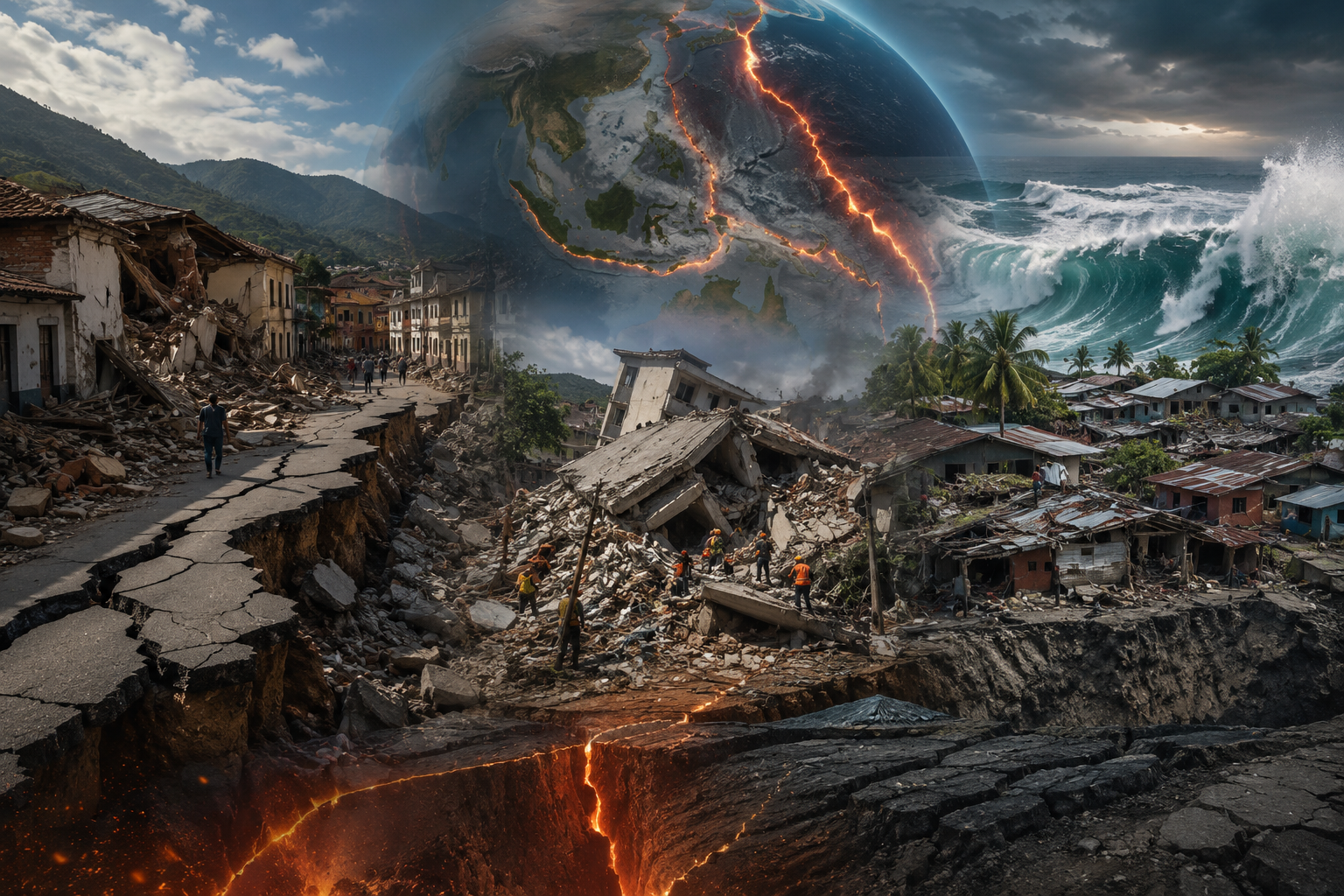
First Venezuela. Then Colombia. Then Indonesia.
Over nearly two months, three countries experienced powerful earthquakes, with magnitudes of 7 or greater. Venezuela was hit by back-to-back magnitude 7.2 and 7.5 earthquakes on June 24. On August 10, a magnitude 7.4 earthquake struck western Colombia. Five days later, on August 15, a magnitude 7.7 earthquake hit off Indonesia’s Flores Island.
The sequence is striking. The destruction is real. And it is almost irresistible to connect the dots.
But earthquakes do not necessarily follow the patterns that human beings see in them.
The three events occurred in different tectonic settings and on different fault systems. There is currently no scientific evidence that they constitute one connected global earthquake sequence. Experts say that a cluster of powerful earthquakes over a relatively short period does not, by itself, demonstrate that global seismic activity has suddenly increased.
That distinction matters.
Venezuela came first. The twin earthquakes on June 24 occurred along the complex boundary between the Caribbean and South American plates. They were relatively shallow, less than 20 kilometres deep, which helped produce intense shaking close to populated areas.
Then came Colombia.
On August 10, a magnitude 7.4 earthquake struck western Colombia. Here, the tectonic story is different.
The Colombian earthquake was relatively deep, striking roughly 100 kilometres beneath the surface- far deeper than the Venezuelan shocks. Yet it still caused enormous destruction and a heavy loss of life.
And then, five days later, Indonesia.
The magnitude 7.7 earthquake struck near Flores at a depth of about 10 kilometres. That shallow depth was crucial: much of the earthquake’s energy reached the surface, producing violent shaking, landslides and severe damage. A tsunami warning was issued and later lifted, although waves of around 1.5 metres were recorded in some locations. Hundreds of aftershocks followed.
Flores sits firmly inside the Pacific Ring of Fire – the vast circum-Pacific belt where tectonic plates interact intensely. The US Geological Survey describes the Ring of Fire as the world’s greatest earthquake belt and says about 81% of the planet’s largest earthquakes occur along it.
But there is an important twist.
Colombia lies along the active western tectonic margin of South America, where the Nazca Plate is being forced beneath the South American Plate. This is part of the broader circum-Pacific seismic system.
Venezuela, by contrast, lies outside the Pacific Ring of Fire, while Indonesia is firmly within it.
So the three disasters cannot simply be described as three Ring of Fire earthquakes marching across the planet.
What they do demonstrate is the extraordinary complexity of plate tectonics.
Earth’s crust is divided into enormous plates that are constantly moving. Where plates collide, slide past one another or one plate is forced beneath another, stress accumulates. When that stress is released suddenly along a fault, the ground moves, and an earthquake occurs.
And the danger is determined by far more than magnitude.
Depth, distance from populated areas, local geology, building standards, terrain and emergency preparedness can dramatically alter the human toll of an earthquake. A relatively deep earthquake may cause less surface shaking than a shallow one of similar magnitude. Soft ground can amplify shaking. Weak buildings can turn a geological event into a humanitarian catastrophe.
So, is the Ring of Fire waking up?
No, not in the sense of a planetary system suddenly switching into a more dangerous phase.
The Earth has not suddenly started shaking. It has always been moving.
What has changed is our perception. Powerful earthquakes now arrive on our screens almost instantly, making geographically distant disasters feel like parts of one unfolding event.
The real lesson from Venezuela, Colombia and Indonesia is therefore not that the planet has suddenly become more active.
It is that earthquakes remain impossible to predict with precision, and that preparedness, resilient buildings and rapid emergency response remain our best defence.
The Ring of Fire isn’t waking up.
It never went to sleep.


