







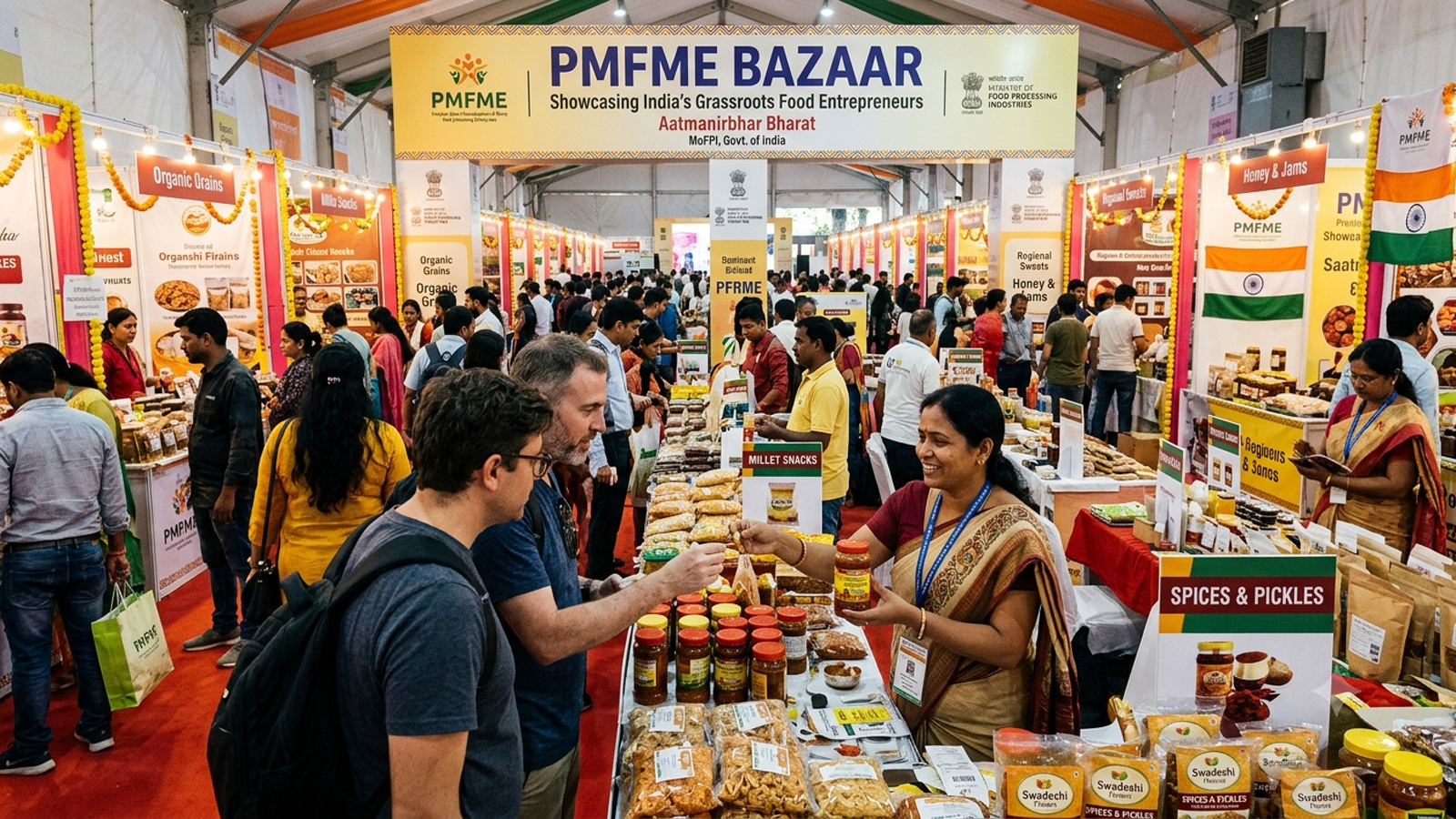
From makhana-based cookies in Bihar and preservative-free jamun products made with the help of tribal women in Rajasthan to tofu innovations in Maharashtra and millet processing in Odisha, the PMFME (Pradhan Mantri Formalisation of Micro Food Processing Enterprises) Bazaar in the national capital showcased how small food enterprises are turning local ingredients, traditional knowledge and grassroots entrepreneurship into businesses with wider markets.
Organised by the Ministry of Food Processing Industries at the India Habitat Centre on August 24 and 25, the PMFME Bazaar brought together exhibitors from 25 States and Union Territories.
The two-day event provided micro food processing enterprises, self-help groups (SHGs), farmer producer organisations (FPOs), cooperatives and entrepreneurs a platform to showcase their products, interact with buyers and explore new markets.
The stalls featured a wide variety of products, ranging from millets, spices and pickles to snacks, beverages and other value-added foods, reflecting India’s diverse culinary traditions. More than a marketplace, the Bazaar highlighted the ways in which local ingredients and traditional practices can be developed into modern products and brands capable of reaching consumers beyond their regions.
Launched on June 29, 2020, the PMFME Scheme provides financial, technical and business support to micro food processing enterprises, helping entrepreneurs establish new units or strengthen existing businesses.
The stories of entrepreneurs showcased at the Bazaar offered a glimpse into the impact of such support on businesses operating at very different scales and in different parts of the country.
Bihar’s makhana gets a modern identity
For Faraz and his team at SHHE Foods Private Limited, the Bazaar was an opportunity to showcase a journey that began in Bihar with a simple idea – giving the state’s much-loved makhana a modern identity.
SHHE Foods started its operations in 2021, experimenting with value-added makhana products. Among its innovations were makhana-infused cookies and smaller, convenient packs designed for easy consumption.
The enterprise associated with the PMFME Scheme in the same year. According to the account shared at the Bazaar, the association helped strengthen the company’s visibility and brand-building efforts while opening up new business opportunities. The Bazaar itself has emerged as an important platform for the enterprise to establish customer and business connections.
PMFME support also helped the company upgrade its processing unit. Under the scheme’s credit-linked capital subsidy, which provides 35 per cent of the total project cost up to Rs 10 lakh per unit, SHHE Foods received more than Rs 3 lakh in subsidy against a Rs 10 lakh loan.
The financial assistance enabled the enterprise to invest in improved machinery and increase its production capacity substantially.
From processing around 100 kg a day, the company now processes at least 1,000 kg a day.
The expansion is also reflected in its sales. SHHE Foods’ sales, which stood at around Rs 2.5-3 lakh in 2021, have now crossed Rs 14 crore.
For the enterprise, the growth represents more than an increase in production and sales. It reflects how a small food business can use financial support, improved machinery, branding and market exposure to expand its ambitions.
Tribal women turn jamun into value-added products in Udaipur
In Udaipur, the PMFME story takes a different form, bringing together tribal knowledge, Ayurveda and food processing.
Tribalveda, which began in 2017, combines tribal wisdom with Ayurveda. One of its key seasonal activities revolves around jamun, with 3,000 to 5,000 tribal women collecting the fruit from forests during the jamun season.
The fruit is then transformed into a range of preservative-free products, including jamun vinegar, cubes and strips.
For the women involved, the activity provides more than an additional source of income. It creates employment, strengthens livelihoods and opens new opportunities for their communities.
PMFME support helped Tribalveda strengthen its operations through improved machinery and expand the market for its products.
The company’s products are now available through Amazon, Flipkart and its own website. Its market has also expanded internationally, with products reaching customers in Dubai and the United States.
The journey from forest-collected fruit to products reaching customers outside India illustrates how traditional knowledge and locally available resources can be combined with modern processing and market access.
Maharashtra entrepreneur takes Soya Rich from small setup to eight cities
In Maharashtra, Mayur Hande’s Soya Rich represents another example of a small food processing enterprise using technology and financial support to expand.
The business was started 13 years ago and focuses on soya and tofu products. Soya is processed into milk, which is then fermented to make tofu. The enterprise also experiments with different flavours, including mint and smoked variants.
However, the expansion of the business had been constrained by the need for better machinery and limited access to finance. Delays in obtaining loans had also slowed its plans.
Soya Rich joined the PMFME Scheme in 2021. For a project costing Rs 20 lakh, the enterprise secured a bank loan backed by a 35 per cent capital subsidy of the project cost under the scheme.
The support helped the business acquire machinery while also assisting with branding, market expansion and connections with government portals.
The results have been significant. From a single small setup, Soya Rich has expanded its operations to eight cities.
Its monthly sales have risen from around Rs 2 lakh to nearly Rs 35 lakh.
The enterprise’s experience demonstrates the role that access to finance, machinery and market support can play in enabling a small food processor to expand beyond its original location.
Odisha’s millet processor looks towards exports
At Malati Food Products in Odisha, food processing represents a legacy that goes back nearly three decades.
Piyush Mohanty has been associated with the enterprise, which began in 1995. The business processes different varieties of millets through cleaning, grinding, processing and packaging.
For years, inadequate machinery made it difficult for the enterprise to achieve the quality standards it wanted. Its association with PMFME in 2024 created an opportunity to upgrade its processing facility.
The enterprise received a capital subsidy of more than Rs 9 lakh, enabling it to invest in improved processing machinery.
The new machinery quickly translated into better product quality, while sales increased by around 40 per cent.
Malati Food Products also expanded its marketing presence through Amazon and Flipkart. Participation in trade fairs provided the enterprise with greater exposure as well as knowledge and market connections.
The changes have also altered the company’s ambitions. With stronger processing capabilities and an expanding market presence, Malati Food Products now plans to explore exports from next year.
For an enterprise that began in Odisha in 1995, the possibility of reaching international markets marks a new stage in its journey.
When local ingredients become national opportunities
The four enterprises showcased at the PMFME Bazaar operate in different regions and work with very different products – makhana, jamun, soya and millets. Yet their journeys share a common thread.
Each began with a local resource, traditional knowledge or a small-scale food processing idea. Access to financial assistance, machinery, branding, market exposure and business opportunities helped them strengthen their operations and look towards wider markets.
The PMFME Bazaar, with participation from enterprises across 25 States and Union Territories, brought these diverse experiences together in one space.
The event also demonstrated the range of India’s micro food processing sector. Products rooted in regional food traditions are increasingly being packaged, processed and marketed in ways that allow them to reach consumers well beyond their original communities.
For entrepreneurs such as Faraz, the growth of SHHE Foods from a small makhana-processing operation to a business with sales exceeding Rs 14 crore; for Tribalveda, the journey of jamun products from Rajasthan’s forests to customers in Dubai and the US; for Soya Rich, the expansion from one setup to eight cities; and for Malati Food Products, the prospect of taking a decades-old millet-processing enterprise to export markets — the Bazaar offered evidence of how opportunity can transform small beginnings.
The stories also underline the broader purpose of the PMFME Scheme, which seeks to provide micro food enterprises with the financial, technical and business support needed to establish or strengthen their operations.
At the India Habitat Centre, the products on display represented India’s culinary diversity. But behind the flavours, aromas and traditional recipes were stories of entrepreneurs, workers and communities attempting to build sustainable livelihoods and businesses.
The PMFME Bazaar thus emerged not merely as a showcase of food products, but as a reflection of grassroots innovation and entrepreneurship, demonstrating how local ingredients and traditional knowledge can find new horizons when combined with technology, investment, branding and access to markets.


