







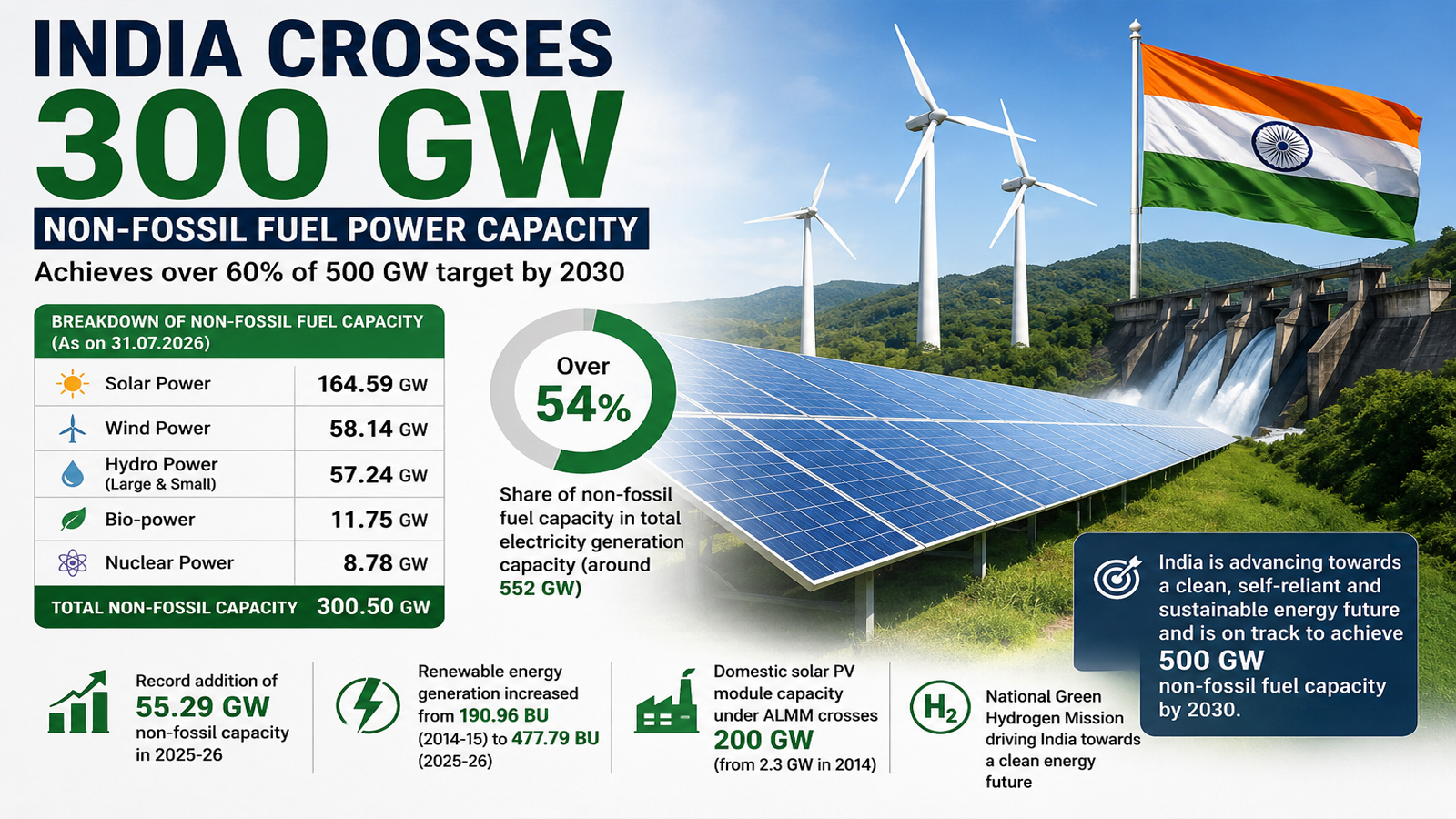
India has crossed the landmark 300 GW mark in installed non-fossil fuel-based electricity generation capacity, with the country’s clean energy capacity reaching 300.50 GW as of July 31, 2026, according to the Ministry of New and Renewable Energy.
The milestone means India has already achieved more than 60% of its target of installing 500 GW of non-fossil fuel-based power capacity by 2030. Non-fossil sources now account for more than 54% of the country’s total installed electricity generation capacity, which stands at around 552 GW.
Solar power accounts for the largest share of India’s non-fossil capacity at 164.59 GW, followed by wind power at 58.14 GW and large and small hydro power at 57.24 GW. Bio-power contributes 11.75 GW, while nuclear power accounts for 8.78 GW.
The latest milestone reflects the rapid expansion of India’s renewable energy sector over the past decade. Solar capacity, which stood at just 2.8 GW in 2014, has risen to nearly 165 GW. Wind power capacity has also increased sharply from 21 GW in 2014 to more than 58 GW currently.
India added a record 55.29 GW of non-fossil fuel-based electricity generation capacity during 2025-26. Solar power accounted for 44.6 GW of the addition, while another 6 GW came from wind power.
The expansion of installed capacity has been accompanied by a significant increase in renewable energy generation. Renewable electricity generation rose from 190.96 billion units in 2014-15 to 477.79 billion units in 2025-26.
The government has also focused on strengthening domestic manufacturing capabilities to support the rapid expansion of renewable energy and reduce dependence on external supply chains.
Under the Production Linked Incentive (PLI) scheme, India has sought to promote domestic manufacturing of high-efficiency solar photovoltaic modules. The capacity enlisted under the Approved List of Models and Manufacturers (ALMM) for solar PV modules has crossed 200 GW, compared with just 2.3 GW in 2014.
The government has positioned the clean energy transition not only as a climate action priority but also as a key component of India’s industrial competitiveness, energy security and economic resilience.
Alongside the expansion of renewable power capacity, the Ministry of New and Renewable Energy is pursuing industrial decarbonisation through the National Green Hydrogen Mission. The initiative seeks to build India’s capabilities in the production, use and export of green hydrogen and its derivatives.
The crossing of the 300 GW mark comes as India continues to accelerate efforts to achieve its 2030 clean energy goals and build a more self-reliant and sustainable energy ecosystem.


