







India’s journey towards a cleaner, more secure and self-reliant energy future is emerging as one of the defining achievements of the Narendra Modi government. Over the past decade, solar energy has moved from being a relatively small component of India’s power sector to becoming one of the principal pillars of the country’s renewable energy expansion. The scale and speed of this transformation demonstrate how sustained policy support, infrastructure development, technological innovation and public participation can reshape an entire sector.
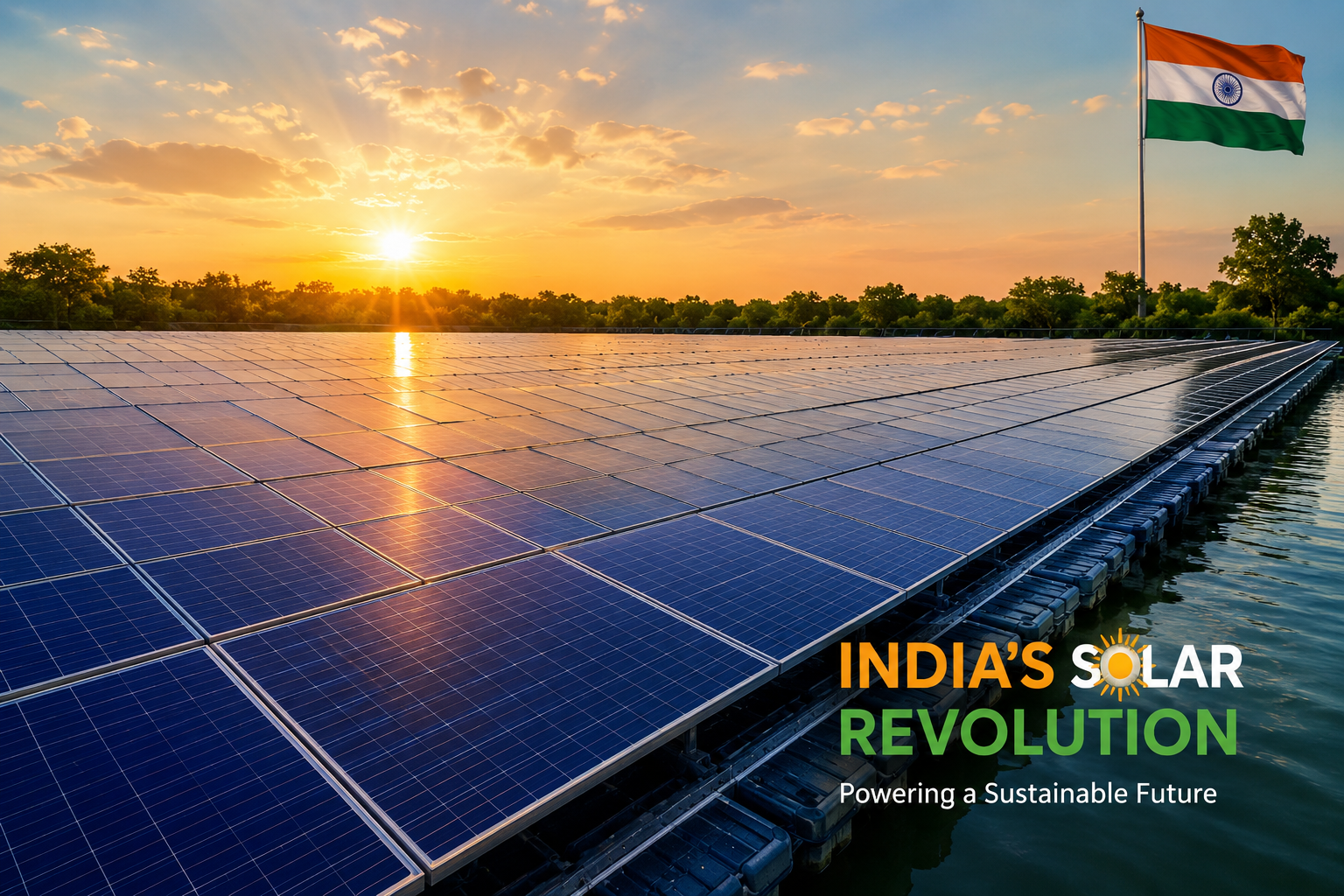
The latest approval of the Pradhan Mantri Surya Sarovar Yojana (PM-SSY) represents another important step in this journey. With an outlay of ₹5,070 crore, the scheme aims to develop 5,000 MW of floating solar photovoltaic projects with co-located energy storage systems. By using existing reservoirs and suitable inland water bodies, the initiative will make productive use of available resources while reducing pressure on scarce land. The scheme is expected to help reduce around 10 million tonnes of carbon dioxide emissions every year and generate approximately 16,000-17,000 full-time equivalent jobs.
What makes India’s solar transformation particularly significant is the remarkable growth achieved within a relatively short period. India’s installed solar capacity has increased from around 3 GW in 2014 to 162.15 GW as of 30 June 2026. During financial year 2025-26 alone, the country added 44.61 GW of solar capacity, nearly twice the addition recorded in the previous financial year. Total non-fossil fuel capacity has also reached 283.46 GW. These figures reflect the impact of a consistent policy framework and a clear long term vision for India’s energy transition.
The Modi government’s approach has extended well beyond the creation of large solar power plants. The Solar Parks Scheme has facilitated the development of large scale projects by providing land and supporting infrastructure, while the Green Energy Corridor is strengthening transmission networks to move renewable power from resource-rich regions to demand centres. By February 2026, 54 solar parks with a combined sanctioned capacity of 39,188 MW had been approved across the country. Projects such as Bhadla, Pavagada and Rewa have become symbols of India’s growing solar capabilities.
Equally important has been the government’s effort to make solar power more affordable. Competitive bidding and transparent tariff discovery have dramatically reduced solar tariffs over the years. The record low tariff of ₹2.44 per unit achieved at the Bhadla Solar Park auction in 2017 marked a major milestone and helped demonstrate that clean energy could also be economically competitive.
The government’s vision has also placed strong emphasis on domestic manufacturing. Through the Production Linked Incentive scheme for high-efficiency solar photovoltaic modules, India is building a stronger manufacturing ecosystem and reducing dependence on imports. The scheme has attracted substantial investment and supported employment, while the approved list of models and manufacturers framework has helped promote quality and reliability in solar equipment.
The most transformative aspect of this solar revolution, however, may be its growing connection with ordinary citizens. PM Surya Ghar: Muft Bijli Yojana is taking rooftop solar directly to households, while PM-KUSUM is supporting farmers through solar pumps and feeder solarisation. In this manner, renewable energy is no longer confined to large power companies or industrial projects. Households, farmers, businesses and communities are becoming active participants in India’s clean-energy transition.
This approach reflects the larger philosophy of the Modi government’s development agenda, which includes ideas like- growth must be accompanied by sustainability, energy security and greater self-reliance. India’s commitments under Panchamrit including the target of 500 GW of non-fossil fuel capacity by 2030 and net-zero emissions by 2070, provide a clear long-term direction. Initiatives such as Mission LiFE further underline the importance of responsible consumption and citizen participation.
India’s solar story is therefore not merely about adding gigawatts of capacity. It is about creating jobs, strengthening manufacturing, reducing import dependence, improving energy security, making electricity more affordable and contributing to global climate action. India’s emergence as one of the world’s fastest growing solar markets is a reflection of the country’s expanding capabilities and the effectiveness of sustained policy intervention.
The Narendra Modi government’s solar initiatives demonstrate that environmental responsibility and economic development need not be competing priorities. With ambitious targets, innovative schemes and increasing participation from citizens and industry, India is building an energy system that is cleaner, more resilient and more self-reliant.
The sun has always been one of India’s greatest natural resources. The achievement of the last decade has been to turn that abundant resource into a powerful instrument of national development. As India moves towards the goal of a Viksit Bharat, its solar revolution is lighting not only homes and industries, but also the path towards a greener, stronger and more sustainable future.


