







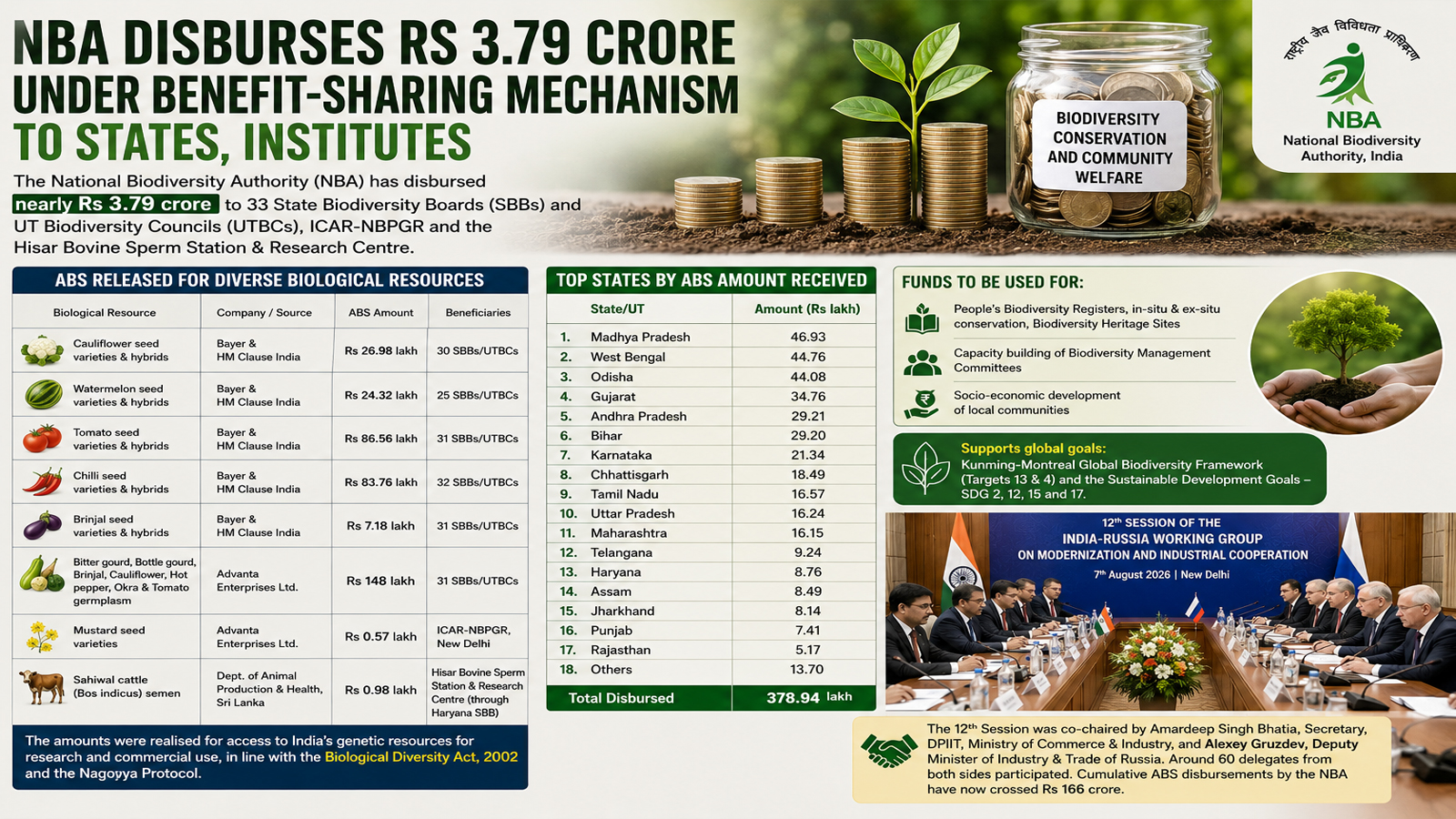
The National Biodiversity Authority (NBA) has disbursed nearly Rs 3.79 crore under the Access and Benefit Sharing (ABS) mechanism to 33 State Biodiversity Boards (SBBs) and Union Territory Biodiversity Councils (UTBCs), as well as national institutions involved in the conservation and utilisation of India’s biological resources.
The latest disbursement covers a wide range of agricultural biodiversity, including varieties and hybrids of tomato, chilli, brinjal, cauliflower, watermelon, bitter gourd, bottle gourd, okra and mustard. It also includes deep-frozen semen of Sahiwal cattle.
The ABS payments were realised from companies including Bayer Science and Innovation Pvt. Ltd., HM Clause India Pvt. Ltd. and Advanta Enterprises Limited for accessing vegetable and oilseed genetic resources for research and commercial utilisation. An additional amount was received from the Department of Animal Production and Health, Government of Sri Lanka, for access to Sahiwal cattle semen.
India’s ABS framework, implemented under the Biological Diversity Act, 2002 and aligned with the Nagoya Protocol, provides for equitable sharing of benefits arising from the use of biological resources. In cases where companies accessed biological resources through markets, traders or intermediaries and the original source could not be identified, the NBA used benefit-sharing modalities prepared by an Expert Committee and approved by the Authority.
The funds have been distributed proportionately among SBBs and UTBCs in states and Union Territories where the respective crops are cultivated. The allocation was determined using cultivation-area data published by the Ministry of Agriculture and Farmers Welfare.
Tomato accounted for Rs 86.56 lakh of the latest disbursement, distributed among 31 SBBs and UTBCs, while Rs 83.76 lakh was released for chilli resources across 32 SBBs and UTBCs. A further Rs 26.98 lakh was allocated for cauliflower seed varieties and hybrids across 30 SBBs and UTBCs, and Rs 24.32 lakh for watermelon resources across 25 SBBs and UTBCs.
Another Rs 7.18 lakh was released for brinjal seed varieties and hybrids across 31 SBBs and UTBCs. Advanta Enterprises Limited contributed Rs 1.48 crore towards access to germplasm of bitter gourd, bottle gourd, brinjal, cauliflower, hot pepper, okra and tomato, benefiting 31 SBBs and UTBCs. The ICAR-National Bureau of Plant Genetic Resources in New Delhi received Rs 57,000 for mustard seed varieties, while Rs 98,000 was released to the Hisar Bovine Sperm Station and Research Centre through the Haryana State Biodiversity Board for Sahiwal cattle semen.
Madhya Pradesh received the largest share among the states and Union Territories, with Rs 46.93 lakh, followed by West Bengal with Rs 44.76 lakh and Odisha with Rs 44.08 lakh. Gujarat received Rs 34.76 lakh, while Andhra Pradesh and Bihar received Rs 29.21 lakh and Rs 29.20 lakh, respectively.
Karnataka received Rs 21.34 lakh, followed by Chhattisgarh at Rs 18.49 lakh, Tamil Nadu at Rs 16.57 lakh, Uttar Pradesh at Rs 16.24 lakh and Maharashtra at Rs 16.15 lakh. Telangana received Rs 9.24 lakh, Haryana Rs 8.76 lakh, Assam Rs 8.49 lakh, Jharkhand Rs 8.14 lakh and Punjab Rs 7.41 lakh. Rajasthan received Rs 5.17 lakh, while other beneficiaries collectively received Rs 13.70 lakh.
The recipient biodiversity boards and councils are required to use the funds for biodiversity conservation and community-oriented activities. These include preparing and updating People’s Biodiversity Registers, promoting in-situ and ex-situ conservation, strengthening Biodiversity Heritage Sites, building the capacity of Biodiversity Management Committees and supporting the socio-economic development of local communities.
The Ministry of Environment, Forest and Climate Change (MoEFCC) said the mechanism ensures that benefits generated through the commercial use of India’s biological resources are channelled back into biodiversity conservation and the welfare of communities involved in preserving these resources.
The latest disbursement also reinforces India’s commitment to the Kunming-Montreal Global Biodiversity Framework, particularly Target 13 on fair and equitable benefit sharing from the use of genetic resources and Target 4 on the conservation of genetic diversity. The initiative also contributes to Sustainable Development Goals relating to zero hunger, responsible consumption and production, life on land and global partnerships.
With the latest release, cumulative Access and Benefit Sharing disbursements by the NBA have crossed Rs 166 crore. The initiative seeks to strengthen the link between biodiversity conservation, scientific research, commercial utilisation of biological resources and the livelihoods of communities that help conserve India’s biological wealth.


