







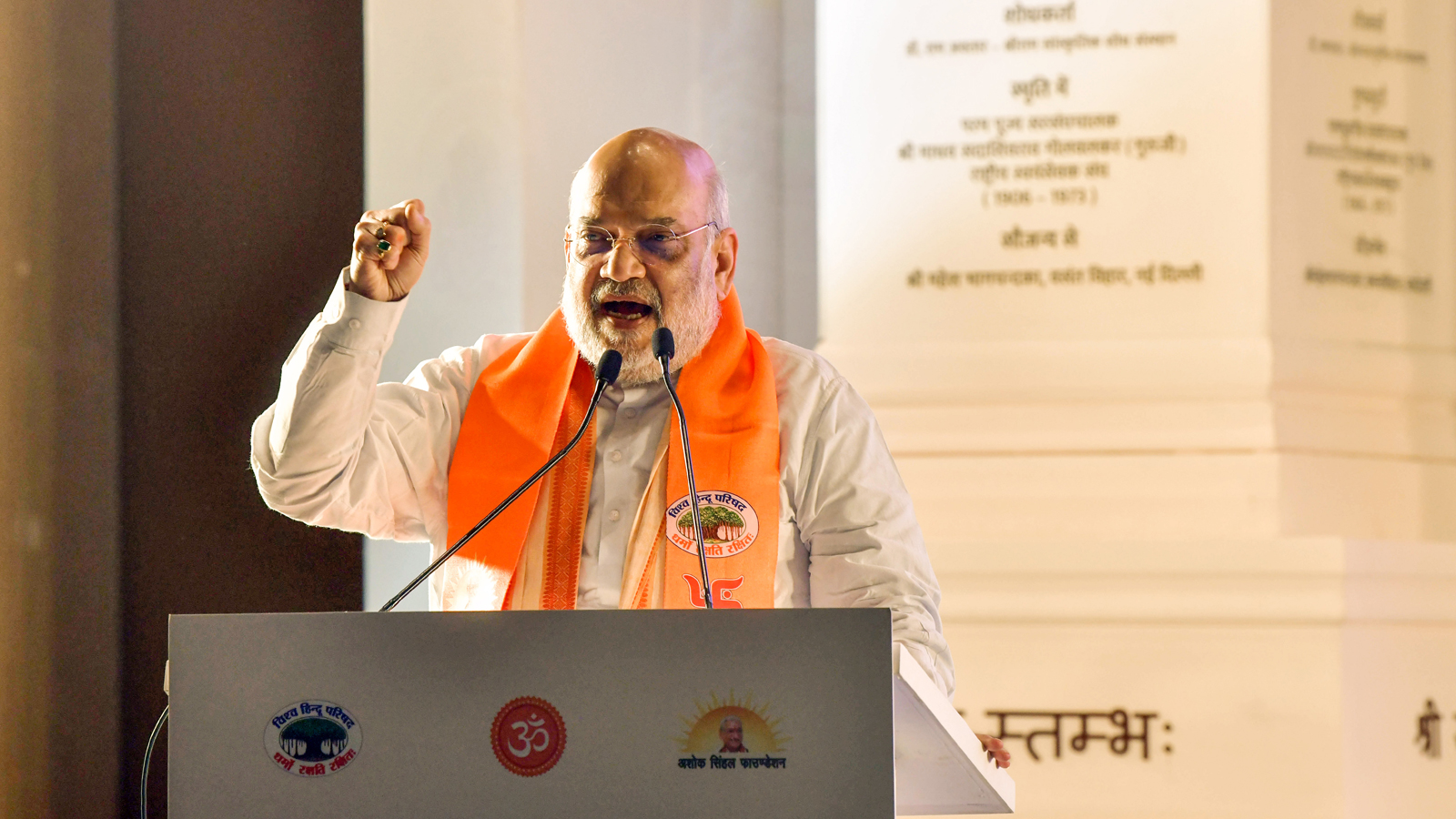
Union Home Minister Amit Shah on Sunday addressed the inaugural ceremony of the centenary year celebrations commemorating the birth anniversary of former Vishwa Hindu Parishad (VHP) president Ashok Singhal, describing his life as a confluence of sacrifice, simplicity, patriotism, devotion to Dharma and an unwavering spirit of struggle.
HM Shah said Singhal remained exemplary at every stage of his life, from being a student and Swayamsevak to a Pracharak and later the international president of the VHP. He said Singhal dedicated his entire life to Hindutva and remained committed to his ideals until his last breath.
“Such personalities are rarely seen,” HM Shah said, highlighting Singhal’s simplicity despite his birth into a prestigious and affluent family. He recalled that Singhal chose to live in a small room at the VHP office, where he spent nearly 20 years serving the organisation. HM Shah said the room has now become almost an exhibition space for workers and serves as an example of Singhal’s simple lifestyle and dedication.
The Home Minister said Singhal continued to work for nearly 16 hours a day even at an advanced age, with his exemplary patriotism serving as his primary source of inspiration. He also recalled Singhal’s deep reverence for Hindu Dharma, the Vedas, the Upanishads, Sanskrit, Indian culture and the tradition of saints.
HM Shah said Singhal believed that Hindu Dharma should be taken to the world not merely because Hindus follow it, but because its core philosophy is concerned with the welfare of the entire universe. Referring to the Shanti Mantra, he said Singhal viewed the promotion of Hindu Dharma as a means of advancing the welfare of humanity.
HM Shah also highlighted Singhal’s association with the Ram Janmabhoomi movement, saying the issue was deeply embedded in his thoughts and convictions. He said Singhal believed India could attain a position of honour and prestige in the world only by overcoming the remnants of foreign rule and constructing a grand Ram Temple.
Recalling Singhal’s role in the movement, HM Shah said that when the Uttar Pradesh government ordered a lathi charge during the Ram Janmabhoomi movement, Singhal reached the frontline in disguise and was injured. He said the image of Singhal wiping blood from his face with a gamchha reflected his commitment to the cause and should remain an inspiration for the youth.
HM Shah said the VHP, the institution of saints, the Ram Janmabhoomi movement, the construction of the Ram Temple and the Sangh were among the causes closest to Singhal’s heart. He said Singhal worked openly and consistently for these causes, which eventually became synonymous with his identity.
Describing Singhal as an “institution in himself”, HM Shah said his life, sacrifice, simplicity, dedication and perseverance could serve as an inspiration for young people. He expressed confidence that the centenary celebrations would help take these values to a wider audience, particularly among the youth.
The Home Minister also said there was no distinction between Singhal’s personal and public life. Having embraced the ideal of living for the nation, Singhal merged his personal life with this larger purpose and treated organisational work as a form of spiritual discipline.
HM Shah said the purpose of the centenary celebrations was not merely to remember Singhal but to take the values reflected in his life to every household, particularly to young people. He said remembering national and social figures was important to prevent an “ideological vacuum” and ensure that younger generations had worthy ideals and sources of inspiration.
“Gratitude is not merely a sentiment; it is a national necessity,” HM Shah said, stressing the significance of commemorating Singhal’s birth centenary.
During the event, presentations were also made on various service initiatives associated with the centenary celebrations, including prayers at the temples of Sant Ravidas and Maharishi Valmiki, Ganga Aarti in Prayagraj, Ganga conservation activities, service to Gaumata, commemoration of the Ram Setu movement and distribution of artificial limbs in Ayodhya.
The digital inauguration of 11 Shri Ram Stambhs was also held during the event. HM Shah said the pillars commemorate the route taken by Maryada Purushottam Shri Ram during his exile and would convey the message of the Ram Van Gaman Path and the values associated with Shri Ram to future generations.
HM Shah also recalled that Singhal could not witness the Bhoomi Pujan or the completion of the Ram Temple despite having dedicated himself to the Ram Janmabhoomi movement. He said Singhal never worked with the expectation of seeing the fulfilment of his efforts during his own lifetime and regarded the movement as a struggle spanning generations.
Referring to the construction of the Ram Temple, HM Shah said that after Prime Minister Narendra Modi came to office in 2014, governmental obstacles were removed within five years and the grand temple was constructed without bloodshed. He said the development represented a matter of peace and satisfaction for devotees of Shri Ram in India and across the world.
HM Shah said he shared Singhal’s belief that the construction of the Ram Temple would open a new path for India’s progress and help the country’s ideas, culture, Dharma and values reach people across the world.
He expressed hope that the youth of the country would continue to draw values and inspiration from Singhal’s personality, life, contributions and words for generations to come.


