







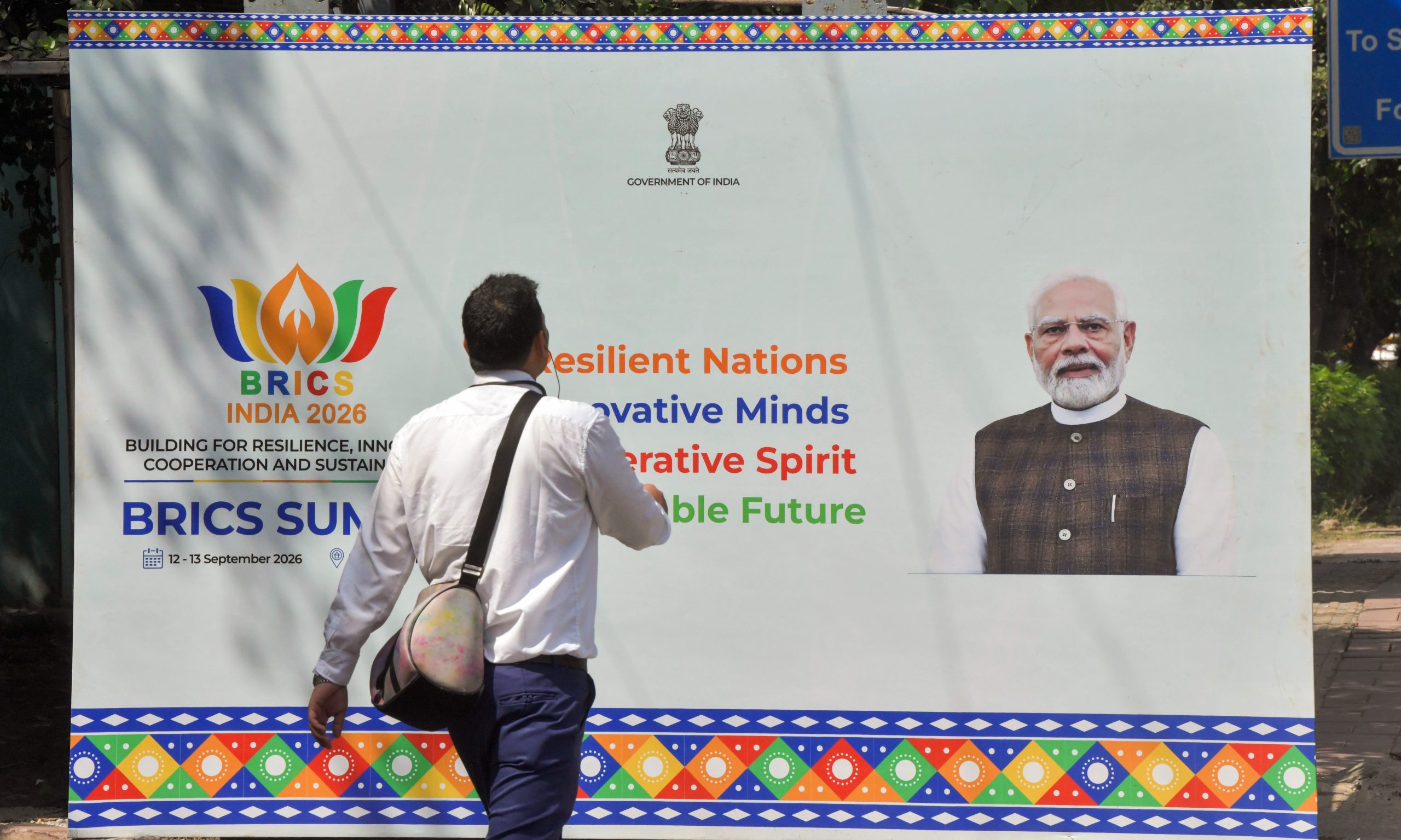
As New Delhi gears up for the BRICS Summit later this week, Jawaharlal Nehru University Professor Srikanth Kondapalli highlighted how the expansion of the original five-member composition into an “intercontinental organisation” representing the Global South has “significantly broadened its geographical and political footprint”.
Delhi is set to host the 18th BRICS Leaders’ Summit on September 12-13, as India concludes its 2026 chairship of the expanded grouping of major emerging economies and developing countries.
India’s chairship, which began on January 1, 2026, is guided by the theme “Building for Resilience, Innovation, Cooperation and Sustainability”, with the four pillars reflecting its focus on strengthening resilience, harnessing innovation, deepening cooperation and advancing sustainable development through a people-centric approach.
Kondapalli said the grouping’s expansion gives it a sizeable presence in the global multilateral system.
“Today BRICS has also become an intercontinental organisation focusing on the Global South,” Kondapalli said, noting that the grouping currently has 11 members and 10 partner countries.
Kondapalli said the growing interest in BRICS membership underscores its increasing appeal across the Global South.
“Three years ago, Russian Foreign Minister Lavrov mentioned that there are 41 countries that have applied for membership in BRICS. So that is quite a big number,” he said.
“If 41 members are admitted, then you have almost a quarter of the General Assembly of the United Nations,” he added.
However, the professor noted that further expansion of the grouping could bring additional considerations for consensus-building, particularly in the “absence of a formal charter governing membership”.
BRICS has evolved into an important platform for political and diplomatic coordination among major emerging economies and developing countries. It currently comprises 11 full members — Brazil, Russia, India, China, South Africa, Egypt, Ethiopia, Indonesia, Iran, Saudi Arabia and the United Arab Emirates.
The grouping has also introduced a partner-country category, with Belarus, Bolivia, Cuba, Kazakhstan, Malaysia, Nigeria, Thailand, Uganda, Uzbekistan and Vietnam among the partners.
The expanded BRICS grouping accounts for a significant share of the global population and economy, representing around 49.5 per cent of the world’s population, 40 per cent of global GDP and 26 per cent of global trade.
The grouping began as BRIC, comprising Brazil, Russia, India and China. It was formalised at the first meeting of BRIC Foreign Ministers on the sidelines of the United Nations General Assembly in New York in 2006. The first BRIC Leaders’ Summit was subsequently held in Yekaterinburg, Russia, in 2009.
South Africa joined the grouping in 2011, transforming BRIC into BRICS. The grouping subsequently entered a new phase of expansion, with Egypt, Ethiopia, Iran, Saudi Arabia and the UAE becoming full members in January 2024, followed by Indonesia in January 2025.
The expansion was accompanied by the creation of the partner-country category, approved at the 16th BRICS Summit in Kazan in 2024. Nine countries initially joined the category in 2025, while Vietnam subsequently became the tenth BRICS partner country.
-with inputs from ANI


