







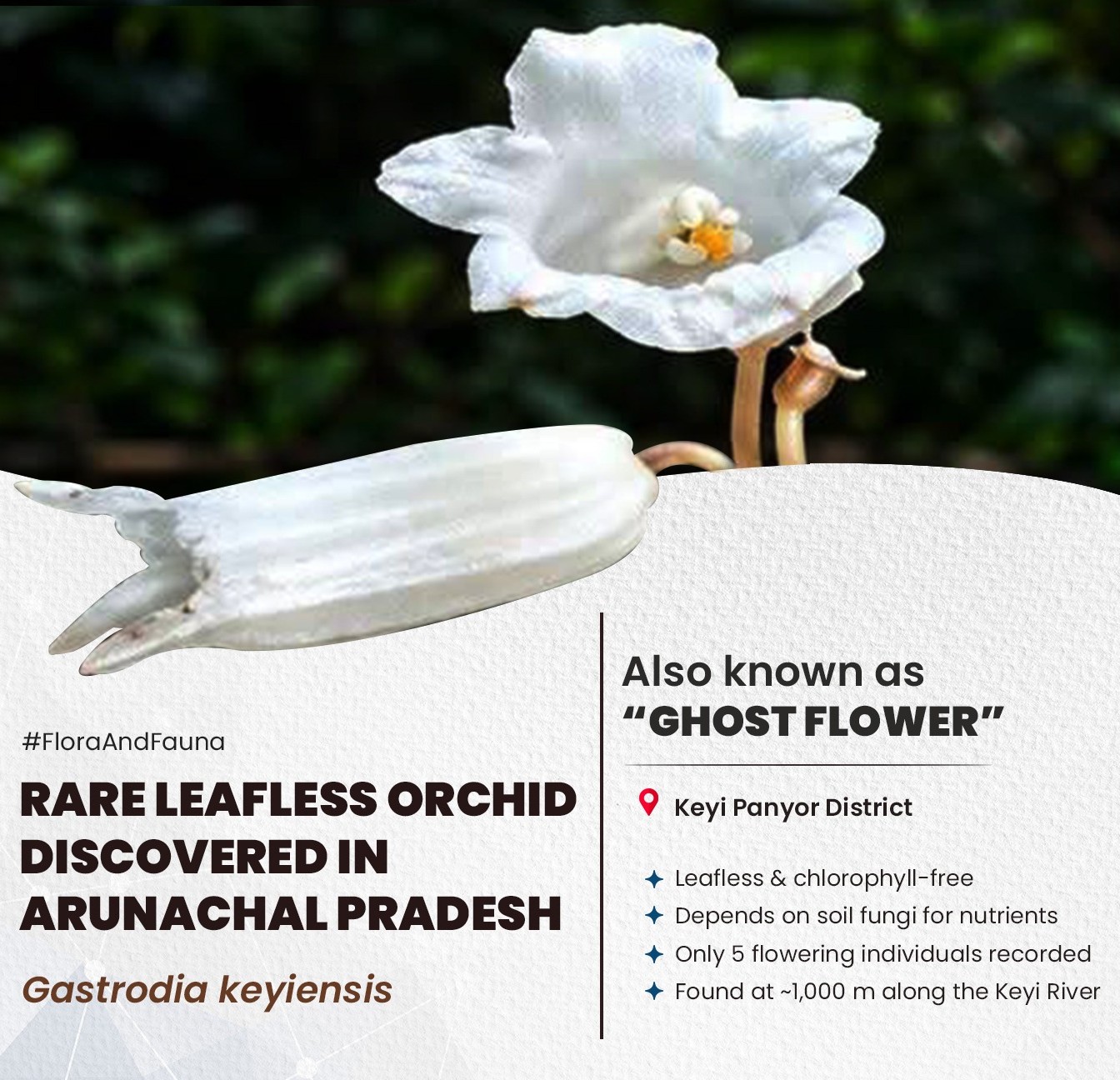
Scientists have discovered a rare leafless orchid species, Gastrodia keyiensis, in a remote gorge along the Keyi River in Arunachal Pradesh’s Keyi Panyor district, officials said on Monday.
The elusive orchid, which has neither leaves nor chlorophyll and depends on soil fungi for nutrients, was found at an altitude of around 1,000 metres, with only five flowering individuals recorded during the botanical survey, they said.
The new species has been formally described in the international taxonomic journal Phytotaxa in a research paper authored by Madhusudhan Khanal, Dipankar Borah, Shuvadip Sarkar, Neelam Gap, Santosh Kumar Rai and Devendra Kumar.
Deputy Chief Minister Chowna Mein, in a social media post, described the discovery as another addition to Arunachal Pradesh’s natural heritage and said the finding “adds another fascinating chapter” to the state’s biodiversity.
He said the orchid’s limited known distribution and short flowering period underline the need for continued research and conservation of fragile ecosystems.
https://x.com/ChownaMeinBJP/status/2101918982898929815?s=20
The researchers are affiliated with institutions including the G B Pant National Institute of Himalayan Environment, Sikkim University, Kaliabor College and the Botanical Survey of India. The paper was published on September 9.
The species has been named Gastrodia keyiensis, with the specific name derived from the Keyi River, where it was discovered.
It belongs to the genus Gastrodia, a group of orchids known for their unusual non-photosynthetic lifestyle.
Unlike most plants, these orchids do not produce food through photosynthesis. Instead, they obtain nutrients through associations with fungi in the soil, a condition known as holomycotrophy.
The orchid was found growing in deep shade on thick layers of decaying leaf litter in bamboo groves along the right bank of the Keyi River, officials said.
The plants can grow up to about 35 cm in height and produce one to three flowers. Researchers recorded only five flowering individuals at the type locality, highlighting how difficult the species is to locate in its natural habitat.
According to the taxonomic study, the new species has a broadly obovate basal portion of the labellum with six to seven prominent longitudinally thickened structures, along with a thick, strongly curved yellow apical portion. These features help distinguish it from the related species.
The flower is particularly unusual because much of the plant’s life is spent hidden beneath the forest floor.
Lacking leaves and chlorophyll, Gastrodia keyiensis is adapted to the dark, humid conditions of the forest floor and depends on its fungal association for nourishment. Its flowers are white to pale bluish, with a distinctive yellow and strongly curved portion of the labellum.
The orchid’s elusive nature, short flowering period and long underground phase make it difficult to detect during routine botanical surveys, researchers said.
In the Nyishi dialect, the orchid is locally known as “Oram Opuh”, meaning “Ghost Flower”.
The name reflects its unusual appearance and its tendency to remain concealed for most of its life cycle.
Researchers have noted that the species is currently known only from its type locality, with an estimated area of occupancy of about four square kilometres. It has been placed in the Data Deficient (DD) category because its actual population size and wider distribution remain unknown. Further surveys and long-term monitoring have been recommended.
The discovery further highlights the exceptional botanical wealth of Arunachal Pradesh, which is home to around 600 documented orchid species, according to the state Forest department.
The state has been described as an “Orchid Paradise” because of its high orchid diversity, while its varied elevations, climate and forest habitats provide suitable conditions for a wide range of plant species.
-PTI


