







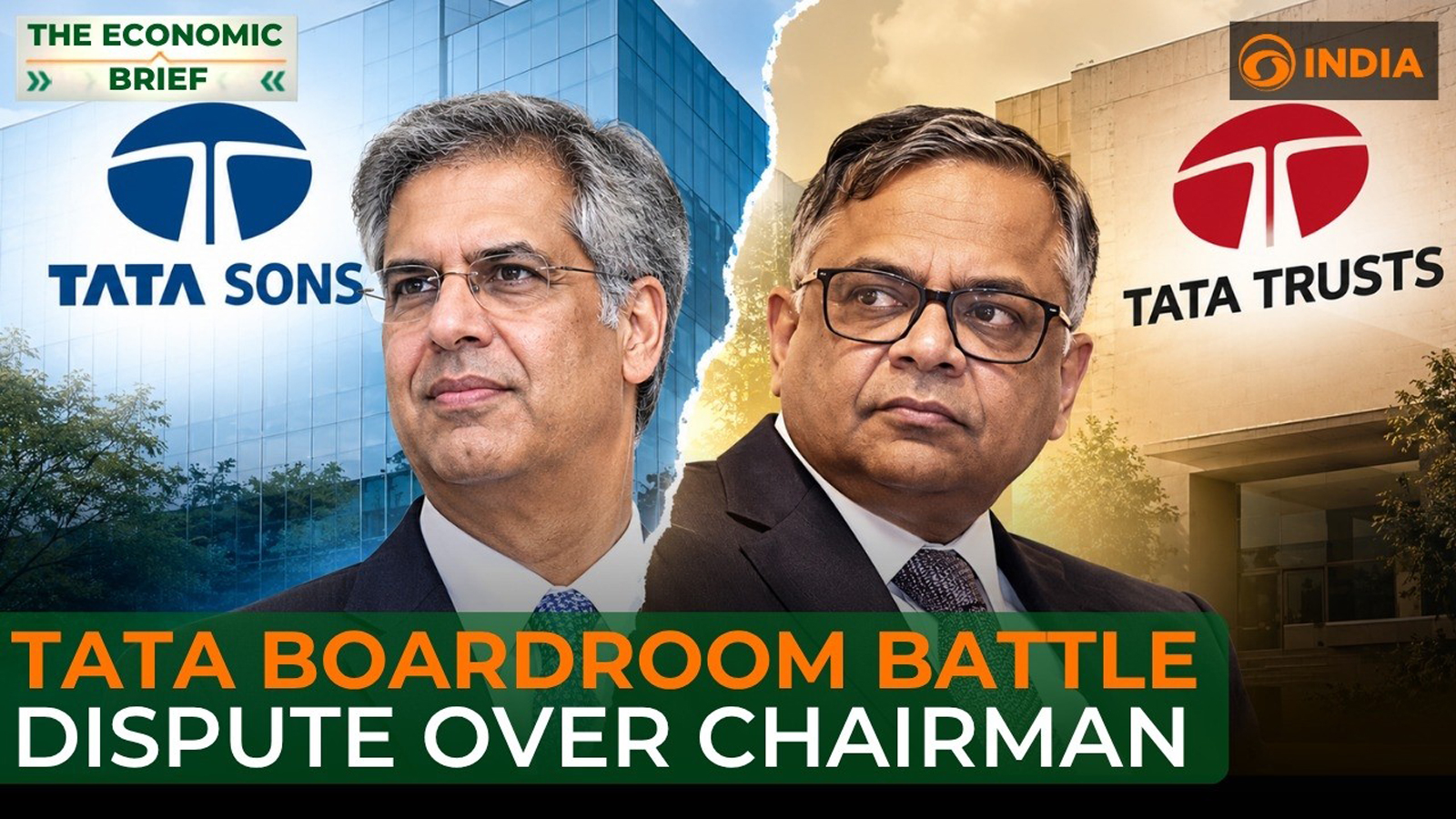
Inside This Week’s Economic Brief
This week’s Economic Brief covers the escalating Tata Sons boardroom crisis, the new US-Denmark-Greenland security pact, US sanctions targeting Iranian aviation, and India’s 19 new AI billionaires on the Hurun list.
This week’s edition of The Economic Brief on DD India examined four major stories: an escalating governance crisis at Tata Sons, a new US-Denmark-Greenland security pact, expanding US sanctions on Iran’s aviation sector, and record AI-driven wealth creation in India. The episode featured extensive analysis from economist and author Prasenjit Basu.
Tata Sons Faces a Three-Front Crisis
A boardroom battle at Bombay House has escalated into what the program described as a three-front crisis for Tata Sons. On September 17, the board voted 4-1 to grant N. Chandrasekaran a fresh five-year term as executive chairman and to begin complying with the RBI’s mandatory listing order – with the lone dissent from Noel Tata, chairman of Tata Trusts, which holds nearly 66% of the company.
The dispute centers on three fronts:
* A legal challenge over whether the chairman’s reappointment required an affirmative majority of Trust-nominated directors under Tata Sons’ reserved-matters veto, with the Trusts arguing the vote is void.
* Regulatory pressure, after the RBI rejected Tata Sons’ attempt to surrender its core investment company license, keeping it in the NBFC upper layer and subject to a listing deadline that has already passed; the RBI has filed a caveat in the Bombay High Court.
* A shareholder deadlock, as the Ratan Tata Trust – holding nearly 24% of Tata Sons – cannot convene its board amid a Maharashtra Charity Commissioner inquiry into trustee composition, leaving it unable to meet quorum. The AGM deadline has been extended to November 18.
Prasenjit Basu said the standoff stems from Noel Tata’s claim to a veto requiring majority support from Trust-nominated directors, but noted Chandrasekaran retains a strong position with board backing. He argued the RBI and government are right to push for listing, noting that Shapoorji Pallonji Group – the largest minority shareholder, holding 18.4% and reportedly carrying around ₹60,000 crore in debt – favors listing to crystallize its stake’s value, and that mechanisms used by other Asian conglomerates could protect against hostile takeover risk after listing.
US-Denmark-Greenland Pact Reshapes Arctic Security
A new US-Denmark-Greenland security and economic pact updates and expands the 1951 defense agreement, establishing two new US bases – Narsarsuaq in the south and Mestersvig in the east – alongside expanded Pituffik Space Base rights, though troop numbers and timelines remain unspecified. The pact strengthens NATO’s Arctic posture, requires Greenland to remain within NATO even if it becomes independent, bars non-NATO military presence, and gives Greenland the right to screen investment proposals, effectively excluding China and Russia.
It recognizes Greenland’s right to self-determination and takes effect in perpetuity once approved by Greenland’s and Denmark’s parliaments. Basu called the agreement a win for Washington, noting the bases will provide long-term security influence even if Greenland gains independence, while giving the US an edge in future mineral talks given its security role.
US Escalates Aviation Sanctions on Iran
Washington has warned foreign airports, insurers, fuel suppliers, and ticketing companies that servicing Iranian airlines could trigger secondary sanctions, deepening isolation for carriers like Mahan Air, Iran Air, and Meraj Air. The move comes as US-Iran tensions have already doubled jet fuel prices, triggering aviation’s worst crisis since COVID-19. Basu said the sanctions mainly affect Iran and carriers flying through its airspace, noting many airlines already reroute around the region at modest, not prohibitive, added cost.
Hurun Names 19 AI Entrepreneurs Driving Record Wealth
The Hurun India Rich List has added AI as a standalone category for the first time, featuring 19 individuals with combined wealth exceeding ₹3 lakh crore ($33 billion), 15 of them new entrants. The average new AI entrant holds around ₹12,000 crore, nearly five times the average for industrial products entrants. Notable names include Perplexity’s Aravind Srinivas (₹28,500 crore), Sarvam AI co-founders Vivek Raghavan and Pratyush Kumar (₹3,200 crore each), and former Twitter CEO Parag Agrawal (₹10,500 crore). India now counts 391 billionaires, 27 more than last year, with AI, semiconductors, aerospace, and defense together accounting for 48 individuals worth over ₹4.2 lakh crore.
Key Takeaways
Tata Sons’ governance crisis highlights the tension between legacy trust structures and modern regulatory demands for transparency. The Greenland pact cements long-term US strategic influence in the Arctic without formal annexation. Iran’s aviation sector faces deepening isolation under expanded US sanctions. And India’s AI sector is emerging as a major new engine of wealth creation, reshaping the country’s billionaire landscape.


