







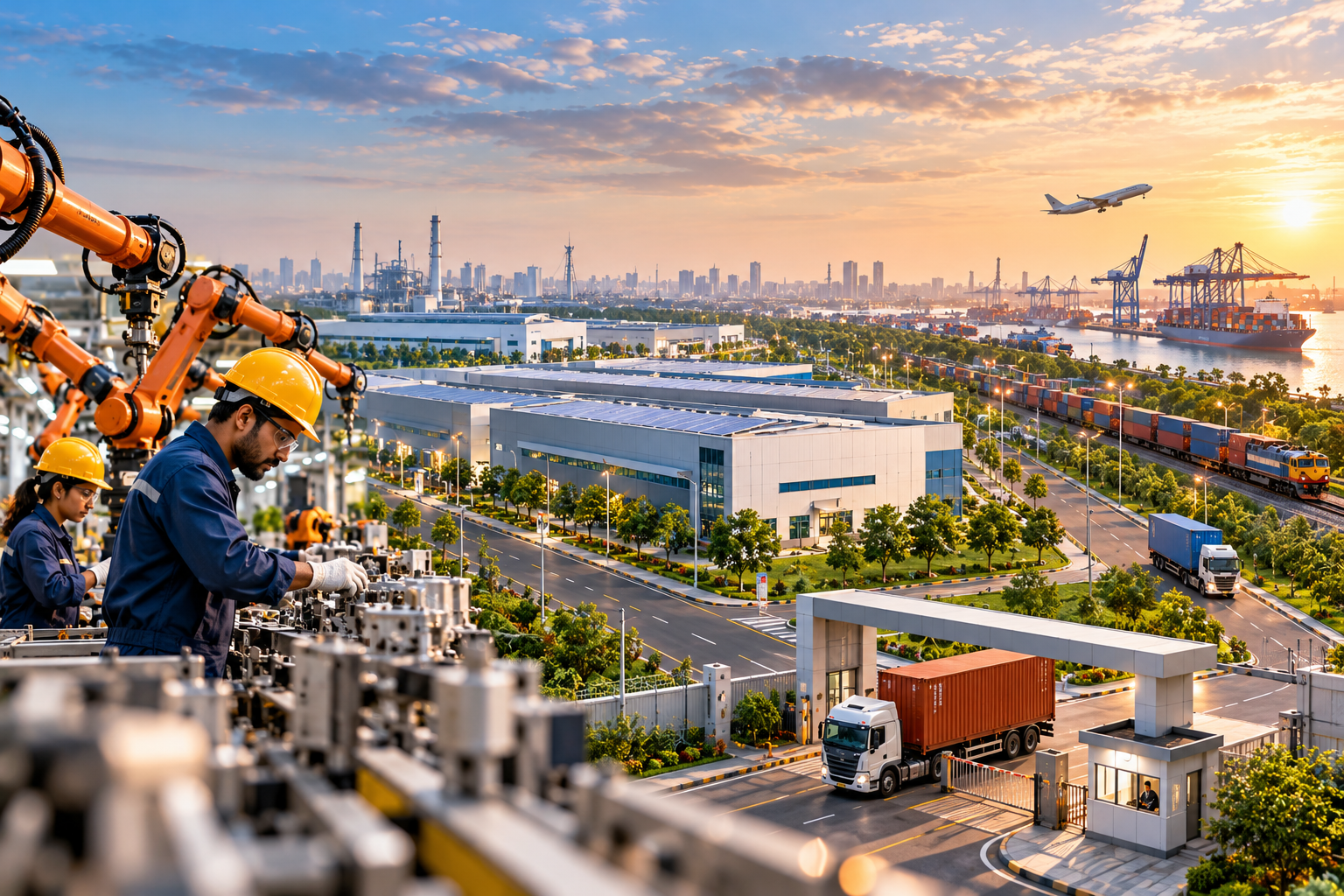
India is stepping up efforts to strengthen its manufacturing ecosystem through the Bharat Audyogik Vikas Yojna (BHAVYA), a ₹33,660-crore initiative aimed at developing 100 plug-and-play industrial parks across the country. The scheme seeks to make it easier for industries to establish operations by providing ready infrastructure, common facilities and streamlined approval processes.
The initiative marks a further shift in India’s industrial development strategy—from providing industrial land and basic infrastructure to creating integrated ecosystems where businesses can move more quickly from investment to production. By bringing together utilities, logistics, administrative support and worker amenities, BHAVYA aims to attract investment, support micro, small and medium enterprises (MSMEs), strengthen supply chains and generate employment.
A changing manufacturing landscape
Manufacturing remains an important pillar of India’s economic growth, accounting for around 16–17 per cent of GDP and employing more than 27 million workers, according to the background material released by the government. The National Manufacturing Mission aims to increase manufacturing’s contribution to GDP to 25 per cent by 2035.
The sector is also moving towards higher-value production, with medium- and high-technology industries accounting for 46.3 per cent of manufacturing value addition. This transition is increasing the need for reliable power and water supply, efficient transport links, modern industrial facilities and predictable regulatory processes.
As global supply chains diversify, investors are increasingly looking for locations where land, infrastructure and approvals are available without prolonged delays. Plug-and-play industrial parks seek to address these requirements by developing essential infrastructure before individual businesses begin operations.
From industrial estates to integrated industrial hubs
India’s approach to industrial development has evolved over several phases. Earlier industrial estates and Special Economic Zones (SEZs) provided industrial land, common infrastructure and regulatory incentives. The government’s background material states that, as of February 2026, India had 370 notified SEZs, which had attracted investments worth ₹7.82 lakh crore and generated employment for more than 31.7 lakh people.
The approach subsequently expanded towards integrated industrial corridors and planned manufacturing hubs. The National Industrial Corridor Development Programme combines industrial development with utilities, logistics and urban services, supporting the creation of more comprehensive industrial locations.
Projects such as Dholera Special Investment Region in Gujarat, Shendra-Bidkin Industrial Area in Maharashtra, Vikram Udyogpuri in Madhya Pradesh and the Integrated Industrial Township in Greater Noida illustrate this emphasis on integrated planning.
The India Industrial Land Bank had mapped 4,164 industrial parks as of October 14, 2026, according to the government’s background material. BHAVYA builds on this wider industrial infrastructure landscape by proposing a nationwide expansion of ready-to-operate industrial parks.
What BHAVYA offers
Approved by the Union Cabinet in March 2026 and notified on April 10, the scheme has a total outlay of ₹33,660 crore. It is being implemented in partnership with state governments and private developers.
BHAVYA provides financial assistance of up to ₹1 crore per acre for the development of industrial parks. Eligible infrastructure includes internal roads, electricity, water supply, drainage, common effluent treatment facilities and information and communication technology-enabled administration.
Underground utility corridors are also envisaged to facilitate maintenance and reduce disruption to industrial operations. The parks may include ready-built factory sheds, built-to-suit industrial units, testing and certification facilities, and warehousing.
The scheme also recognises the importance of worker welfare. Provisions include worker housing, healthcare facilities, skill development centres and other social amenities. Up to 25 per cent of approved funding may be allocated to external infrastructure, including road, rail and last-mile logistics connectivity.
These facilities are intended to reduce the initial costs and practical challenges faced by businesses when setting up manufacturing units, while improving connectivity with wider transport networks.
Implementation and selection of industrial parks
BHAVYA will be implemented over six years, from financial year 2026–27 to 2031–32. In the first phase, up to 50 industrial parks will be selected through a challenge-based process conducted in two rounds. Further phases will take the total number of supported parks to 100.
Project selection will consider factors such as readiness, land availability and industrial potential. Individual parks are expected to cover between 25 and 1,000 acres, subject to the scheme’s prescribed criteria.
Dedicated Special Purpose Vehicles will oversee project development, operations, investor facilitation and long-term maintenance. The BHAVYA Portal, launched in June 2026, supports project submission, appraisal and evaluation, with the objective of enabling a transparent and competitive selection process.
Manufacturing companies, MSMEs, start-ups and investors are among the intended beneficiaries of the infrastructure and streamlined approval systems.
Plug-and-play model gains ground
The plug-and-play approach involves developing industrial land and essential infrastructure in advance, allowing businesses to focus on establishing and running their operations. Common utilities, shared facilities and single-window approval systems can help reduce delays and the upfront investment required to begin production.
The model has gained momentum through several industrial development initiatives. The Union Budget 2025–26 allocated ₹2,500 crore for plug-and-play industrial parks, while the government’s background material states that India currently has 260 such parks.
Sector-specific facilities are also part of this approach. The government material refers to the approval of the BHAVYA-Rasayan Scheme for three chemical parks in July 2026. These are intended to provide common facilities and environmental safeguards for chemical manufacturing.
Dholera as an example of integrated planning
Dholera Special Investment Region in Gujarat illustrates the development of an integrated industrial city with planned roads, utilities, digital networks and urban services. Its infrastructure includes common underground networks for power, water, gas and drainage, supporting the plug-and-play model.
The region is being developed for sectors including semiconductors, aerospace and defence, solar manufacturing, green hydrogen, biotechnology and heavy engineering. Connectivity with ports, airports, expressways and the Dedicated Freight Corridor is expected to support access to domestic and international markets.
According to the government’s background material, 495 acres across 11 plots have been allotted in Dholera, with an investment potential of ₹97,328 crore and employment potential of more than 6,000 jobs. The material also identifies land allotments for major projects, including Tata Electronics’ semiconductor facility and ReNew Power’s solar module manufacturing plant.
Towards a stronger manufacturing base
BHAVYA represents the next stage in India’s effort to develop industrial locations that combine land, infrastructure, logistics and business services within a coordinated framework. Its proposed network of 100 parks is intended to extend the benefits of ready-to-operate industrial infrastructure across regions and sectors.


