







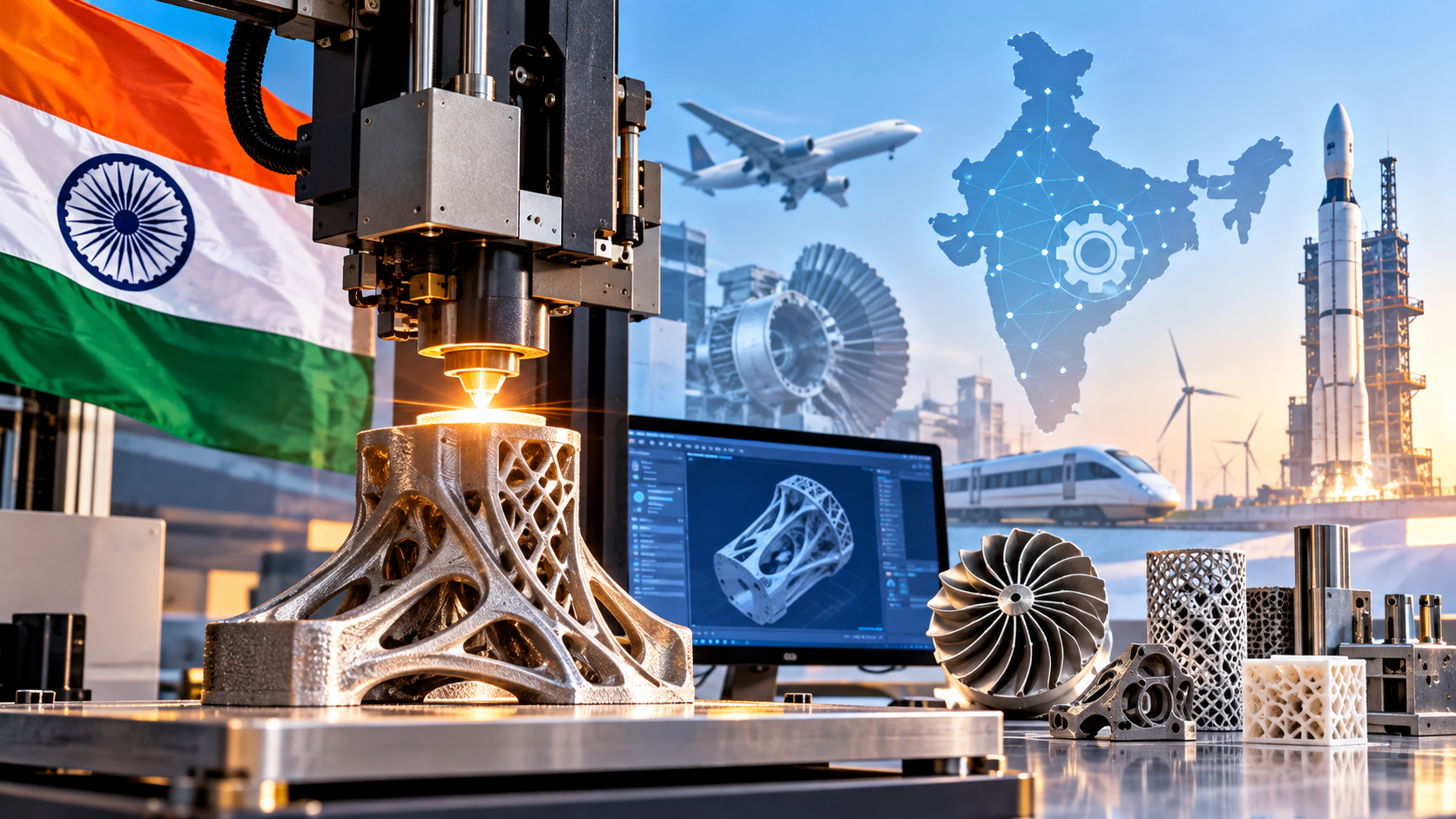
India is strengthening its position in next-generation digital manufacturing, with the National Strategy for Additive Manufacturing (NSAM) having trained more than 1.54 lakh individuals, supported 56 start-ups and facilitated the development of 65 indigenous technologies since its launch in 2022.
The government is now conceptualising NSAM 2.0 to accelerate innovation, expand industrial applications and strengthen India’s competitiveness in the global additive manufacturing market.
Additive manufacturing, commonly known as 3D printing, is a technology that uses digital designs to produce physical objects by depositing materials layer by layer. Unlike conventional manufacturing methods, which often involve cutting or removing material, the process builds components through successive layers.
The technology integrates computer-aided design (CAD), artificial intelligence, electronics and materials science, enabling the production of complex components using polymers, metals, ceramics, composites and biomaterials.
The global additive manufacturing machines market is projected to reach USD 149 billion by 2035, while the additive manufacturing electronics supply chain is expected to expand from USD 18 billion to USD 112 billion, presenting opportunities for Indian manufacturers.
Government initiatives and progress under NSAM
The Ministry of Electronics and Information Technology (MeitY) launched the National Strategy for Additive Manufacturing in February 2022 to establish a domestic ecosystem for 3D printing technologies.
Aligned with the Make in India and Atmanirbhar Bharat initiatives, the strategy aims to capture 5 per cent of the global additive manufacturing market and contribute nearly USD 1 billion to India’s GDP.
Its objectives include developing 50 India-specific technologies, supporting 100 start-ups, creating 500 new products and training one lakh skilled workers. The strategy also seeks to build additive manufacturing capabilities across 10 manufacturing sectors.
To support these objectives, the government has established seven specialised Development and Deployment Centres focusing on research, technology development, industry collaboration and skill enhancement.
According to the government, more than 1.54 lakh people have received training in additive manufacturing-related skills, exceeding the initial target of one lakh.
The initiative has also supported 56 start-ups and enabled the development of 65 indigenous technologies covering materials, machines, design processes and printed products.
These technologies are being applied across aerospace, healthcare, electronics, energy, food processing and photonics.
NSAM 2.0 to focus on innovation and commercialisation
Building on the progress of the first phase, the government is preparing NSAM 2.0 to accelerate the commercialisation of indigenous technologies and strengthen India’s additive manufacturing ecosystem.
The proposed strategy will focus on intellectual property generation, digital integration, affordable manufacturing equipment and materials, and the development of globally competitive technologies.
It also aims to expand the start-up ecosystem, strengthen the additive manufacturing electronics value chain and support wider adoption of the technology in the defence sector.
The next phase is expected to promote sustainable development initiatives and international cooperation through joint research, technology partnerships and common standards.
Applications expand across key sectors
Additive manufacturing is increasingly being adopted in strategic and industrial sectors, including aerospace, defence, healthcare, electronics and construction.
In the space sector, IIT Madras-incubated start-up Agnikul Cosmos launched its Agnibaan SOrTeD mission in May 2024, featuring a single-piece, 3D-printed semi-cryogenic rocket engine.
The project demonstrated the potential of additive manufacturing to produce complex engine components and support indigenous space technology development.
In defence, the Indian Army has used the technology for construction projects, including a two-storey dwelling unit in Ahmedabad completed in 12 weeks. Additive manufacturing has also been extended to defence infrastructure applications in operational areas such as Ladakh.
The technology is also being explored for maintenance, repair and overhaul operations across the armed forces.
In healthcare, government-supported initiatives are developing indigenous medical devices and customised implants. These include natural silk-based implants and 3D-printed bone grafts using bioceramic materials.
Such applications could reduce dependence on imported medical technologies while enabling patient-specific treatments.
In electronics, additive manufacturing centres have demonstrated the production of components including batteries, antennas, capacitors and varistors. The Indian Institute of Science has also demonstrated photonic integrated circuit blocks using additive manufacturing.
The construction sector is exploring 3D printing for faster and more sustainable building methods.
The Kelvin 6K Pro, an on-site construction printer, has demonstrated the ability to construct 2,500-square-foot homes in less than 30 days using low-carbon geopolymer materials.
According to the government, early applications indicate the potential to reduce material and logistics costs by 30 per cent and emissions by up to 90 per cent compared with conventional cement-based construction.
National platforms strengthen industry collaboration
The government is also promoting collaboration among research institutions, industry, start-ups and policymakers through national platforms.
MeitY organised the second National Additive Manufacturing Symposium (NAMS) in New Delhi on March 13, 2026.
The event focused on NSAM 2.0, defence applications, industrial adoption and research initiatives supported by the ministry.
Memorandums of understanding were exchanged to strengthen partnerships, while new additive manufacturing products were launched.
Further discussions on emerging technologies, including additive manufacturing, are scheduled during the second Emerging Science, Technology and Innovation Conclave (ESTIC-2026), to be held at Bharat Mandapam in New Delhi from October 27 to 29.
Organised by the Council of Scientific and Industrial Research (CSIR), the conclave will be held under the theme “Creative Minds, Catalyzing Science, Empowering Technologies.”
The event will cover 12 thematic areas through plenary sessions, technical discussions and exhibitions aimed at promoting research and strategic collaboration.
The government is also encouraging early exposure to emerging technologies through Atal Tinkering Labs, which provide students from Classes VI to XII with access to equipment such as 3D printers, robotics kits and Internet of Things technologies.
As India expands its additive manufacturing capabilities, the technology is expected to support domestic production, reduce import dependence and create opportunities for skilled employment.
The government’s efforts to strengthen research, industrial adoption and commercialisation are intended to position additive manufacturing as an important component of India’s Atmanirbhar Bharat and Viksit Bharat 2047 initiatives.
-PIB


