






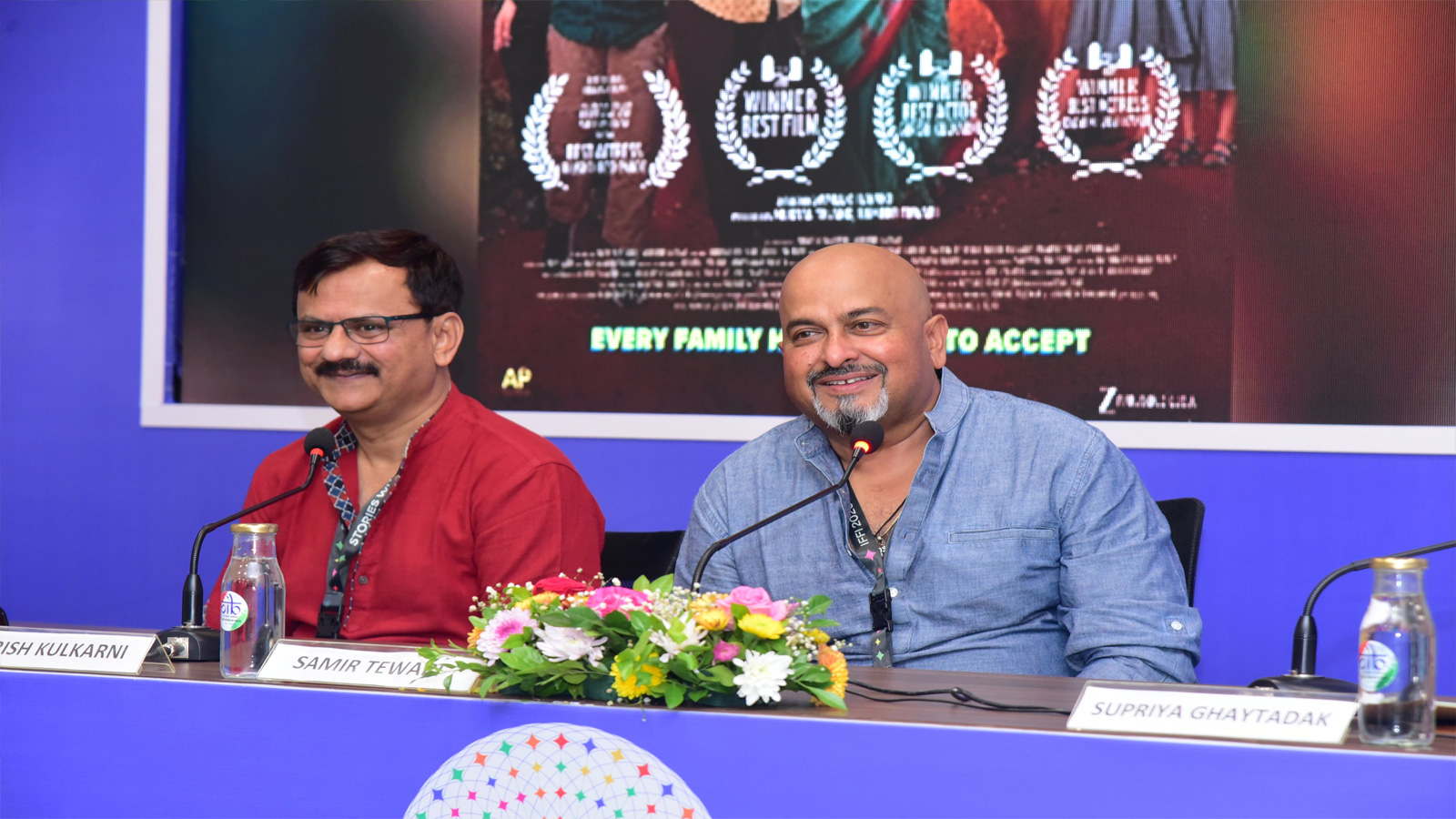
Marathi comedy-drama Baapya, set in coastal Maharashtra, explores gender identity, family relationships and social acceptance through an intimate story of personal choices and changing societal perceptions. Featured in the Mainstream Cinema section of the Indian Panorama at the 57th International Film Festival of India (IFFI), the film highlights the importance of understanding and accepting individuals for who they are.
Director and producer Samir Tewari and actor Girish Kulkarni shared their perspectives on the film and its underlying themes during a media interaction at a press conference organised by the Press Information Bureau (PIB) on the sidelines of the festival.
Emphasising that Baapya does not seek to preach or offer lessons to society, Tewari said the film simply tells a story about acceptance, understanding and relationships.
“It’s just a story about somebody wanting to become who they want to be, and people around them accepting them the way they are,” he said.
Explaining his decision to make the film in Marathi, Tewari said he wanted to create an honest film rooted in a genuine script rather than develop a project around a particular actor.
Production Challenges and Casting the Lead Role
Recalling the challenges during production, Tewari said securing financial backing was difficult because potential investors considered the subject risky, despite appreciating the script.
Casting the lead character, Baapya, was another major challenge, as several actresses were hesitant about portraying a character whose gender identity differed from their own. He credited actress Rajashri Deshpande for taking on the role fearlessly and approaching it as a demanding creative challenge.
Reflecting on changing perceptions of gender, Tewari said society was gradually moving towards blurring conventional distinctions between men and women. He emphasised that individual choices relating to clothing, behaviour and identity should not become grounds for judgement or discrimination.
“Within every man there is a woman and within every woman there is a man. The faster a society progresses, the more the lines will blur between gender,” he remarked, calling for a move beyond rigid social notions.
Girish Kulkarni Highlights the Role of Art in Social Progress
Actor Girish Kulkarni stressed the importance of treating every individual with dignity and without prejudice. Drawing an analogy from nature, he said people accept the diversity of trees and plants without judging their forms, and the same spirit should guide human relationships.
Highlighting the influence of art on society, Kulkarni observed that cinema and other art forms serve not only as mirrors of contemporary realities but also as guides for social progress.
He said Baapya seeks to reinterpret traditions in the context of changing times without abandoning cultural roots.
“We aren’t forgetting our tradition; we are bringing it forward by interpreting it in a new way, and while strengthening our own roots, we are also thinking ahead. And then we have this immense love coming out of that process,” he said.
Describing acceptance and love as the underlying spirit of the film, Kulkarni said embracing differences in language, clothing and identity reflects India’s distinctive strength of unity in diversity.
Referring to India’s philosophical traditions, he noted that acceptance and the ability to view the present without prejudice are deeply rooted in Indian thought.
“I feel like I personally experienced that journey within myself, and that’s how we were able to translate it onto celluloid,” he added.
IFFI as a Platform for Cultural Exchange
Highlighting the significance of IFFI as a platform for cultural and intellectual exchange, Kulkarni said the festival brings together filmmakers and audiences from India and abroad. It creates opportunities to experience diverse cinematic perspectives and engage in meaningful discussions.
The press conference was moderated by Supriya Ghaytadak.
(PIB)


