






India’s expansion of solar and wind power is increasing the need for electricity storage. Solar generation depends on sunlight, while wind output varies with weather conditions. Their production does not always coincide with the hours when consumers need the most electricity.
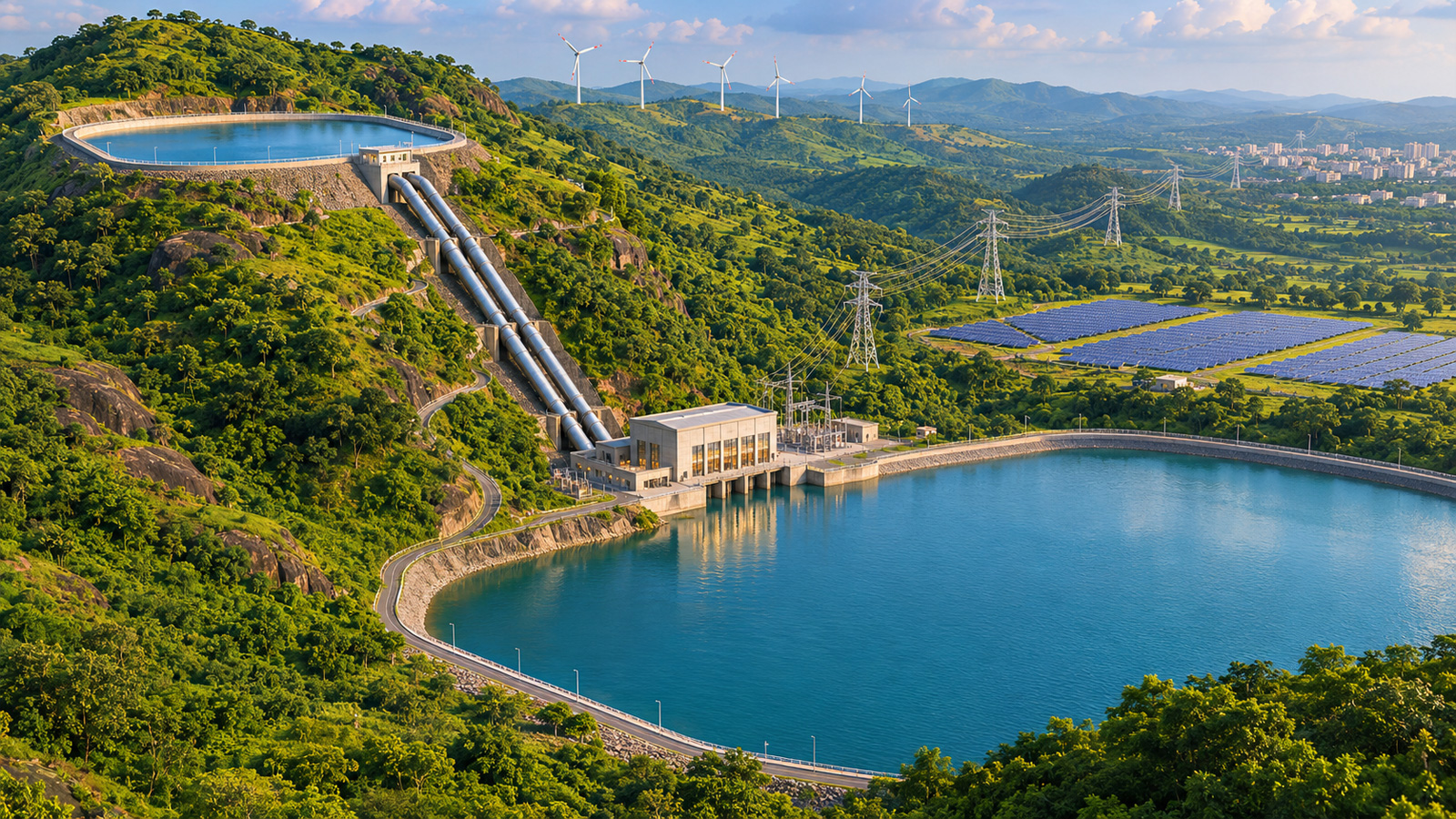
Pumped storage hydropower helps bridge this gap. Often described as a “water battery”, it uses water and gravity to store energy and supply electricity when required.
With India targeting 500 GW of non-fossil fuel electricity capacity by 2030, pumped storage is expected to play an increasingly important role in balancing supply and demand.
What is pumped storage hydropower?
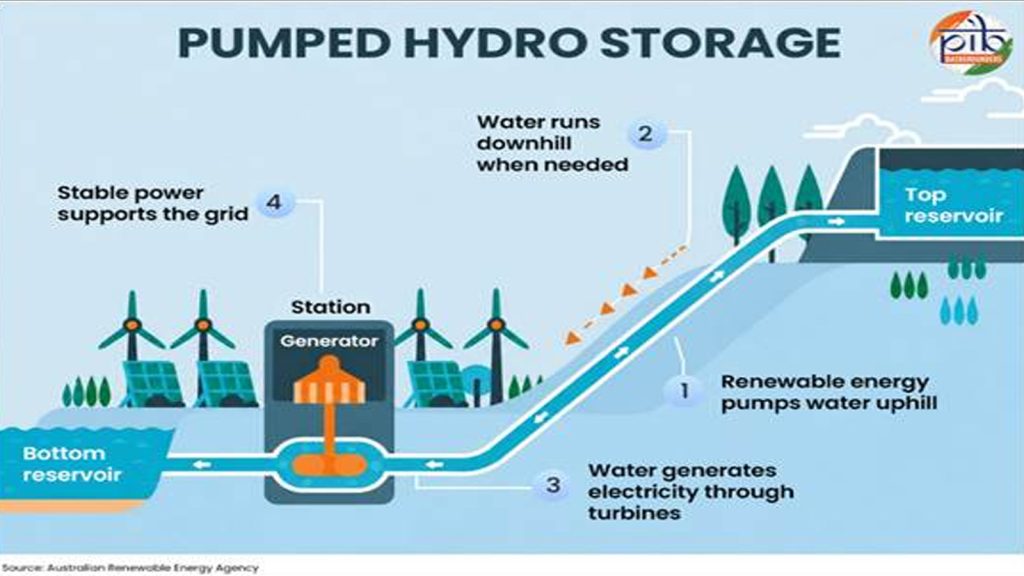
A Pumped Storage Project, or PSP, typically uses two reservoirs at different elevations.
When surplus electricity is available, it powers pumps that move water from the lower reservoir to the upper one. The water stored at a height holds potential energy.
When electricity demand rises, water is released downhill through turbines to generate power before collecting in the lower reservoir. It can subsequently be pumped uphill again, allowing the cycle to repeat.
The system therefore stores energy for later use, helping shift electricity from periods of surplus generation to periods of higher demand.
Why does India need it?
India had 308.027 GW of installed non-fossil fuel electricity generation capacity as of September 2026, after adding around 55.29 GW during 2025–26.
As solar and wind capacity grows, the electricity system needs greater flexibility to accommodate changes in generation. Storage allows surplus renewable electricity to be used later, including during periods of low generation or peak demand.
The Central Electricity Authority (CEA) projects a requirement of 73.93 GW of storage capacity by 2031–32, comprising 26.69 GW from pumped storage and 47.24 GW from Battery Energy Storage Systems (BESS).
Pumped storage can provide large-scale, long-duration storage and support the grid during periods of high demand.
How does pumped storage differ from battery storage?
Pumped storage and batteries offer complementary ways to manage renewable electricity.
Battery Energy Storage Systems can respond rapidly to short-duration requirements, including frequency regulation, peak management and grid balancing. They can also be installed relatively quickly near generation facilities or consumption centres.
Pumped storage requires suitable geographical conditions and reservoir infrastructure. It can shift large quantities of electricity over longer periods, while its long operating life supports sustained infrastructure needs.
The choice depends on the location, the duration of storage required and the services needed by the electricity system.
What are the different types of pumped storage projects (PSPs)?
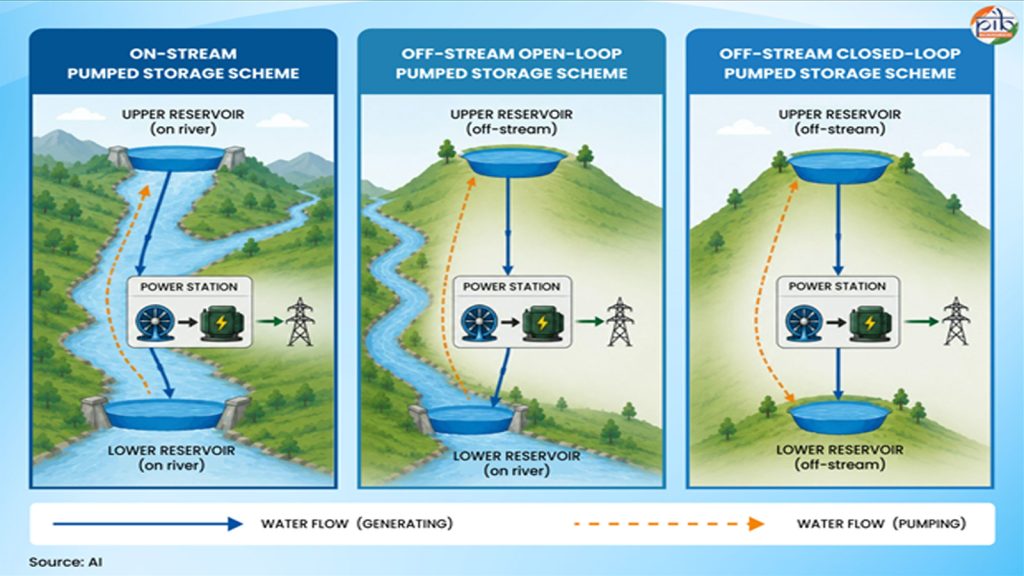
Pumped storage projects (PSPs) are classified according to the relationship between their reservoirs and natural watercourses.
In an on-stream project, both reservoirs are located on a river, stream or nallah. Water flows through turbines to generate electricity and is pumped back to the upper reservoir when surplus power is available.
An off-stream open-loop project has one reservoir on a natural watercourse, while the other is situated away from a river or perennial stream or nallah.
In an off-stream closed-loop project, neither reservoir is located on a river, perennial stream or perennial nallah. Water moves between reservoirs situated away from these perennial natural watercourses.
All three configurations depend on site-specific technical and geographical conditions. Efforts are being made to identify more off-stream sites to support faster development and minimise impacts on aquatic ecology and the surrounding environment.
How much pumped storage capacity does India have?
As of August 2026, India had approximately 7.43 GW of operational pumped storage capacity across 10 projects with installed capacity above 25 MW.
A further 15.87 GW across 11 projects was under construction or implementation. Another eight projects, totalling 10.40 GW, had been appraised or received concurrence from the Central Electricity Authority.
These projects form part of a larger pipeline intended to expand India’s long-duration storage capabilities.
Where is India’s pumped storage potential concentrated?
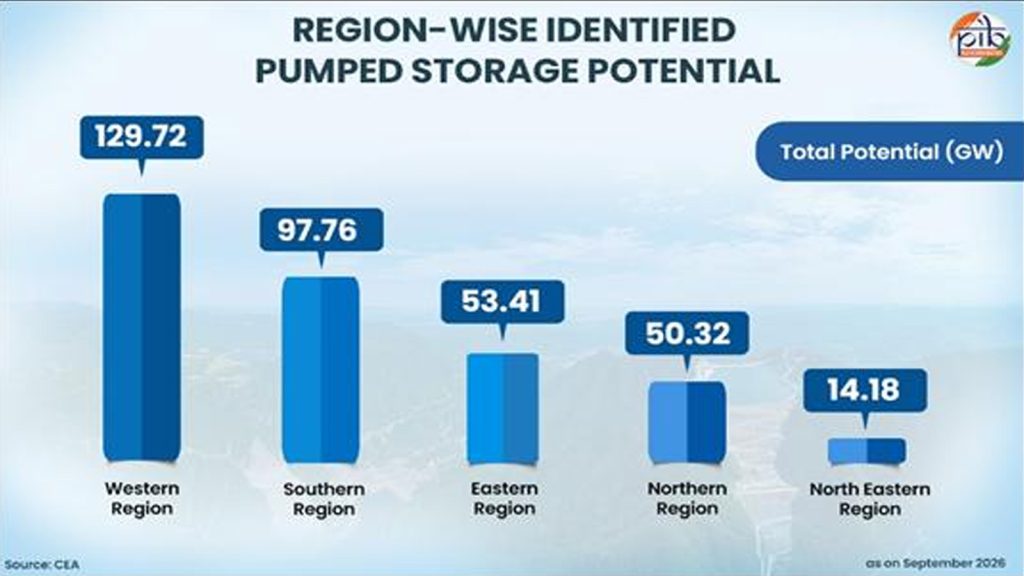
India has identified 320 pumped storage projects with a combined potential of 345.38 GW. This includes 62 on-stream projects accounting for 56.67 GW and 258 off-stream projects accounting for 288.71 GW. The assessment includes projects at different development stages, including those already operational.
The Western Region has the largest identified potential at 129.72 GW. The Central Electricity Authority attributes this largely to the topography and steep gradients of rivers originating in the Western Ghats. Maharashtra accounts for 67.36 GW and Gujarat for 33.36 GW.
The Southern Region has 97.76 GW of potential, led by Andhra Pradesh, Telangana and Tamil Nadu. The Eastern Region accounts for 53.41 GW, including 41.53 GW in Odisha.
The Northern Region has 50.32 GW, led by Uttar Pradesh and Himachal Pradesh, while the North Eastern Region contributes 14.18 GW.
Identified potential does not automatically translate into projects ready for construction. Each site requires assessment of its topography, geology, hydrology, reservoir characteristics, foundation conditions, seismicity, environmental implications and transmission connectivity.
How much capacity could be added over the next decade?
The Central Electricity Authority’s capacity addition pathway envisages commissioning 100.81 GW between 2025–26 and 2035–36, including projects already under construction. This would take cumulative pumped storage capacity to approximately 105.56 GW.
Under the projected pathway, cumulative capacity would reach around 31.80 GW by 2029–30, 52.99 GW by 2030–31 and 61.79 GW by 2031–32, before rising further over the following years.
These figures represent an envisaged development pathway, with delivery dependent on project preparation, approvals and construction.
What measures are supporting development?
The government has introduced policy, financial and regulatory measures to encourage pumped storage development.
The Ministry of Power issued dedicated development guidelines in April 2023. These were followed by tariff-based competitive bidding guidelines in February 2025 to provide a standardised framework for procuring storage capacity and stored electricity.
Budgetary support covers enabling infrastructure such as roads, bridges, railway sidings, ropeways, communication facilities and transmission lines.
Eligible projects awarded for construction by June 30, 2028, can receive a 100 per cent waiver of Inter-State Transmission System charges for 25 years from commercial operation.
Measures to accelerate project preparation include shorter timelines for Central Electricity Authority concurrence on Detailed Project Reports, differentiated environmental appraisal provisions and changes facilitating surveys and investigations.
An August 2025 notification also revised the capital expenditure threshold governing CEA concurrence for hydroelectric schemes to Rs 3,000 crore. Off-stream closed-loop pumped storage schemes were exempted from this concurrence requirement irrespective of capital expenditure.
The CEA’s Jal Vidyut DPR portal supports monitoring of survey and investigation work and coordination among stakeholders.
Where does India stand globally?
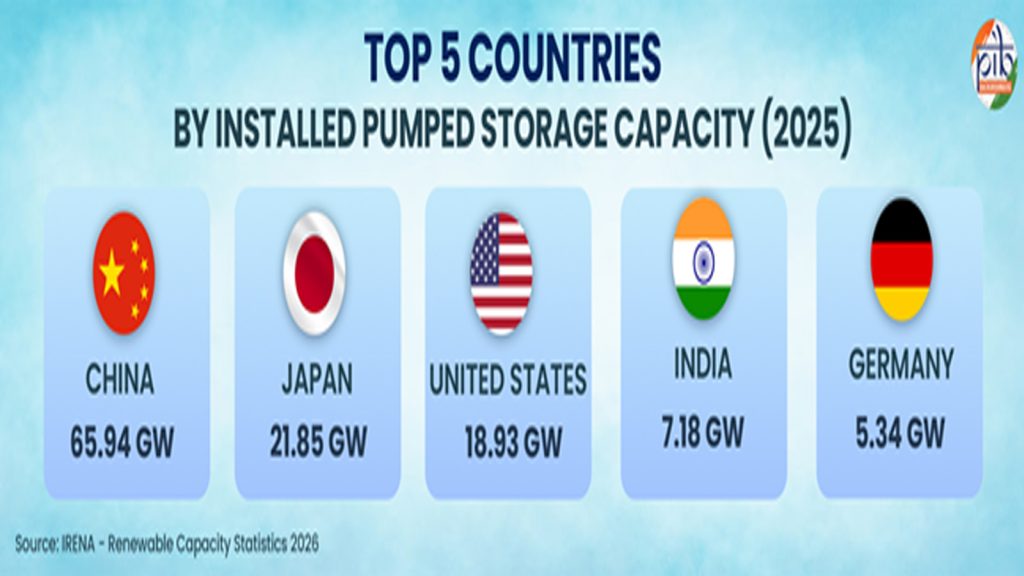
According to the International Renewable Energy Agency (IRENA), global installed pumped storage capacity stood at 159.8 GW at the end of 2025.
China accounted for nearly 66 GW, followed by Japan with around 22 GW and the United States with approximately 19 GW. India ranked fourth with 7.18 GW at the end of 2025, before its capacity increased to about 7.43 GW in 2026.
What will determine its role in India’s energy future?
Pumped storage can help India use renewable electricity more effectively, meet peak demand and improve grid flexibility. Its contribution will depend on developing suitable sites and coordinating storage with new generation and transmission infrastructure.
As solar and wind become larger parts of the electricity mix, the ability to move energy from the time it is generated to the time it is needed will become essential. Pumped storage offers one established way to provide that flexibility at scale.
(PIB)


