






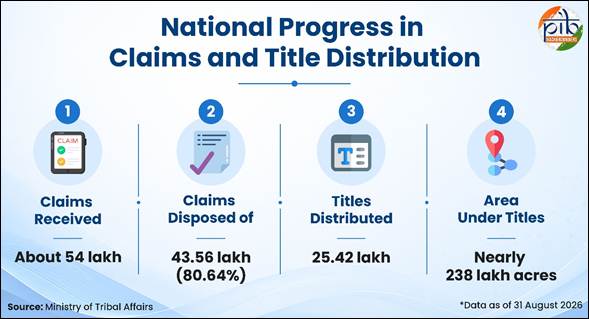
The Forest Rights Act, 2006, provides legal recognition to the land and community forest rights of Scheduled Tribes and other traditional forest dwellers. With 25.42 lakh titles distributed across nearly 238 lakh acres, the focus is now on strengthening implementation, linking beneficiaries to livelihood schemes and digitising the claims process.
What is the Forest Rights Act?
For generations, forest-dwelling communities have lived in forests and depended on them for their homes, food and livelihoods. However, many of their traditional rights over forest land remained unrecorded when forests were consolidated under government control during the colonial period and after Independence.
The Scheduled Tribes and Other Traditional Forest Dwellers (Recognition of Forest Rights) Act, 2006, commonly known as the Forest Rights Act (FRA), seeks to address this historical gap. It recognises and vests legal rights over forest land in forest-dwelling Scheduled Tribes (FDSTs) and other traditional forest dwellers (OTFDs).
The Act received the President’s assent on December 29, 2006, and came into force on December 31, 2007. The Forest Rights Rules were notified on January 1, 2008.
The legislation has three broad objectives: recognising forest rights that were not recorded earlier; providing secure land tenure, livelihood and food security to eligible communities; and strengthening forest conservation by giving rights holders the responsibility and authority to use forests sustainably, conserve biodiversity and maintain ecological balance.
The Ministry of Tribal Affairs is the nodal ministry for implementing the Act, while State Governments and Union Territory Administrations are responsible for its implementation. The Act is being implemented in 20 States and the Union Territory of Jammu and Kashmir.
Who is eligible to claim forest rights?
The Act covers two categories of communities:
* Forest-dwelling Scheduled Tribes: Members of Scheduled Tribes who primarily reside in forests or forest land and depend on them for their bona fide livelihood needs.
* Other traditional forest dwellers: Individuals or communities who have primarily resided in and depended on forests for at least three generations, equivalent to 75 years, before December 13, 2005.
The rights apply to forest land occupied before December 13, 2005. For land used for a home or cultivation, an individual claim is limited to the area actually occupied, subject to a maximum of four hectares.
The Act covers all categories of forest land, including reserved and protected forests, wildlife sanctuaries and national parks. It also provides that eligible forest dwellers cannot be evicted or removed from the land they occupy until the process of recognising and verifying their rights is complete.
The Central Government may also provide for the diversion of small areas of forest land, each measuring less than one hectare, for specified government facilities, subject to a recommendation from the Gram Sabha. These facilities include schools, hospitals, anganwadis, fair price shops, drinking water facilities, minor irrigation canals, roads and community centres.
What is a Forest Rights Title?
A Forest Rights Title is the official document recording a recognised forest right. It identifies the person or community holding the right, the village concerned, the land or forest area covered and its boundaries.
For individual titles, the document is issued in the names of the eligible holders. In the case of a married couple, the title is issued jointly in both names. For a single-headed household, it is registered in the name of the single head of the household.
A title is signed on behalf of the State Government by three district-level officers: the Divisional Forest Officer, the District Tribal Welfare Officer and the District Collector. The individual rights holder receives a certified copy, while a community title is issued to the Gram Sabha.
Forest rights titles are heritable but cannot be sold or transferred. They provide legal recognition of the rights recorded in them.
What kinds of rights does the Act recognise?
The Act provides for three broad categories of titles, covering individual land rights, community use rights and community forest management rights.
1. Individual Forest Rights
These cover forest land occupied by an eligible individual or family for habitation or self-cultivation, subject to the maximum limit of four hectares. The title records the recognised land rights of the household.
2. Community Forest Rights
These recognise the customary rights of a village community over resources it uses collectively. Such rights may include grazing areas, fishing grounds, water bodies and access to minor forest produce. The community holds the title, and any conditions attached to the recognised rights are recorded in it.
3. Community Forest Resource Rights
These give the Gram Sabha or the community the right to protect, regenerate, conserve and manage forests within its customary boundaries. These are areas that the village has traditionally accessed and used.
The Act also recognises the rights of forest dwellers over minor forest produce that they have traditionally collected. These include bamboo, honey, lac, tendu leaves and medicinal plants. Rights holders can collect, use and dispose of such produce.
Special provisions for Particularly Vulnerable Tribal Groups
Particularly Vulnerable Tribal Groups (PVTGs) are entitled to habitat rights over the areas they have traditionally inhabited and used. These rights may cover customary habitats located in reserved and protected forests.
The Ministry of Tribal Affairs issued guidelines on habitat rights on January 5, 2026. According to the latest information provided by the Ministry, habitat rights have been granted to 11 PVTGs in three States: Odisha, Chhattisgarh and Madhya Pradesh.
How are forest rights claims processed?
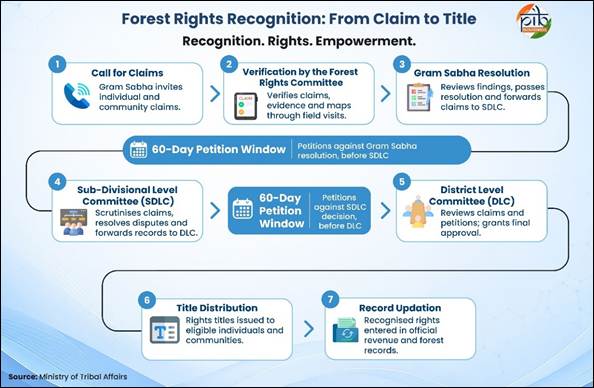
The Gram Sabha, comprising all adult members of a village, is the starting point of the claims process. The Act provides for the full and unrestricted participation of women in its proceedings.
The Gram Sabha elects a Forest Rights Committee consisting of 10 to 15 members to assist in receiving and verifying claims. At least two-thirds of the committee members must belong to Scheduled Tribes, while at least one-third must be women.
The claims process follows three principal stages:
Stage 1: Gram Sabha verification
The Gram Sabha receives claims, verifies the supporting information, maps the land and passes a resolution on the claims. The resolution is then forwarded to the Sub-Divisional Level Committee (SDLC).
Stage 2: Sub-Divisional Level Committee scrutiny
The SDLC examines the Gram Sabha’s resolution and prepares the record of forest rights, which lists the rights proposed for recognition. It then forwards the record to the District Level Committee (DLC).
Stage 3: District Level Committee decision
The DLC examines the case and takes the final decision. Its decision is final and binding under the Act.
The SDLC and DLC include officers from the State’s Revenue, Forest and Tribal Affairs departments, along with three members of Panchayati Raj Institutions. Of the three elected representatives, two must be Scheduled Tribe members and at least one must be a woman.
The Act also provides an appeal mechanism. Anyone disagreeing with a Gram Sabha resolution or an SDLC decision can approach the next committee within 60 days. The committee may allow an additional period of up to 30 days under the Forest Rights Rules.
The Ministry has emphasised that every rejection must be accompanied by a reasoned order communicated to the claimant. This ensures that applicants are informed of the grounds for rejection and can exercise their right to appeal.
Once titles are issued, the recognised rights must be entered in the relevant revenue and forest records. The Forest Rights Rules have required this since 2008, while a 2012 amendment prescribed a time limit of three months for completing the process.
At the State level, a State Level Monitoring Committee, chaired by the Chief Secretary, oversees implementation and is required to meet at least once every three months.
How much progress has been made?
As on August 31, 2026, approximately 54 lakh claims had been received under the Act, of which 43.56 lakh, or 80.64 per cent, had been disposed of. A total of 25.42 lakh titles had been distributed, covering nearly 238 lakh acres.
Of the titles distributed, 24.18 lakh were individual titles and 1.24 lakh were community titles across the 20 States and one Union Territory implementing the Act.
Chhattisgarh recorded the highest number of titles, with 5,34,068, comprising 4,81,432 individual and 52,636 community titles. It was followed by Odisha, which distributed 4,73,936 titles, including 4,64,504 individual and 9,432 community titles.
Madhya Pradesh distributed 2,89,461 titles, comprising 2,60,707 individual and 28,754 community titles. Telangana recorded 2,31,456 titles, including 2,30,735 individual and 721 community titles. Andhra Pradesh distributed 2,28,489 titles, comprising 2,26,667 individual and 1,822 community titles.
Why is entering titles in revenue records important?
Issuing a Forest Rights Title is an important step, but recording the recognised rights in revenue and forest records is equally significant.
The entry establishes an official record of the rights holder and the land concerned. It can also help eligible beneficiaries access government schemes and institutional support.
The Ministry has highlighted that recording titles in revenue records makes it easier for forest rights holders to benefit from PM-KISAN and other agriculture, fisheries and livelihood schemes.
A key milestone in this direction came on February 11, 2019, when a direction was issued to extend PM-KISAN benefits to Forest Rights Patta holders.
State-level initiatives are also helping connect forest rights records with other administrative systems.
In Maharashtra, a Government Resolution dated July 10, 2026, introduced separate village forms—7E for entering individual forest rights in revenue records and 12E for the crop register. These records can help beneficiaries access crop loans, Kisan Credit Cards, crop insurance and Direct Benefit Transfer.
Andhra Pradesh has linked its Giribhumi FRA portal with the State’s revenue and banking systems, while Telangana’s online title system is integrated with the BhuBharathi revenue portal.
These measures aim to make recognised forest rights more useful in accessing agricultural credit, insurance and welfare benefits.
National FRA Digital Platform: Moving the claims process online
To improve transparency, coordination and efficiency, the Ministry of Tribal Affairs has taken steps to digitise the implementation of the Act.
During Janjatiya Gaurav Pakhwada, observed from November 1 to 15, 2026, the Ministry launched the National FRA Digital Platform. The platform aims to bring the entire claims process onto a single digital system, from submission of claims before the Gram Sabha to the issuance of digitally signed titles.
The Ministry has also demonstrated a national FRA Portal and a mobile application to support digitisation and mapping of forest rights records. States have been encouraged to link their records with the national platform.
The digital initiative is expected to help streamline the processing of claims, improve access to information and strengthen monitoring of implementation.
The Ministry also receives monthly progress reports from States and Union Territories covering claims, titles and rejections. District Collectors and District Magistrates have been advised to ensure timely disposal of pending claims. Regular review meetings are held with State Tribal Welfare Departments, while grievances received by the Ministry are forwarded to the concerned States and Union Territories for necessary action.
How is the government supporting States?
The Ministry is providing financial and institutional support to State Governments through the Dharti Aaba Janjatiya Gram Utkarsh Abhiyan (DA-JGUA), launched on October 2, 2024, to address infrastructure gaps in tribal villages.
Under the programme, the Ministry funds dedicated FRA cells at State and district levels for two years. These cells assist in settling pending claims and help ensure that SDLC and DLC meetings are held on time.
Support is also provided for State FRA portals, including digital mapping of land records, servers, software and security audits. Under the Support to Tribal Research Institutes scheme, the Ministry provides ₹25 lakh per State for mapping potential forest areas.
The programme also supports Community Forest Resource Management Plans prepared by Gram Sabhas. The Ministry provides ₹15 lakh for each plan and an additional ₹1 lakh for technical support.
A joint communication issued by the Ministries of Tribal Affairs and Environment, Forest and Climate Change on July 27, 2026, allows these community management plans to be aligned with the Forest Department’s Working Plans. The arrangement is intended to improve coordination while retaining the Gram Sabha’s central authority in community forest resource management.
In addition, free courses on the Forest Rights Act are available on the iGOT platform under Mission Karmayogi. States are also organising legal literacy camps to spread awareness about forest rights and the claims process.
Key policy milestones
The implementation framework of the Forest Rights Act has evolved through successive rules, guidelines and advisories.
The Act received Presidential assent on December 29, 2006, and came into force on December 31, 2007. The Forest Rights Rules were notified on January 1, 2008. Comprehensive implementation guidelines followed on July 12, 2012, while guidelines on Community Forest Resource rights were issued on April 23, 2015.
A direction to extend PM-KISAN to Forest Rights Patta holders was issued on February 11, 2019. Guidelines for the conservation, management and sustainable use of Community Forest Resources followed on September 12, 2023.
The Dharti Aaba Janjatiya Gram Utkarsh Abhiyan was launched on October 2, 2024, with support for dedicated FRA cells at State and district levels. In 2026, the Ministry issued guidelines on habitat rights for PVTGs on January 5 and an advisory on June 24 to expedite the incorporation of forest rights records into revenue and forest records.
The Ministries of Tribal Affairs and Environment, Forest and Climate Change also jointly issued advisories on July 6, 2021, March 14, 2024, and July 27, 2026, to accelerate implementation, address issues arising after claims are processed and facilitate convergence of funds.
More recently, the Ministry held three Regional Review Conferences in Bengaluru, Kolkata and Srinagar during September and October 2026. These conferences brought together 19 States and the Union Territory of Jammu and Kashmir to review progress and call for time-bound action plans.
What lies ahead?
The Forest Rights Act, 2006, is not limited to recognising rights over forest land. It also provides a framework for securing livelihoods, protecting traditional access to forest resources and involving local communities in sustainable forest management.
The distribution of 25.42 lakh titles covering nearly 238 lakh acres marks significant progress. However, effective implementation also depends on timely disposal of pending claims, accurate entry of titles in revenue and forest records, and stronger access to government livelihood and welfare schemes.
The National FRA Digital Platform is expected to strengthen this process by bringing claim submission, verification and title issuance onto a common digital system. Alongside this, support for Gram Sabhas and Community Forest Resource Management Plans will be important in ensuring that communities can exercise their recognised rights and responsibilities.
The broader objective is to combine legal recognition with economic security and sustainable conservation, enabling forest-dwelling communities to protect the forests on which their lives and livelihoods depend.
(PIB)


