





India’s response to the COVID-19 pandemic was shaped by a series of timely decisions, clear responsibilities and continuous adjustments as the public health situation evolved. From airport screening and inter-ministerial coordination before the first reported case to emergency healthcare measures, oxygen allocation and a nationwide vaccination campaign, the Government’s approach combined central direction with implementation by States and local authorities.
The response, which extended from January 2020 to May 2023, involved government institutions, healthcare workers, laboratories, private hospitals, industry and civil society. Its central features were early risk assessment, legal and administrative coordination, evidence-based decisions, mobilisation of resources and sustained public health action.
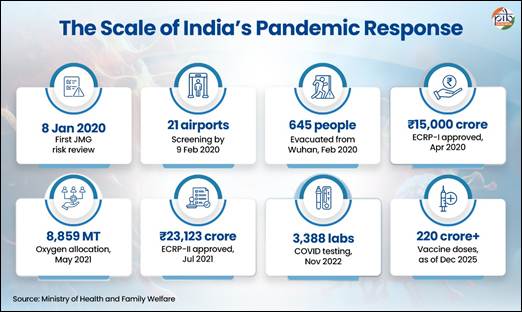
As of 31 December 2025, 97 per cent of the population aged 12 years and above had received at least one dose of a COVID-19 vaccine, while 90 per cent was fully vaccinated. A total of 22.89 crore precaution doses had also been administered across the country.
The challenge: Responding to an unfamiliar virus
The World Health Organization (WHO) was notified on 31 December 2019 about pneumonia cases of unknown cause in Wuhan, China. With no vaccine, established treatment or comprehensive understanding of the virus available at the time, countries faced the challenge of preparing for a rapidly evolving health emergency.
For India, the immediate concern was the possibility of imported infections through international travel. The Government began assessing risks, strengthening surveillance and coordinating with different ministries even before the country’s first reported case.
India’s first COVID-19 case was reported in Thrissur, Kerala, on 30 January 2020. By then, airport screening, monitoring arrangements and initial preparedness measures were already underway.
The response subsequently moved through five broad phases: preparation, containment, phased reopening, vaccination and surge management, followed by sustained health-system preparedness and adaptation.
Early preparedness: Acting before the first case
India’s initial response focused on anticipating the threat and creating mechanisms to identify and manage suspected infections.
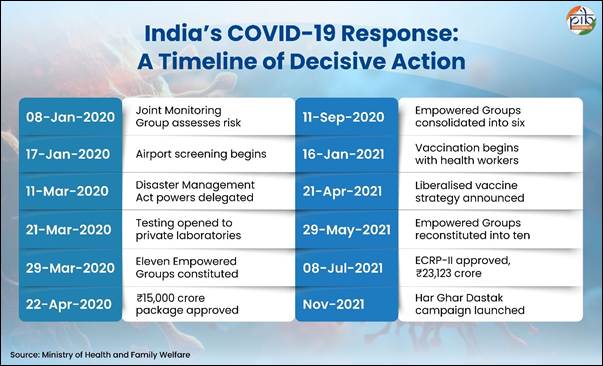
The Joint Monitoring Group (JMG), a standing technical forum comprising health officials and experts and chaired by the Director General of Health Services, met on 8 January 2020 to assess the emerging risk and review preparedness.
International passenger screening began on 17 January and was extended to 21 airports within a week. On 25 January, seven multidisciplinary Central teams were deputed to review airport screening arrangements and assess the end-to-end management of suspected cases referred to designated hospitals.
The Health Ministry also wrote to four other ministries, while the Cabinet Secretariat convened inter-ministerial meetings to coordinate preparations. A national operations centre, managed by the National Centre for Disease Control (NCDC), was activated on 8 February 2020.
In February, the Government evacuated 645 people from Wuhan and placed them in quarantine at two centres.
These measures reflected an approach based on early risk assessment, surveillance and coordination rather than waiting for infections to spread before building response mechanisms.
Clear mandates: Establishing legal and administrative authority
As the outbreak intensified, India strengthened the legal and administrative framework for managing the emergency.
On 11 March 2020, powers under the Disaster Management Act, 2005, were delegated to the Union Health Secretary. Two days later, States were advised to invoke the Disaster Management Act and the Epidemic Diseases Act, 1897, wherever necessary.
On 29 March 2020, the Government constituted 11 Empowered Groups, each assigned a specific area of responsibility. Their mandates covered the medical response, testing, supply chains, communication, public grievances and other essential aspects of pandemic management.
The arrangement was intended to ensure that different parts of the response had clearly defined leadership and responsibilities. Senior officials, including the Union Home Secretary and the Secretary of the Ministry of Electronics and Information Technology, led groups dealing with their respective areas.
The Government also issued operational plans to guide implementation. The Cluster Containment Plan, released on 2 March, outlined measures for case identification, contact tracing and containment of affected areas. On 4 April, a plan for managing large outbreaks, accompanied by a checklist of district-level actions, was shared with States.
On 28 April, the Union Health Secretary wrote to all Chief Secretaries, asking them to ensure the continuation of essential medical services.
The Group of Ministers overseeing the response reviewed progress, with its 14th meeting on 5 May 2020 hearing presentations from several Empowered Groups.
What were the Empowered Groups?
The 11 Empowered Groups were specialised coordination mechanisms established on 29 March 2020 to manage different aspects of the national response. Their structure was subsequently modified to reflect changing requirements. They were consolidated into six groups in September 2020 and reconstituted into ten on 29 May 2021, with separate groups focusing on critical areas such as oxygen, vaccination and testing.
Adaptability: Reshaping the response as needs changed
The pandemic required the Government to continuously review its institutional arrangements and operational priorities.
The initial 11 Empowered Groups were consolidated into six in September 2020. As the situation changed and new challenges emerged, the groups were reconstituted into ten on 29 May 2021. The revised arrangement included separate groups for oxygen, vaccination and testing, reflecting the growing importance of these areas during the second wave.
Containment measures also became increasingly localised. Districts were classified into red, orange and green zones to guide the intensity of restrictions and local response plans. States were asked to strengthen contingency arrangements to manage outbreaks in their respective areas.
A review conducted by the Principal Secretary to the Prime Minister in September 2020 identified the need to pursue a phased reopening, or unlocking, while maintaining appropriate precautions.
This approach allowed the administrative structure and containment strategy to evolve alongside the pandemic rather than relying on a fixed response plan.
Evidence-based decisions: Using data, technology and genomics
Scientific evidence and surveillance data played an important role in determining the pace of reopening and identifying emerging threats.
India conducted its first national serosurvey in May and June 2020. It estimated that approximately 0.73 per cent of the population had been infected, indicating that a large proportion of people remained susceptible to the virus.
The findings informed the decision to reopen economic and public activities in stages. Workplace guidelines were issued in May, followed by specific procedures in June for offices, places of worship, hotels, restaurants and shopping malls.
By the fourth round of the national serosurvey, 67.6 per cent of the population had antibodies against the virus.
What is a serosurvey?
A serosurvey examines blood samples collected from a cross-section of the population to identify antibodies against a particular infection. It helps estimate the proportion of people who have previously been infected and provides information on the spread of a disease beyond confirmed cases.
Technology and genomic surveillance further strengthened the response. By 4 May 2020, close to nine crore people had downloaded the Aarogya Setu app, which supported contact tracing and public health communication.
Genome sequencing of virus samples collected from patients across the country had also begun. In December 2020, the Indian SARS-CoV-2 Consortium on Genomics (INSACOG) was established as a national network for genomic surveillance.
In March 2021, the National Institute of Virology reported the spread of the Delta variant in Maharashtra. Genomic surveillance helped public health authorities monitor changes in the virus and understand the emergence and spread of variants.
Mobilising resources: Bringing public and private institutions together
India’s response relied on expanding testing, strengthening domestic manufacturing and involving private healthcare providers.
Private laboratories were permitted to conduct COVID-19 testing on 21 March 2020. By 24 March, 118 laboratories had the capacity to test 12,000 samples daily.
The Government also worked to build domestic production capacity for essential protective equipment. Production of personal protective equipment (PPE) coveralls, which was nil on 1 March, increased to approximately 4.5 lakh units per day by May 2020.
Public-sector company HLL Lifecare was designated as the single procurement agency. Evaluated bids were shared daily with the relevant Empowered Group to support procurement decisions.
States were advised to expand hospital bed capacity in partnership with private hospitals, using the rates under the Pradhan Mantri Jan Arogya Yojana (PMJAY) and Central Government Health Scheme (CGHS) as references.
Quality control remained an important part of procurement. The Group of Ministers emphasised random batch sampling of PPEs, masks and ventilators to ensure that supplies met required standards.
The Empowered Groups also briefed the Prime Minister on partnerships with private-sector organisations, non-governmental organisations and international institutions. In April 2021, the Prime Minister asked officials to explore the use of civil society volunteers for non-specialised tasks, helping healthcare personnel focus on essential medical responsibilities.
Leadership and coordination: Connecting the Centre, States and districts
The scale of the pandemic required continuous coordination between national leadership and the authorities responsible for implementation on the ground.
Reviews chaired by the Prime Minister, Cabinet Secretary and Union Health Minister brought together Central ministries and State Governments. These meetings examined developments, identified implementation gaps and considered measures required in affected areas.
Multidisciplinary Central teams were sent to States during 2020 and 2021 to review preparedness and containment measures. Senior Ministry officials were also oriented to serve as State nodal officers through a national training-of-trainers programme.
Communication with States and Union Territories took place through official letters, website advisories and video conferences. Airport health officers were also included in coordination arrangements.
Between 20 March and 11 May 2020, the Prime Minister held five virtual meetings with all Chief Ministers to review the situation and discuss the response.
In June 2020, he directed States and Union Territories to undertake city-wise and district-wise planning for hospital beds. The review also acknowledged the work of States, districts and cities that had made significant efforts to contain the outbreak.
On 27 April 2021, as the second wave intensified, the Prime Minister stressed the need for proper implementation of COVID-19 strategies by agencies in the States.
The administrative structure connected decision-making at the national level with implementation at different levels. Periodic reviews by the Prime Minister’s Office provided overall direction, the Group of Ministers reviewed major response areas, Empowered Groups coordinated specialised functions, States implemented measures within their jurisdictions, and districts translated containment plans into local action.
Decisive action during the second wave: Managing oxygen and expanding vaccination
The second wave in 2021 placed extraordinary pressure on India’s healthcare system, particularly on the availability of medical oxygen.
On 15 April 2021, an Empowered Group met to review the oxygen situation in 12 States. It mapped available supplies in consultation with industry, regulators and manufacturers and allocated defined quantities to States for the following days.
Communicated oxygen allocations increased from 4,880 tonnes on 20 April to 6,593 tonnes on 30 April. States were also advised to establish oxygen plants at hospitals, particularly in remote areas, to strengthen local availability.
The Government simultaneously took steps to expand vaccine production and coverage. The vaccination preparedness process had begun much earlier, with the constitution of a task force in April 2020 and a dry run in December 2020.
Vaccination started on 16 January 2021, initially covering healthcare workers. The programme was subsequently expanded in phases. On 21 April 2021, the Government announced a liberalised vaccination strategy that permitted flexible pricing and procurement to encourage manufacturers to increase production.
From 1 May 2021, all adults became eligible for vaccination.
On 27 April, Empowered Groups dealing with oxygen, medical infrastructure and communication briefed the Prime Minister directly on the evolving situation.
The decisions on oxygen supply and vaccination reflected the need to act quickly under pressure while coordinating production, allocation and delivery across the country.
Sustaining the response: Strengthening healthcare infrastructure and vaccination
The Government continued to invest in healthcare preparedness even as the vaccination campaign expanded and the immediate pressure of the second wave began to ease.
On 8 July 2021, the Cabinet approved Phase II of the India COVID-19 Emergency Response and Health System Preparedness Package (ECRP-II), with an outlay of ₹23,123 crore.
Implemented through the National Health Mission, the package focused on strengthening healthcare capacity at district and sub-district levels. It provided for support to central hospitals, establishment of war rooms and IT systems, genome sequencing, surveillance at 28 points of entry and central procurement of essential supplies.
Reported outcomes included the establishment of 663 new laboratories, 697 liquid oxygen tanks, 63 field hospitals and 200 telemedicine hubs.
India crossed one billion COVID-19 vaccine doses on 21 October 2021. On 27 October, the Union Health Minister asked State and Union Territory Health Ministers to begin house-to-house vaccination to reach eligible beneficiaries.
The nationwide campaign, Har Ghar Dastak, was launched on 3 November 2021. It aimed to increase awareness, mobilise communities and vaccinate eligible people who had not received their first dose, as well as those due for their second dose. Health workers conducted house-to-house visits across States and Union Territories.
The vaccination programme was further expanded to adolescents aged 15 to 18 years from 3 January 2022 and children aged 12 to 14 years in March 2022. Precaution doses were also introduced for eligible beneficiaries. A 75-day free precaution-dose campaign began in July 2022.
In June 2022, a Revised Surveillance Strategy placed emphasis on early detection, tracking of variants and genomic surveillance. Guidelines covering vaccination, home isolation, international arrivals and surveillance were periodically revised from December 2021 to reflect the evolving situation.
India’s frontline health workers also received international recognition. In May 2022, more than 10 lakh Accredited Social Health Activists (ASHAs) were honoured with the WHO Director-General’s Global Health Leaders Award.
On 5 May 2023, the WHO withdrew the Public Health Emergency of International Concern status for COVID-19, which had been declared on 30 January 2020.
India’s vaccination progress
The vaccination campaign became one of the largest components of the country’s pandemic response, expanding from healthcare workers to adults, adolescents and other eligible groups.
As of 31 December 2025:
* 97 per cent of the population aged 12 years and above had received at least one dose of a COVID-19 vaccine.
* 90 per cent of this population was fully vaccinated.
* 22.89 crore precaution doses had been administered across the country.
These figures reflect the scale and continuity of the vaccination programme beyond the initial emergency phase.
India’s five phases of COVID-19 response
India’s pandemic response can be understood through five broad phases, each reflecting a shift in priorities as the situation developed.
Phase 1: Prepare (January–February 2020)
The Government began risk assessment through the Joint Monitoring Group on 8 January, introduced airport screening from 17 January and reported its first case on 30 January. The evacuation of 645 people from Wuhan and their quarantine formed part of the initial preparedness effort.
Phase 2: Contain (March–April 2020)
The Cluster Containment Plan was issued on 2 March, private laboratories were permitted to conduct testing from 21 March, and the nationwide lockdown began on 25 March. Eleven Empowered Groups were constituted on 29 March to coordinate the response.
Phase 3: Reopen and prepare (May–December 2020)
The first national serosurvey estimated that around 0.73 per cent of the population had been infected. Reopening proceeded in stages, while the Empowered Groups were consolidated into six. Genomic surveillance was strengthened, and preparations for vaccination advanced.
Phase 4: Vaccinate and manage the surge (January–June 2021)
Vaccination began on 16 January 2021. During the second wave, daily cases crossed four lakh, prompting intensified oxygen allocation and healthcare coordination. From 1 May, all adults became eligible for vaccination.
Phase 5: Build and adapt (July 2021–May 2023)
The Government approved ECRP-II with an outlay of ₹23,123 crore, India crossed one billion vaccine doses, and the Har Ghar Dastak campaign expanded vaccination coverage. Surveillance and healthcare preparedness continued until the WHO withdrew the emergency status on 5 May 2023.
The leadership model behind the response
India’s COVID-19 response demonstrated how a large-scale emergency can be managed through a structured chain of leadership and implementation.
At the apex, periodic reviews by the Prime Minister’s Office provided overall direction, with Empowered Groups reporting on progress. The Group of Ministers, chaired by the Union Health Minister, reviewed issues relating to containment, supplies, technology and relief. Empowered Groups, led by senior officials, coordinated specialised areas of work.
States translated national directions into regional strategies, while district administrations implemented containment measures and managed local healthcare requirements. Red, orange and green zoning helped guide district-level plans. As of 5 May 2020, 130 districts were classified as red zones, 284 as orange zones and 319 as green zones.
This multi-level arrangement linked national policy decisions with State-level coordination and district-level execution.
The takeaway: Leadership as a continuous mission
India’s COVID-19 response was not shaped by a single decision or institution. It emerged from a sequence of decisions that evolved with the pandemic.
The Government began preparations before the first reported case, established clear administrative responsibilities, used scientific evidence to guide reopening and surveillance, and brought public and private institutions into the response. As the crisis changed, the coordination structure was reorganised, healthcare capacity was expanded and difficult decisions were taken on oxygen allocation and vaccine availability.
The experience underlines several important lessons in crisis leadership: anticipate risks early, assign clear responsibilities, empower institutions, coordinate across levels of government, rely on evidence and review decisions continuously.
Most importantly, a national emergency requires leadership that combines a clear sense of purpose with the ability to adapt. India’s COVID-19 response illustrates how sustained coordination, institutional flexibility and collective participation can turn that purpose into action.
(PIB)


