





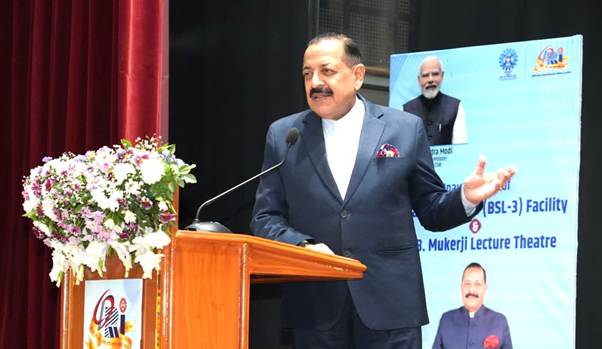
Union Minister of State (Independent Charge) for Science and Technology Dr. Jitendra Singh has said that India is moving towards becoming a global hub for innovative drug discovery and development, calling for a shift from generic medicine manufacturing to the discovery and development of new therapeutics.
The Minister made the remarks while inaugurating a state-of-the-art Biosafety Level-3 (BSL-3)/Animal Biosafety Level-3 (ABSL-3) facility and the Dr. B. Mukerji Lecture Theatre at the CSIR-Central Drug Research Institute (CDRI) in Lucknow on Friday.
He said indigenous research, clinical development and stronger partnerships with the pharmaceutical industry would be essential for strengthening India’s position in the global pharmaceutical sector and achieving the vision of Viksit Bharat 2047.
New facility to strengthen infectious disease research
The newly inaugurated BSL-3/ABSL-3 facility will provide high-containment research infrastructure for studies involving Mycobacterium tuberculosis and non-tuberculous mycobacteria (NTM). It is expected to strengthen the institute’s research capabilities in addressing challenging infectious diseases.
The Minister also welcomed collaborative agreements signed by CSIR-CDRI with the ICMR-National Institute of Research in Tribal Health, Uttar Pradesh University of Medical Sciences and Medanta Hospital, Lucknow. He said these partnerships could support collaborative research, accelerate clinical translation and help deliver scientific outcomes for public benefit.
CDRI’s contribution to drug discovery
Highlighting the institute’s achievements, Dr. Singh said CSIR-CDRI has developed 13 drugs that have reached the market, licensed more than 80 process technologies and six diagnostic technologies, published over 12,000 research articles and filed more than 1,000 patents in India and internationally.
The institute has a research infrastructure comprising a compound library of around 90,000 molecules, more than 50 animal models and over 30 in-vitro screening systems, besides advanced analytical and safety assessment facilities.
The Minister cited Centchroman, also known as Ormeloxifene, as an example of indigenous research translated into a public health intervention. Developed by CDRI as a non-steroidal, once-a-week oral contraceptive, it was included in the National Family Planning Programme in 2016.
According to the figures shared at the event, more than 350 lakh strips have been distributed free of cost to women through ASHA workers over the last five years, while the current user base exceeds five lakh women.
Drug development pipeline and industry partnerships
Dr. Singh also highlighted the institute’s ongoing drug development research. A standardised extract of Picrorhiza kurroa for metabolic dysfunction-associated steatotic liver disease (MASLD) has completed Phase III clinical trials.
Two other CDRI-discovered compounds — L-Ormeloxifene for contraception and S007-1500 for fracture healing — have entered Phase I clinical trials. The institute is also pursuing research leads in malaria, cancer, neuropathic pain and age-related macular degeneration, along with phytopharmaceutical candidates for cancer and Parkinson’s disease.
The Minister said India ranks third globally in pharmaceutical production by volume and 11th by value, and supplies more than half of Africa’s generic medicine requirements and around 40 per cent of generic drug demand in the United States.
He called for stronger collaboration between research institutions and pharmaceutical companies to take promising discoveries from laboratory research to clinical evaluation and commercialisation.
Referring to CDRI’s partnerships with companies including Zydus, Cipla, Dr. Reddy’s Laboratories, Himalaya and Themis Medicare, he encouraged the institute to further strengthen its role as a research and innovation partner for the pharmaceutical industry.
AI and interdisciplinary research to accelerate innovation
The Minister emphasised the role of emerging technologies, particularly artificial intelligence, in transforming drug discovery. He called for greater integration of biology, chemistry and computational sciences, along with closer collaboration among scientists, clinicians, hospitals and industry.
He said research should remain aligned with clinical requirements, with patients as the ultimate beneficiaries of drug development.
Dr. Singh also highlighted CDRI’s contribution to scientific capacity building. The institute has trained more than 2,000 PhD scholars and over 10,000 trainees, he said, adding that skilled researchers, technologists and regulatory specialists are essential to a strong innovation ecosystem.
-PIB


