





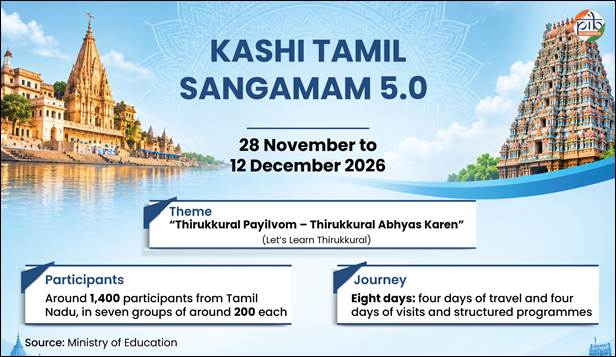
The fifth edition of Kashi Tamil Sangamam will be held from November 28 to December 12, bringing the cultural, linguistic and civilisational links between Tamil Nadu and Kashi into focus. This year’s theme, “Thirukkural Payilvom – Thirukkural Abhyas Karen” or “Let’s Learn Thirukkural”, places the classical Tamil text at the centre of educational and cultural engagement.
Around 1,400 delegates from Tamil Nadu are expected to visit Varanasi, Prayagraj and Ayodhya as part of the programme. The initiative will also extend beyond the visiting delegations, with a nationwide Students’ Engagement Programme involving 1,000 higher education institutions.
The Sangamam seeks to strengthen people-to-people connections between Tamil Nadu and Kashi, two ancient centres of learning, and promote the spirit of Ek Bharat Shreshtha Bharat.
A shared cultural and civilisational legacy
The historical links between Tamil Nadu and Kashi are reflected in centuries-old religious, cultural and educational exchanges. People from Tamil Nadu have traditionally visited Kashi, while Kashi and Rameswaram hold an important place in the religious traditions of both regions.
Several Tamil institutions and communities have longstanding associations with Varanasi. Tamil residents have lived around Hanuman Ghat and Kedar Ghat for generations. Swami Kumaragurupara of Dharmapuram Adheenam travelled from Tamil Nadu to Kashi and established the Kedareshwar Temple at Kedar Ghat. The Kumaraswamy Mutt and Markandeya Ashram are also located there.
The connection is also reflected in education and literature. Banaras Hindu University has a chair dedicated to Mahakavi Subramania Bharati, while Tenkasi in Tamil Nadu is known as the Kashi of the South.
First held in 2022 during Azadi Ka Amrit Mahotsav, Kashi Tamil Sangamam was conceived to bring the knowledge and cultural traditions of the two regions closer through academic exchanges, cultural programmes and direct interaction.
Thirukkural takes centre stage
The fifth edition will focus on the teachings of the Thirukkural, the classical Tamil text on ethics and conduct authored by Thiruvalluvar. It comprises 1,330 couplets divided into three sections: Aram (virtue), Porul (wealth) and Inbam (love).
The Central Institute of Classical Tamil has translated the text into 25 Indian languages, including all 22 languages listed in the Eighth Schedule of the Constitution, as well as several foreign languages and Braille.
The edition aims to introduce the text’s ethical and moral teachings to young people and learners across the country, encouraging them to understand and apply its values in everyday life.
Students’ engagement across 1,000 institutions
A major component of the fifth edition is a nationwide Students’ Engagement Programme involving 1,000 higher education institutions. It will promote the study of the Thirukkural among students from different academic disciplines and linguistic backgrounds.
Participating institutions will assess interested students and nominate one candidate on merit. Selected students will attend an online academic orientation in the 22 scheduled languages and English, followed by a one-month research and academic engagement using multilingual study material provided by the Central Institute of Classical Tamil.
Eligible students will receive a stipend of ₹10,000, subject to programme guidelines and completion of prescribed requirements. Each participant will prepare a four-to-ten-page article or research note under the guidance of a faculty member and deliver a one-hour presentation on the Thirukkural at their institution.
Thirukkural lessons in Uttar Pradesh schools
The programme will also take the text into schools and colleges in Uttar Pradesh. Fifty teachers from Tamil Nadu will visit educational institutions in the state to introduce students to the Thirukkural. Experts from Tamil Nadu will conduct orientation modules, interactive sessions and quizzes, including engagements in Varanasi.
The National Book Trust, in association with the Rashtriya e-Pustakalaya, will organise interactive sessions in schools in Varanasi to encourage reading habits, storytelling and creative activities.
Digital outreach and cultural programmes
Technology will be used to make the Thirukkural accessible to a wider audience. The Central Institute of Classical Tamil’s multilingual app contains all 1,330 couplets with translations into the 22 scheduled languages. The institute will also develop short animated videos, films on selected couplets and audiobooks.
Couplets accompanied by translations are planned for display on passenger information systems and signboards at railway stations, airports and highway toll plazas, in coordination with the Indian Railways, Airports Authority of India and National Highways Authority of India.
The Sangamam will be inaugurated on November 28, with the valedictory function scheduled for December 12. Banaras Hindu University will co-host a national conference on the Thirukkural, with the Bharatiya Bhasha Samiti as a partner. Cultural performances, screenings of short films and displays of handloom and handicraft products from Tamil Nadu and Uttar Pradesh will also be part of the programme.
Delegates to visit Varanasi, Prayagraj and Ayodhya
The 1,400 delegates from Tamil Nadu will be organised into seven groups of around 200 participants each. The eight-day journey for each group will include four days of travel and four days of visits and structured engagements.
The participants will represent seven categories: students, teachers, writers and media professionals, agriculture and allied sectors, professionals and artisans, women, and spiritual leaders.
In Varanasi, the itinerary includes visits to Kashi Vishwanath Temple, Sarnath or Banaras Hindu University, Ramnagar Fort and Bharat Mata Temple, along with Ganga Aarti, Ganga Snan, academic interactions and cultural programmes.
A special Tamil heritage circuit will include Mahakavi Subramania Bharati’s ancestral house, Kedar Ghat and Kashi Madam in Little Tamil Nadu, along with an academic interaction at the Tamil Department of BHU. Delegates will also visit the Triveni Sangam in Prayagraj and Shri Ram Temple in Ayodhya.
Building on four editions
The first Kashi Tamil Sangamam, held in November-December 2022, brought more than 2,500 participants from 12 walks of life to Varanasi, Prayagraj and Ayodhya. It featured academic exchanges, seminars, exhibitions and cultural programmes.
The second edition was held in December 2023 at Namo Ghat in Varanasi, with a focus on exchanges across literature, philosophy, spirituality, music, dance, yoga, Ayurveda and modern innovations.
The third edition, held in February 2025, highlighted the legacy of Sage Agasthyar. Around 1,000 delegates from Tamil Nadu and 200 students from Central Universities participated. The programme also featured performances by more than 869 artists and 190 local folk and classical groups, attracting nearly two lakh visitors.
The fourth edition, held in December 2025, focused on the theme “Tamil Karkalam – Let us learn Tamil”. It brought together more than 1,400 delegates and included Tamil language lessons in Uttar Pradesh schools, study tours for college students and an expedition from Tenkasi to Kashi highlighting shared heritage.
-PIB


