






Indian researchers have developed a technology to prevent colour blurring in white light-emitting diodes by stabilising halide perovskite nanocrystals, potentially paving the way for more stable and cost-effective lighting and display devices.
The commercial white light-emitting diodes (WLEDs) widely used in homes and smartphones are energy-efficient but rely on expensive rare-earth elements and complex, high-temperature manufacturing processes. They also offer fixed light tones that cannot be easily adjusted once manufactured.
Researchers are exploring all-inorganic halide perovskite nanocrystals (CsPbX₃, where X represents chlorine, bromine or iodine) as a potential alternative. These materials are bright, inexpensive and capable of producing exceptionally pure colours. However, they face a major challenge known as anion exchange, in which halide ions migrate between neighbouring nanocrystals of different compositions, causing intended colours to blend into unwanted intermediate shades, such as orange, within minutes.
A team from the Centre for Nano and Soft Matter Sciences (CeNS), Bengaluru, an autonomous institute under the Department of Science and Technology (DST), Government of India, in collaboration with IIT Delhi, has developed a dual-protection strategy to prevent this colour degradation.
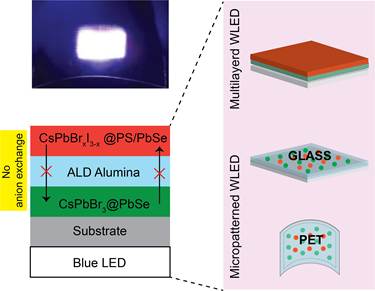
The researchers, Gauri Sharma, Swati Khurana, Sameer Sapra and Pralay K. Santra, first reduced halide vacancies on the nanocrystal surface using lead selenide, thereby restricting ion migration without compromising brightness or colour quality.
They subsequently introduced atomic layer deposition (ALD) to coat the nanocrystals with an ultrathin, transparent layer of aluminium oxide (alumina), measuring around 5–6 nanometres. The coating acts as a physical barrier, preventing ions from diffusing between adjacent colour-emitting layers.
Using spray coating and micropatterning techniques, the team fabricated multilayer white-LED devices on rigid glass and flexible plastic (PET) substrates. Optimised devices demonstrated continuous operation for up to 24 hours, maintaining stable white-light emission even under heating and cooling conditions.
The researchers also demonstrated that the white-light tone could be adjusted from dimmer to warmer shades by changing the electrical current, offering greater flexibility in lighting applications.
Published in the journal Small, the study marks a step towards scalable, flexible and affordable white-lighting technologies. However, further refinement is needed to address lead toxicity and develop more environmentally friendly alternatives before the technology can be adopted commercially.
(PIB)


