







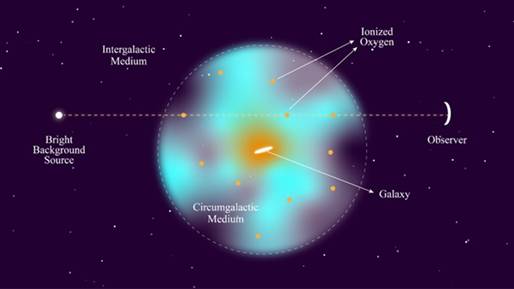
A new study by scientists at the Raman Research Institute (RRI) suggests that existing methods used to measure the mass of gas surrounding galaxies may significantly overestimate it due to interference from intergalactic matter, potentially reshaping current understanding of galaxy formation and evolution.
The research, conducted by RRI—an autonomous institute under the Department of Science and Technology—indicates that a substantial portion of highly ionised oxygen detected around galaxies may not originate from the circumgalactic medium (CGM), as widely assumed, but from the surrounding intergalactic medium (IGM).
Galaxies are enveloped by vast, diffuse halos extending up to 10–20 times their visible size. This halo, dominated by dark matter and gas, contains most of a galaxy’s mass. The gaseous component closest to the galaxy is known as the CGM, while the more distant region forms the IGM. Understanding the mass and composition of the CGM is critical, as it regulates the inflow and outflow of gas that drives star formation and galaxy evolution.
Astronomers estimate the mass of the CGM by measuring the amount of highly ionised oxygen detected when light from distant bright objects passes through the halo of a foreground galaxy. However, the study highlights a fundamental limitation of this technique: observations capture all ionised oxygen along the line of sight, making it difficult to distinguish between contributions from the CGM and the IGM.
Using theoretical models, the researchers found that a significant fraction of the ionised oxygen attributed to the CGM may actually come from the IGM. “We are challenging the notion that all observed ionised oxygen belongs to the CGM,” said Dr Kartick Sarkar, astrophysicist at RRI and one of the authors of the study published in *The Astrophysical Journal*.
According to the study, in massive galaxies such as the Milky Way, the CGM may account for only about 50 per cent of the observed ionised oxygen, with the remaining contribution coming from the IGM. In lower-mass galaxies, the CGM’s contribution could drop to as low as 30 per cent, potentially explaining discrepancies between observed data and existing models for such galaxies.
The findings suggest that ignoring the IGM’s contribution could lead to a systematic overestimation of CGM mass, particularly in low-mass galaxies. Researchers believe the revised framework could help reconcile long-standing inconsistencies between theoretical predictions and observations.
Scientists from RRI, in collaboration with researchers from the Hebrew University of Jerusalem, are now working to refine their model by incorporating additional physical parameters. The team aims to develop a more comprehensive framework to accurately quantify the relative contributions of the CGM and IGM.


