







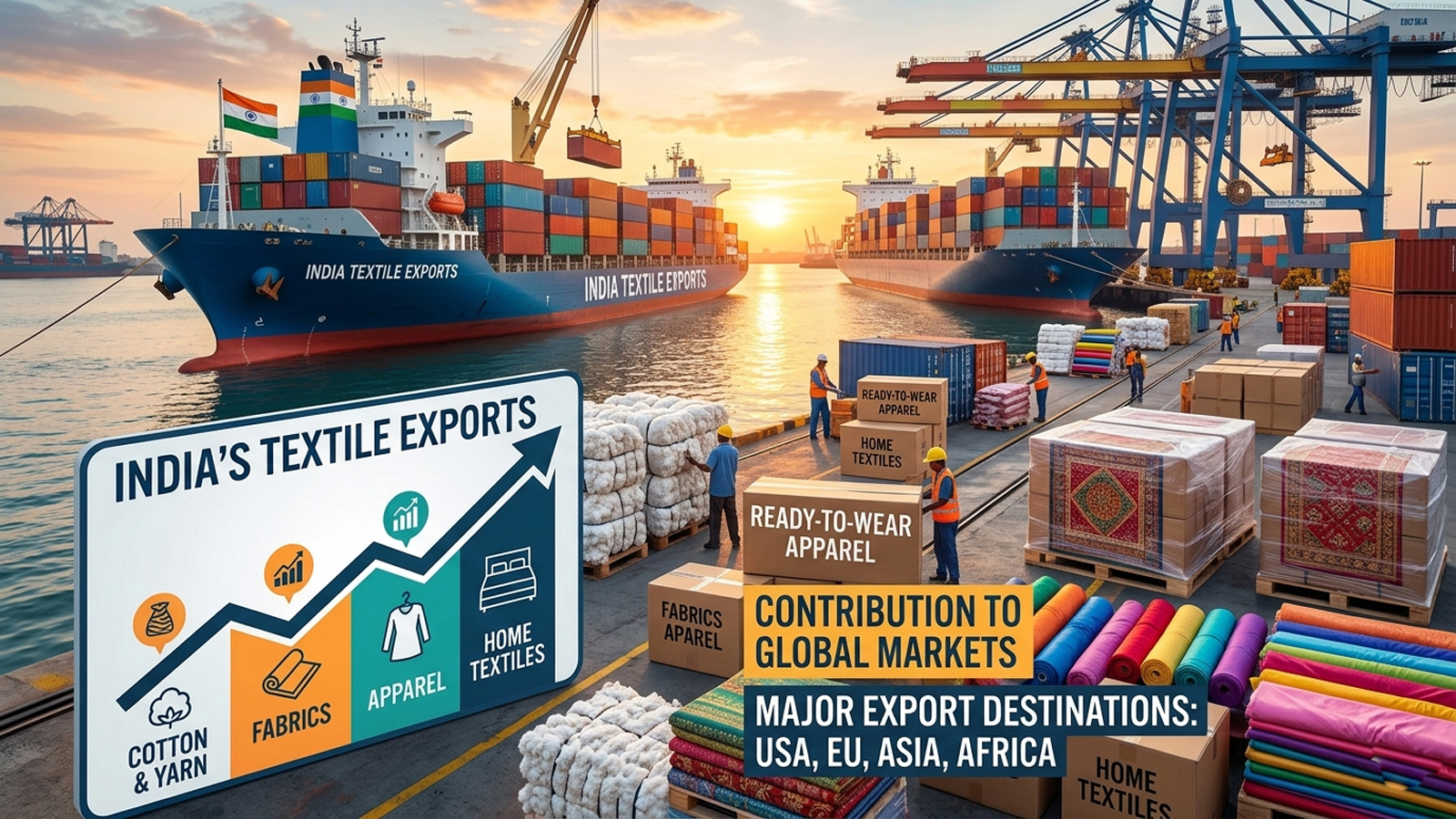
India’s textile sector recorded steady growth in global markets during FY 2025-26, with total exports rising by 2.1 per cent to ₹3,16,334.9 crore, according to the Ministry of Textiles.
The increase from ₹3,09,859.3 crore in FY 2024-25 reflects sustained international demand and the sector’s competitiveness across key product categories, including garments, yarn, fabrics, and handicrafts.
Ready-made garments (RMG) continued to dominate India’s textile exports, growing by 2.9 per cent to ₹1,39,349.6 crore. Cotton yarn, fabrics, made-ups, and handloom products recorded relatively stable growth of 0.4 per cent, reaching ₹1,02,399.7 crore. Meanwhile, man-made textiles posted stronger gains, with exports rising 3.6 per cent to ₹42,687.8 crore.
Among value-added segments, handicrafts (excluding handmade carpets) emerged as the fastest-growing category, registering a 6.1 per cent increase to ₹15,855.1 crore.
The data also highlighted a broad-based expansion in export destinations, with growth recorded in more than 120 markets between April 2025 and February 2026. Significant increases were seen in countries such as the UAE, UK, Germany, Spain, Japan, and several African nations, indicating diversification of India’s export basket.
Government support measures have played a key role in sustaining export momentum. Schemes such as the Rebate of State and Central Taxes and Levies (RoSCTL) and the Remission of Duties and Taxes on Exported Products have been extended beyond March 2026 to provide continued relief to exporters.
In addition, progress on multiple free trade agreements (FTAs) is expected to further boost the sector. Key developments include trade pacts with the European Free Trade Association (EFTA), the United Kingdom, Oman, and New Zealand, along with the conclusion of negotiations for an India–EU agreement. These agreements are likely to improve market access, reduce tariff barriers, and strengthen India’s integration into global supply chains.
The Textiles Ministry said the consistent growth in textile exports, supported by policy initiatives and expanding market reach, underscores the government’s focus on enhancing value-added exports, generating employment, and positioning India as a key player in the global textile industry.


