







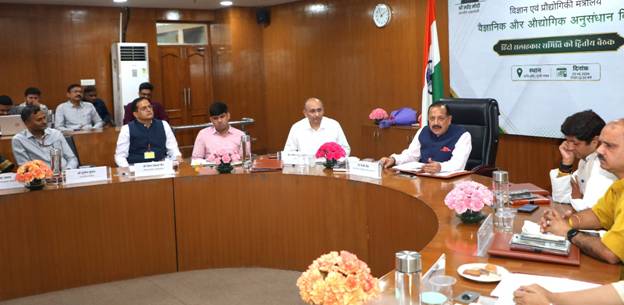
Union Minister Jitendra Singh on Wednesdsy said Hindi was gaining wider acceptance across sectors as its use expanded in employment, business, science, technology and official communication, while chairing a meeting of the Hindi Advisory Committee organised by the Department of Scientific and Industrial Research (DSIR) in New Delhi.
“A language grows faster when it gets linked with employment and business stakes,” Singh said while addressing the meeting, which focused on expanding the use of Hindi in scientific research, administration, digital platforms and public communication.
He added that Hindi was “not being imposed upon anyone” and was instead being promoted by linking it with “official work, employment, business, science, technology and public participation.”
Highlighting what he described as a “significant positive transformation” in the use of Hindi under Prime Minister Narendra Modi’s government over the last decade, Singh noted that interest in learning Hindi had increased even in non-Hindi-speaking regions.
Referring to changing employment trends, he observed that many young people in southern India were voluntarily learning Hindi as multinational companies increasingly preferred candidates proficient in both Hindi and English. He further noted that many employees from South India were now using “highly refined and effective Hindi”, reflecting what he described as a changing linguistic landscape in the country.
Linking shift in reading language with India’s digital transition, Singh said the culture of reading had “not disappeared in the digital age” and had instead shifted to mobile phones and online platforms. He urged institutions to make scientific literature, research material, government initiatives and ministry achievements available digitally in Hindi and other Indian languages.
Calling for wider public access to scientific knowledge, Singh said sustained efforts were underway to communicate science and technology-related content in “simple and practical Hindi”.
Referring to the increasing use of Indian languages in medical and engineering education, he said imparting knowledge in the mother tongue made learning “more accessible and effective”, while adding that certain technical terms should continue in their international form to help students remain globally competitive.
The meeting also reviewed the ministry’s progress in Hindi implementation, scientific writing, digital Hindi content and other official language initiatives. Committee members proposed wider Hindi translations of scientific journals and research papers, greater use of Hindi outreach through social media and infographics, and regular workshops aimed at simplifying scientific research for the wider public.
Singh also emphasised that promoting Hindi should encourage “voluntary participation and practical usage” while strengthening its role in India’s scientific, educational and administrative ecosystem.


