







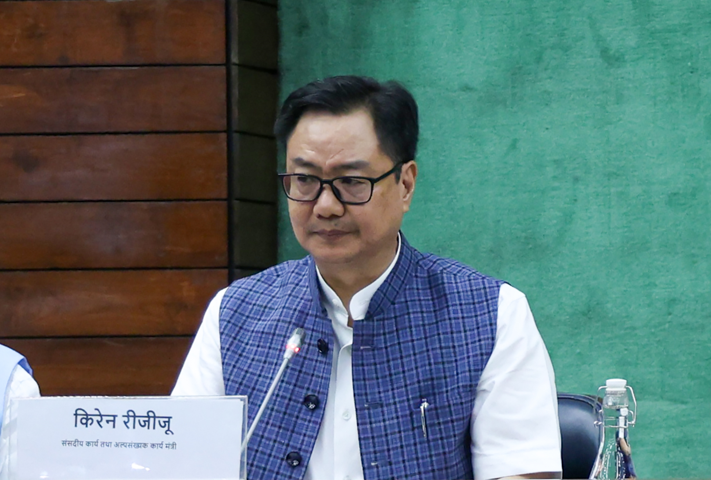
Union Minority Affairs Minister Kiren Rijiju on Tuesday said India continues to remain one of the safest and most inclusive countries for minority communities, while highlighting their significant contribution to the nation’s growth and development.
Addressing the Conference of State Minorities Commissions organised by the National Commission for Minorities in New Delhi, Rijiju said minority communities have played an important role in shaping India’s social, cultural and economic progress.
“The contribution of all minority communities to India’s growth and development is immense,” Rijiju said, noting the role of Parsis in industry and business, Christians in education and healthcare, and Muslims, Buddhists, Jains and other communities in enriching India’s cultural and intellectual landscape.
He also said that minorities from neighbouring countries have often looked towards India as a place of “shelter, security and dignity,” citing examples from countries such as Afghanistan and Sri Lanka.
The conference brought together representatives from State Minorities Commissions, state governments, Union Territories, policymakers and community leaders to deliberate on minority welfare, institutional strengthening and inclusive development.
Minister of State for Minority Affairs George Kurian highlighted welfare initiatives such as the PM Jan Vikas Karyakram (PMJVK), saying the government is focusing on infrastructure development and empowerment of minority communities as part of the vision for a developed India by 2047.
During the event, officials of the National Commission for Minorities shared details of the Commission’s grievance redressal efforts. Secretary of the Commission Alka Upadhyaya said over 9,500 petitions were received between 2021-22 and 2025-26, of which more than 9,200 complaints had been disposed of.
The conference also featured technical sessions on the role of minorities in nation-building, challenges faced by State Minorities Commissions and best practices adopted by states and Union Territories for minority welfare.
Speakers from different minority communities highlighted their contributions in areas such as education, healthcare, entrepreneurship, culture and social service, while also stressing the need for stronger institutional coordination and greater outreach of welfare schemes.
Chairpersons and representatives from State Minorities Commissions discussed operational challenges including staffing constraints, grievance redressal mechanisms and administrative coordination, and called for stronger collaboration among states to improve protection of minority rights.
States including Assam, Bihar, Kerala, Meghalaya and Tamil Nadu presented successful initiatives related to educational support, skill development, scholarships, livelihood promotion and community welfare programmes aimed at improving outreach to minority communities.
The conference concluded with a renewed commitment to strengthen institutional mechanisms, improve coordination among states and ensure more effective delivery of welfare measures for minority communities across the country.


