







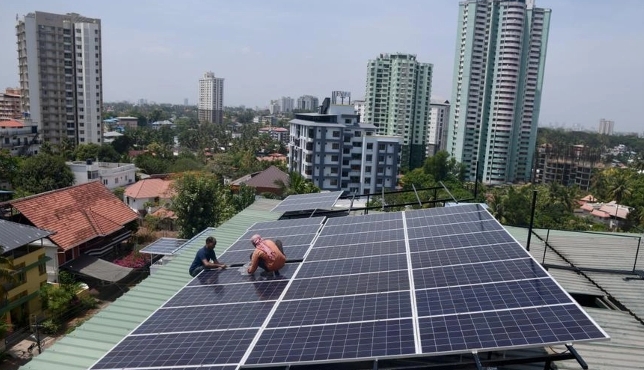
India’s renewable energy sector is expected to attract investments worth $110–120 billion over the next few years, largely driven by solar and wind projects, according to a report released by Colliers India on Wednesday.
The report said the planned expansion of solar and wind capacity by 2030 could create a $10–15 billion opportunity in land aggregation and acquisition. The growth is being driven by the government’s clean energy targets and its long-term commitment to achieving net-zero emissions.
India’s renewable energy capacity currently stands at 251 GW, with an additional 270–300 GW of solar and wind capacity expected to be added by 2030, the report noted.
“India’s renewable energy capacity stands at 251 GW, and with another 270–300 GW of expected solar and wind energy additions by 2030, the sector is set to enter its next phase of accelerated growth,” said Chief Executive Officer (CEO) of Colliers India Badal Yagnik.
He added that the expansion would create substantial opportunities for the real estate sector, particularly in land acquisition as well as industrial and warehousing segments.
According to the report, renewable energy development is also expected to accelerate India’s decarbonisation efforts while supporting the emergence of new growth corridors and investment destinations across the country.
The report noted that non-fossil fuel sources, including renewables and nuclear energy, currently account for 51 per cent of India’s installed power capacity. Combined with advances in domestic manufacturing capabilities, this positions the country to achieve its target of 500 GW of non-fossil fuel-based capacity by 2030.
Land aggregation and acquisition typically account for 10–12 per cent of the total project cost for solar and wind energy developments, the report said.
For solar projects, land is generally acquired either by private developers or by central and state nodal agencies in the case of large-scale solar parks. In wind energy projects, land acquisition is mainly required for electrical substations and supporting infrastructure, while land surrounding turbine sites is commonly secured through lease arrangements.
The report also highlighted rising demand for industrial and warehousing space from renewable energy original equipment manufacturers (OEMs).
“Over the last five years, annual leasing by renewable energy OEMs has surged nearly fourfold to around 3 million sq ft of industrial and warehousing space uptake in 2025,” said Vimal Nadar, Head of Research.
(IANS Inputs)


