







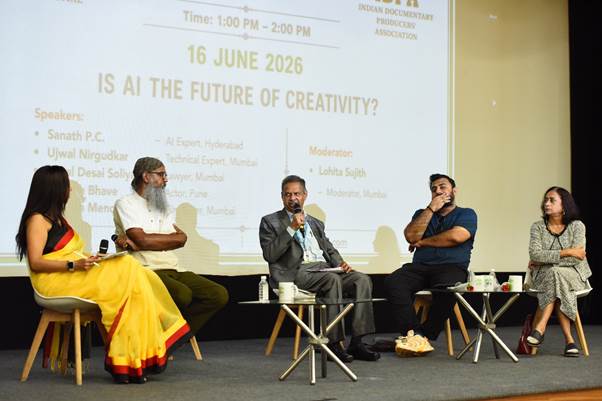
As artificial intelligence rapidly reshapes industries across the globe, a thought-provoking discussion at the 19th Mumbai International Film Festival (MIFF) explored one of the most pressing questions facing the creative world today: Can AI become the future of creativity?
The Indian Documentary Producers Association (IDPA) brought together filmmakers, technologists and legal experts for an Open Forum titled “Is AI the Future of Creativity?”, where the consensus was clear — AI may transform the way films are made, but the heart of storytelling will always belong to humans.
The session featured Sanath P.C., Co-founder of Firefly Creative Studio Pvt. Ltd.; Ujwal Nirgudkar, Chairman of SMPTE; lawyer Hetal Desai Soliya; and filmmaker Subodh Menon, Director of Fanboy Pictures. Together, they examined how artificial intelligence is influencing filmmaking, from script development and visual enhancement to copyright and ethics.
Describing AI as the latest chapter in cinema’s technological evolution, Ujwal Nirgudkar said the technology is already making a significant impact in post-production. From sound enhancement and colour correction to visual restoration of old films, AI is helping filmmakers achieve results faster and more efficiently. However, he noted that industry-wide standards and adoption will take time as the technology continues to evolve.
For filmmaker Subodh Menon, AI’s greatest value lies in its ability to assist rather than create. While AI can generate ideas, analyse content and support brainstorming, he argued that authentic storytelling remains deeply rooted in human experiences, emotions and perspectives. As AI tools become increasingly common, he said, filmmakers must learn to work with them rather than fear them.
Echoing similar views, Sanath P.C. described the current phase of AI development as an exciting period of experimentation. He highlighted how the technology can enhance image quality, improve sound design and elevate audience experiences. Yet, he stressed that AI should function as a creative companion rather than a substitute for artistic vision.
The discussion also addressed the growing legal and ethical questions surrounding AI-generated content. Lawyer Hetal Desai Soliya underscored the importance of using licensed datasets and ensuring meaningful human involvement in creative projects. She pointed out that copyright protection continues to rest with human creators, making responsible use of AI essential for the industry’s future.
Despite differing perspectives on the pace of adoption, the panelists agreed on one key point: AI is a powerful tool, but it is not a replacement for creativity. While algorithms may streamline production processes and unlock new possibilities, imagination, empathy and artistic intuition remain uniquely human strengths.
The audience engagement that followed reflected both curiosity and caution. Participants raised questions about copyright ownership, ethical boundaries, job displacement and the future role of creators in an AI-driven world.


