







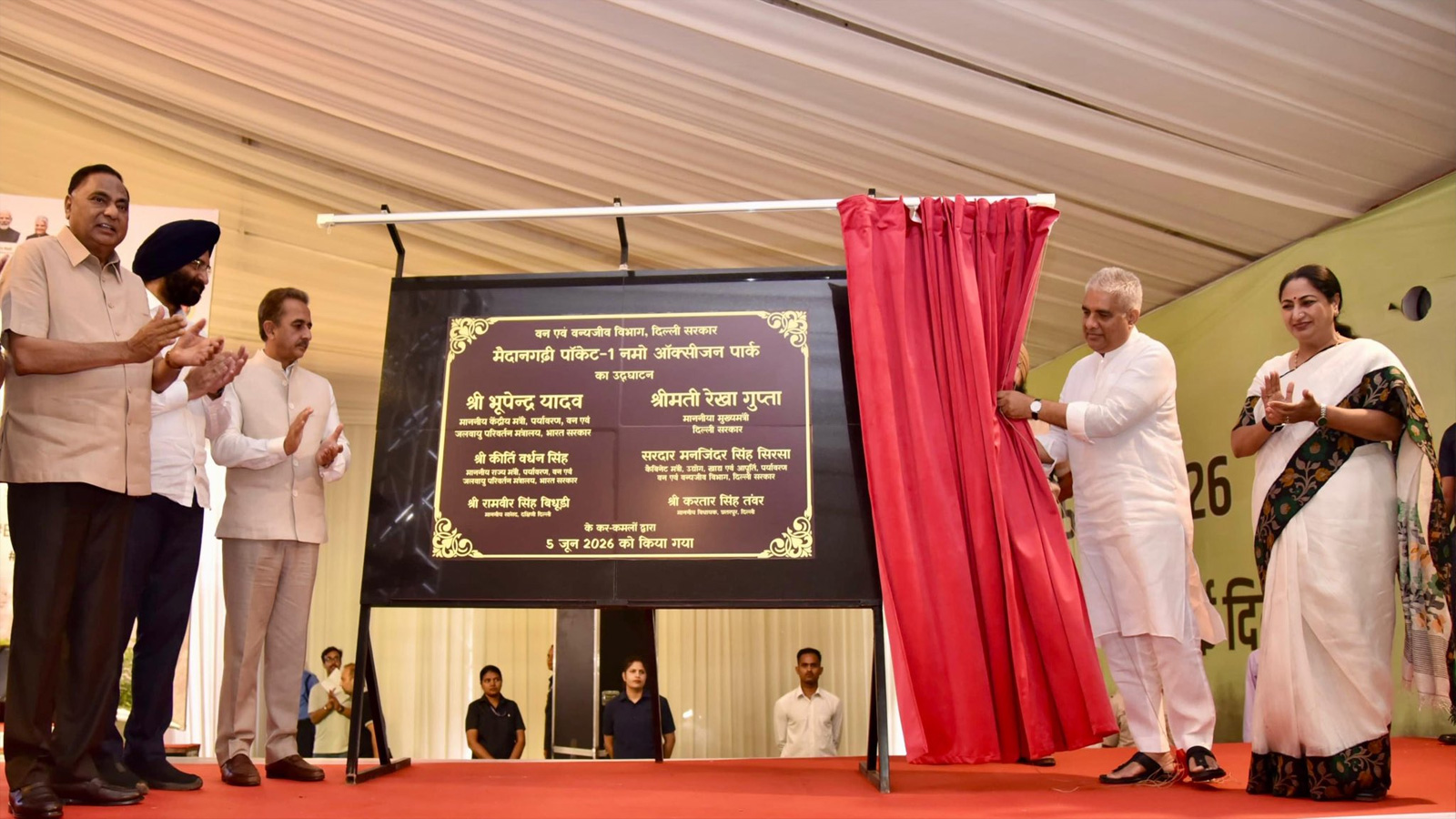
Marking World Environment Day 2026, Union Environment Minister Bhupender Yadav and Delhi Chief Minister Rekha Gupta on Friday inaugurated 18 Namo Oxygen Parks across the national capital and launched a series of green initiatives under the nationwide ‘Ek Ped Maa Ke Naam’ campaign.
The event, held at the Namo Oxygen Park in Maidangarhi, was aimed at strengthening urban greening, improving air quality, and encouraging community participation in environmental conservation. Union Minister of State for Environment Kirti Vardhan Singh and Delhi Environment Minister Manjinder Singh Sirsa were also present.
Addressing the gathering, Yadav said the world is currently facing three major environmental challenges – climate change, biodiversity loss, and land degradation leading to desertification. He highlighted India’s growing role in global environmental action under the leadership of Prime Minister Narendra Modi, citing achievements such as rapid solar energy expansion, the PM Surya Ghar Yojana, the International Solar Alliance, the International Big Cat Alliance, expansion of Ramsar wetland sites, and the country’s progress in meeting climate commitments ahead of schedule.
The minister emphasized that environmental protection cannot be achieved through government efforts alone and requires active public participation. Referring to the ‘Ek Ped Maa Ke Naam’ campaign, he said the initiative has transformed tree plantation into a mass movement rooted in gratitude and environmental responsibility. He urged citizens not only to plant trees but also to ensure their long-term care and survival.
Highlighting efforts to tackle pollution in the capital, Yadav said the Delhi government, in coordination with the Commission for Air Quality Management, is implementing measures to curb road dust, vehicular emissions, and industrial pollution. These include the installation of Online Continuous Emission Monitoring Systems, deployment of pollution-control devices, mechanized road cleaning, and promotion of electric mobility.
Yadav noted that the newly inaugurated 18 Namo Oxygen Parks are designed to function as urban green lungs, helping improve air quality, enhance biodiversity, and provide recreational spaces for residents. He stressed that community involvement would be essential to ensuring the long-term success of such initiatives.
During the event, three major environmental planning documents prepared by the Delhi government were released. These include the Working Plan for the National Capital Territory of Delhi (2026–27 to 2036–37), the Management Plan for the Asola Bhatti Wildlife Sanctuary (2024–25 to 2034–35), and the Delhi Bird Atlas, a comprehensive documentation of the capital’s bird diversity developed through a large citizen-science effort involving birdwatchers, researchers, and volunteers.
Yadav said these scientific planning documents would strengthen environmental governance by supporting biodiversity conservation, ecosystem management, wetland protection, and sustainable urban development.
Speaking on the occasion, CM Gupta announced that the Delhi government has set a target of planting 15 lakh trees across the city this year. She said expanding green cover remains one of the most effective measures for improving Delhi’s air quality and stressed that public participation is crucial not only for plantation drives but also for protecting and nurturing trees after they are planted.
The programme also included a plantation drive under the ‘Ek Ped Maa Ke Naam’ campaign and an exhibition showcasing local grass and shrub species as part of the ‘Dust-Free Delhi’ initiative. Civil society organisations that contributed to the Delhi Bird Atlas were honoured with certificates in recognition of their role in environmental monitoring and documentation.


