







From traditional artisans in remote villages to cutting-edge manufacturing units supplying global markets, India’s Micro, Small and Medium Enterprises (MSMEs) have emerged as one of the strongest pillars of the country’s economic transformation. Backed by policy reforms, digitalisation, improved access to finance and technology, and targeted government support, the sector is expanding rapidly while generating employment, encouraging entrepreneurship and strengthening India’s manufacturing ecosystem.
Today, MSMEs are no longer viewed as small businesses operating at the margins of the economy. They have become engines of innovation, inclusive development and economic resilience, playing a central role in India’s journey towards becoming a developed nation under the vision of Viksit Bharat 2047.
A Sector at the Heart of India’s Economy
India’s MSME landscape reflects remarkable diversity. It includes artisans preserving centuries-old traditions, women-led enterprises, first-generation entrepreneurs, rural businesses, startups and globally competitive manufacturers. Together, these enterprises are driving balanced regional development while creating opportunities across urban and rural India.
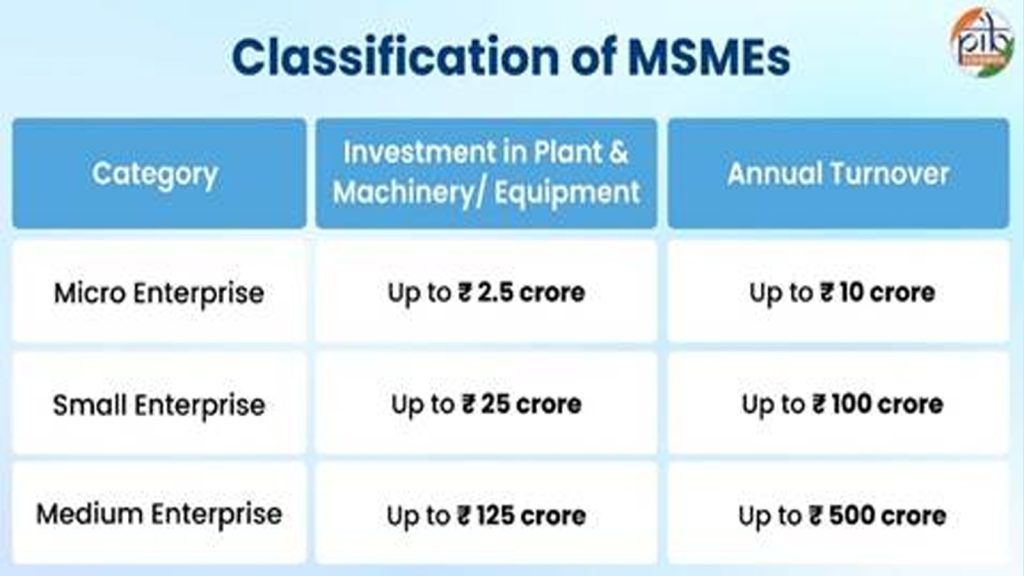
Recognising the evolving needs of the sector, the Government revised the definition of MSMEs with effect from April 1, 2025, based on investment and annual turnover. The revised criteria provide enterprises greater room for expansion while allowing them to continue benefiting from government support.
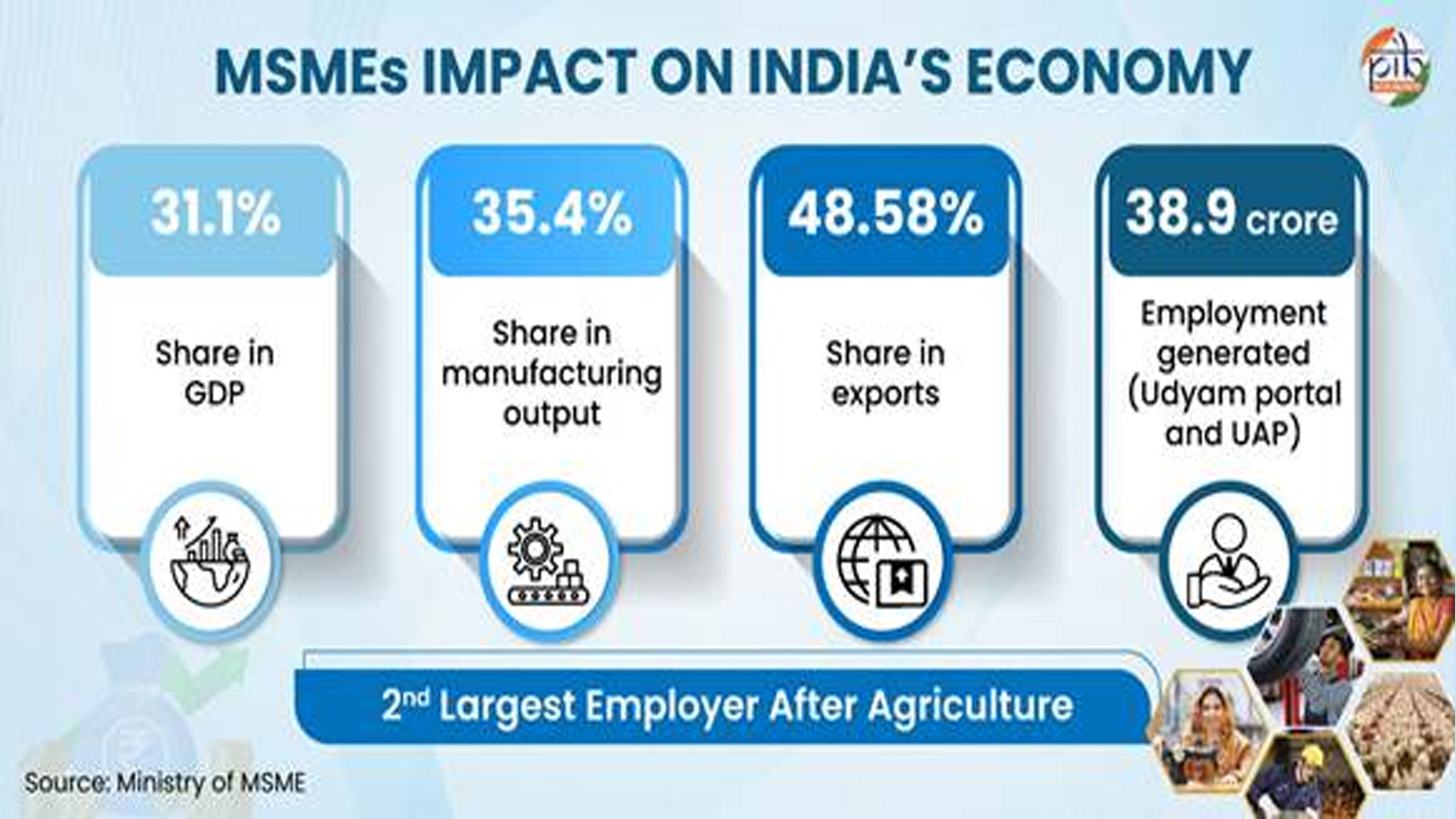
The sector’s economic contribution continues to grow significantly. As of January 2026, MSMEs contribute around 31.1% of India’s GDP; account for 35.4% of manufacturing output; contribute 48.58% of India’s exports; and employ more than 38.9 crore people, making MSMEs the country’s second-largest source of employment after agriculture.
The numbers underscore the sector’s growing importance not only as an economic driver but also as a catalyst for inclusive growth and employment generation.
Formalisation Accelerates Across the Country
One of the biggest milestones during 2025-26 has been the rapid formalisation of India’s MSME ecosystem.
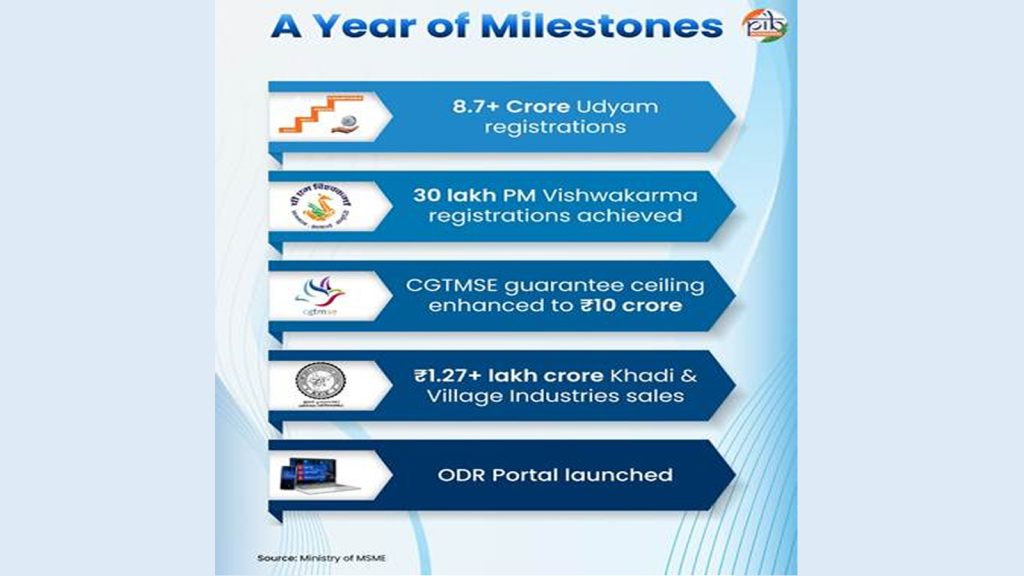
Registrations under the Udyam Registration Portal and the Udyam Assist Platform crossed 8.7 crore by June 2026, bringing millions of enterprises into the formal economy. Formalisation has enabled businesses to access institutional credit, government procurement opportunities, subsidies and various policy benefits while improving their overall competitiveness.
The expansion of the formal enterprise base has also strengthened transparency and facilitated better policy targeting.
Credit Access Receives a Major Boost
Access to affordable finance has traditionally remained one of the biggest challenges for MSMEs. The Government has undertaken several measures to address this gap.
The Credit Guarantee Fund Trust for Micro and Small Enterprises (CGTMSE) completed 25 years of operation, marking an important milestone in supporting collateral-free credit.
Between January and November 2025 alone 29.03 lakh credit guarantees were approved and guarantees covered loans worth ₹3.77 lakh crore.
To further improve access to institutional finance, the ceiling under the credit guarantee scheme was enhanced from ₹5 crore to ₹10 crore, allowing larger enterprises to obtain collateral-free loans.
Complementing these initiatives are the digital Credit Assessment Model and enhanced equity support to the Small Industries Development Bank of India (SIDBI), both aimed at making finance more accessible for entrepreneurs.
Khadi, Village Industries and Coir Continue Their Strong Growth
Traditional industries have also recorded significant progress.
Sales under the Khadi and Village Industries Commission (KVIC) crossed ₹1.27 lakh crore during the year, reflecting increasing consumer preference for locally manufactured products and growing employment opportunities in rural India.
The coir sector also achieved impressive growth, with exports reaching ₹6,614.40 crore during 2025-26, supported by improved technology adoption and expanding international demand.
These achievements demonstrate how traditional industries continue to contribute meaningfully to India’s rural economy.
Technology Driving Better Governance
Digital governance has become an important pillar of MSME development.
The MSME Samadhaan Portal, created to address delayed payment disputes, received 2,56,892 applications involving claims worth ₹55,244.29 crore as of June 2026. More than 58,148 cases have already been resolved through MSE Facilitation Councils.
Similarly, the CHAMPIONS Portal has significantly improved grievance redressal.
During 2025-26, 39,494 grievances were received, 39,387 grievances were resolved and disposal rate reached an impressive 99.72%.
To further strengthen dispute resolution, the Government also launched an Online Dispute Resolution (ODR) Portal, providing technology-enabled mechanisms for resolving delayed payment disputes more efficiently.
Expanding Market Access
Government procurement continues to provide a major growth opportunity for MSMEs.
According to the MSME Sambandh Portal, Central Public Sector Enterprises procured goods and services worth ₹31,443.32 crore during FY 2026-27 (up to June 2026).
Of this, 54.51% procurement came from Micro and Small Enterprises and nearly 29,769 enterprises have benefited.
MSMEs also received significant exposure during the 44th India International Trade Fair (IITF) 2025, where the MSME Ministry’s pavilion, showcasing the theme “Vibrant MSMEs, Viksit Bharat”, won the Silver Medal under the “Empowering India” category.
A total of 292 stalls were allotted to MSMEs and Vishwakarmas from 29 States and Union Territories.
Importantly, more than 67% of the stalls were allotted to women entrepreneurs, over 34% went to SC/ST entrepreneurs, and fifteen stalls were provided to entrepreneurs with disabilities.
PM Vishwakarma Empowering Traditional Artisans.
One of the Government’s flagship initiatives, PM Vishwakarma, has emerged as a transformative programme for artisans engaged in 18 traditional occupations.
Remarkably, the target of 30 lakh beneficiary registrations, originally planned over four years, was achieved within just two years.
Key achievements include – more than 24 lakh artisans completed skill training; over ₹5,133 crore sanctioned as collateral-free loans to 5.98 lakh beneficiaries; and more than 7.91 lakh artisans digitally empowered.
The scheme combines skill development, financial support, digital enablement and marketing assistance to improve artisans’ livelihoods while preserving India’s traditional crafts.
ASPIRE Strengthening Rural Entrepreneurship
The ASPIRE Scheme continues to promote entrepreneurship in rural India through incubation, training and livelihood generation.
As of June 2026, 109 Livelihood Business Incubators were approved; more than 1.23 lakh beneficiaries were trained; over 32,000 beneficiaries have secured employment; and more than 1,000 micro-enterprises were established.
The initiative has become an important instrument for promoting self-employment and strengthening rural economies.
PMEGP Creating Millions of Jobs
The Prime Minister’s Employment Generation Programme (PMEGP) remains one of India’s largest self-employment initiatives.
Since its inception, over 10.84 lakh micro-enterprises have been established, ₹29,623 crore has been provided as margin money subsidy, and more than 97 lakh employment opportunities have been created.
In 2025, the scheme became even more accessible with application facilities introduced in 19 regional languages besides English and Hindi.
MSME Champions Supporting Innovation and Competitiveness
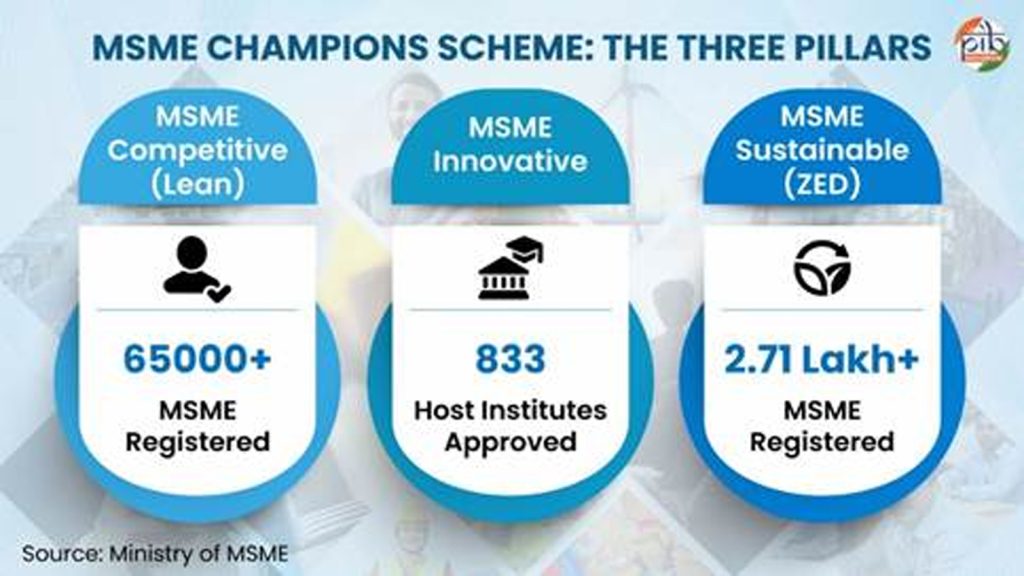
The MSME Champions Scheme continues to improve competitiveness through innovation, quality certification and lean manufacturing.
Under its Innovation component, 833 Host Institutes were approved, and 191 patents, 807 trademarks, 99 designs, and 6 GI registrations were supported.
Under the Zero Defect Zero Effect (ZED) programme, more than 93.61 lakh MSMEs were registered and over 6.68 lakh enterprises were certified.
The Lean Manufacturing Scheme has also gained momentum, with more than 65,647 MSMEs registered and 18,961 enterprises certified.
These interventions are helping Indian manufacturers improve productivity while adopting environmentally sustainable production practices.
Self-Reliant India Fund Expands Equity Support
To bridge the equity financing gap, the Self-Reliant India (SRI) Fund, launched under the Aatmanirbhar Bharat package, continues to support promising enterprises.
As of May 2026, 761 MSMEs are supported, and equity investment worth ₹2,851 crore are provided.
The Union Budget 2026-27 has further allocated an additional ₹2,000 crore to strengthen the fund.
Strengthening MSMEs in the North-East
The Government is also expanding industrial infrastructure across the North-East through the Promotion of MSMEs in North Eastern Region and Sikkim scheme.
By December 2025, 73 infrastructure projects have been approved; government assistance of ₹89.60 crore have been sanctioned; and new manufacturing, testing, packaging, skilling and tourism infrastructure are being developed across Assam, Meghalaya and other northeastern states.
Empowering SC/ST Entrepreneurs
The National SC-ST Hub (NSSH) has significantly expanded support for entrepreneurs belonging to Scheduled Castes and Scheduled Tribes.
Achievements include: more than 19,000 SC/ST entrepreneurs have been supported; 111 Vendor Development Programmes have been organised; and public procurement from SC/ST-owned enterprises have been increased from around ₹99 crore in 2015-16 to over ₹3,731 crore in 2024-25.
The initiative is helping diversify India’s entrepreneurial base while ensuring greater inclusion in government procurement.
Cluster-Based Development Strengthening Manufacturing
The Micro and Small Enterprises Cluster Development Programme (MSE-CDP) continues to modernise industrial clusters through common infrastructure.
As of June 2026, 612 projects have been approved; 364 projects have been completed; and shared infrastructure including Common Facility Centres are benefiting thousands of MSMEs.
Cluster-based development has enabled enterprises to access better technology, testing facilities and common services while reducing production costs.
Reviving Traditional Industries through SFURTI
The Scheme of Fund for Regeneration of Traditional Industries (SFURTI) is helping preserve traditional crafts while improving artisans’ incomes.
So far, 513 clusters are approved, 376 clusters are operational, and around 3.03 lakh artisans have benefited from the scheme.
The scheme addresses structural challenges faced by artisans through improved infrastructure, product development, skill enhancement and market linkages.
RAMP Strengthening State-Level Reforms
Supported by the World Bank, the Raising and Accelerating MSME Performance (RAMP) programme is driving reforms across states.
Highlights include – 398 proposals approved across all States and Union Territories; investment plans worth ₹3,211.75 crore sanctioned; and more than 55 lakh MSMEs impacted by June 2026.
The programme has strengthened Centre-State collaboration while improving institutional support for MSMEs.
Technology Centres Preparing Future-Ready Workforce
Technology Centres continue to support MSMEs through skill development, innovation and technical assistance.
Currently, 18 Technology Centres are operational; 20 new Technology Centres and 100 Extension Centres are under development; and existing Extension Centres have trained over 53,963 youth and supported 1,357 MSMEs.
The World Bank-supported Technology Centre System Programme has also established nine additional centres, which have trained nearly 59,357 individuals and assisted over 1,520 MSMEs.
The Road Ahead
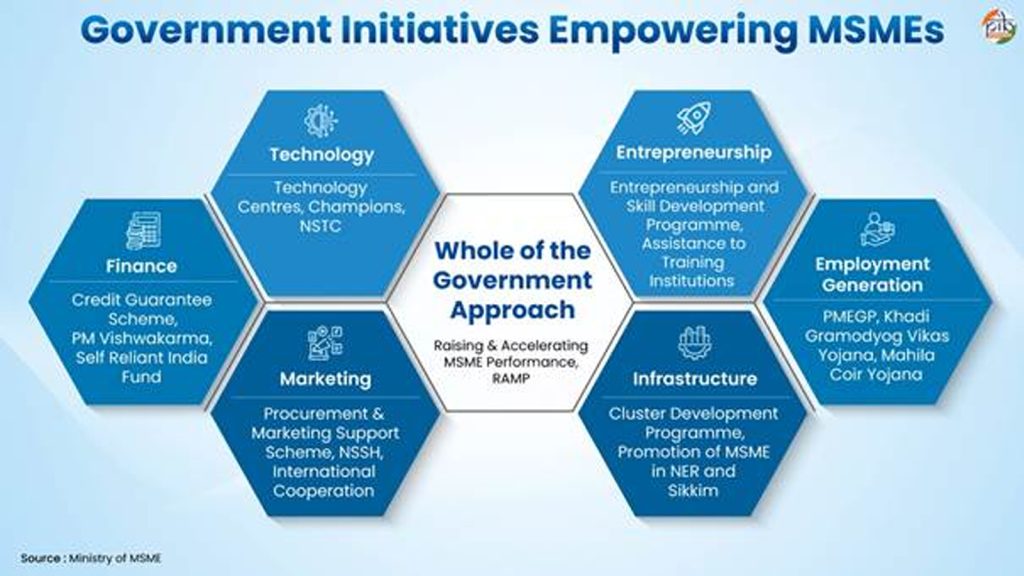
India’s MSME sector has entered a new phase marked by formalisation, innovation, technology adoption and stronger institutional support. Government initiatives across finance, skilling, market access, digital governance and entrepreneurship are creating an ecosystem where enterprises can grow sustainably while contributing to national development.
With its expanding contribution to GDP, manufacturing, exports and employment, the MSME sector is expected to remain one of the principal drivers of India’s economic transformation.
As India advances towards Viksit Bharat 2047, MSMEs will continue to serve not merely as business enterprises but as engines of inclusive development – creating jobs, nurturing innovation, empowering entrepreneurs and strengthening the country’s journey towards becoming a globally competitive and self-reliant economy.


