







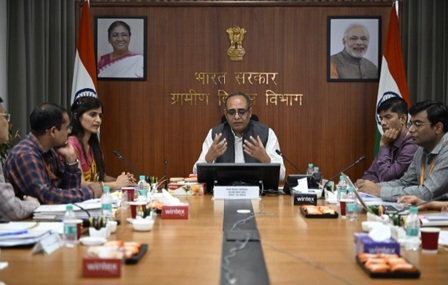
A high-level inter-ministerial consultation on the Draft Convergence Framework under the Viksit Bharat–Guarantee for Rozgar and Ajeevika Mission (Gramin) Act, 2025 (VB–G RAM G) was held in New Delhi on Wednesday, with representatives from 18 ministries and departments participating in discussions ahead of the scheme’s launch on July 1.
The meeting, chaired by Rural Development Secretary Rohit Kansal at Kartavya Bhavan, focused on operationalising the Act’s vision of a whole-of-government approach to rural development through decentralised planning led by Panchayati Raj Institutions.
Addressing the meeting, Kansal said convergence is a key pillar of the VB–G RAM G framework and is critical for tackling interconnected rural development challenges such as water security, livelihoods, infrastructure, climate resilience and local economic growth. He highlighted the Act’s “Single Plan–Multi Funding” approach, which seeks to align multiple schemes and programmes towards common development outcomes while retaining their individual mandates and funding structures.
Officials presented the draft convergence framework, which places the Viksit Gram Panchayat Plan (VGPP) at the centre of rural planning. Prepared through community participation and approved by Gram Sabhas, the VGPP is designed to integrate local development priorities with resources available under various Central and state government schemes.
The framework proposes a bottom-up planning model in which priorities identified at the village level are consolidated through Panchayati Raj Institutions and linked with sector-specific programmes of different ministries. The objective is to ensure public investments are aligned with local needs and deliver more effective and sustainable outcomes.
The meeting also reviewed the thematic priorities and permissible works under the Act. Rural development interventions have been grouped under four focus areas — water security, core rural infrastructure, rural livelihoods, and special works for mitigation of extreme weather events. To facilitate implementation from July 1, the Department of Rural Development has notified an interim list of 318 permissible works covering natural resource management, irrigation, rural connectivity, community infrastructure, livelihood-supporting assets, climate resilience and disaster preparedness.
Detailed discussions were held on technical and financial convergence, identification of schemes suitable for integration, digital interoperability and institutional mechanisms for coordinated implementation and monitoring. Participating ministries and departments shared suggestions on strengthening the framework.
The convergence framework is expected to come into effect alongside the VB–G RAM G Act on July 1, with the government aiming to enhance decentralised planning, optimise public spending and accelerate integrated rural development through coordinated action across departments.


