







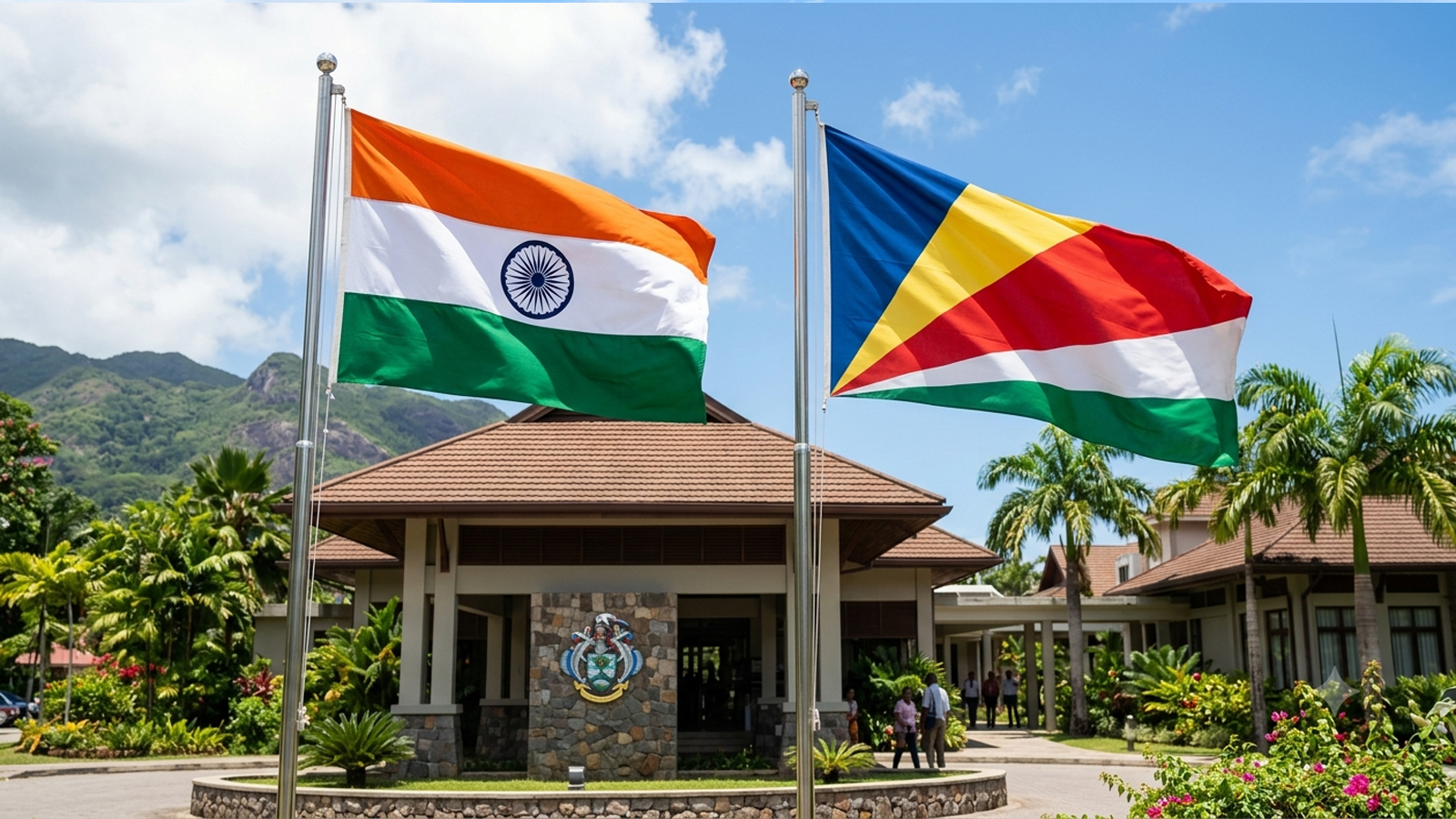
While India and Seychelles have long shared close political and strategic relations, the partnership has steadily expanded into trade, investment, cultural exchanges and development cooperation, reflecting a comprehensive relationship that extends well beyond diplomacy.
As Prime Minister Narendra Modi prepares for his State Visit to Seychelles, the growing economic and people-centric dimensions of the bilateral relationship underscore India’s role as one of the island nation’s most trusted development partners.
Trade Relationship Showing Steady Growth
Although bilateral trade remains relatively modest due to the absence of a direct shipping line, commercial engagement between the two countries has maintained steady momentum.
India exported goods worth USD 76.19 million to Seychelles during 2023-24, while imports from Seychelles stood at USD 8.69 million, marking an overall trade increase of nearly 15 per cent compared to the previous year.
Trade remained stable during April 2024 to February 2025, with total bilateral commerce reaching USD 72.92 million, including Indian exports of USD 68.64 million.
India’s exports largely comprise rice, processed food products, cement, textiles, medicines, medical equipment, vehicles and transport-related products.
Indian Companies Strengthen Economic Footprint
Several Indian companies have established a strong presence in Seychelles over the years.
Bank of Baroda, one of the earliest Indian institutions in the country, has operated a branch in Victoria since 1978, playing an important role in banking and financial services.
In the telecommunications sector, Bharti Airtel has invested more than USD 25 million since entering Seychelles in 1998, providing mobile and internet connectivity across the island nation.
Indian automobile manufacturers have also become key partners in Seychelles’ public transport network. Tata Motors has supplied a significant portion of the country’s bus fleet, while Ashok Leyland has also entered the market in recent years.
Improved Connectivity Boosting Tourism
Air connectivity between the two countries has received a significant boost in recent years.
Following the launch of direct flights between Mahé and Mumbai by Air Seychelles in 2014, connectivity has further improved with IndiGo commencing four weekly direct flights on the route in March 2025.
The enhanced air links have contributed to a steady rise in Indian tourist arrivals to Seychelles, while also strengthening business travel and people-to-people exchanges.
Shared Commitment to Blue Economy and Renewable Energy
Maritime sustainability and climate cooperation have emerged as important pillars of India-Seychelles engagement.
A Blue Economy Protocol, signed in 2015, has laid the foundation for collaboration in sustainable ocean resource management, marine conservation and maritime development.
Seychelles also became one of the founding members of the International Solar Alliance (ISA) after ratifying its framework agreement in 2017.
Renewable energy cooperation has gathered pace through several joint initiatives. One notable project is the solar-powered cold storage facility on Praslin Island, established with ISA support and commissioned in 2024 to strengthen agricultural infrastructure and reduce post-harvest losses.
Additional renewable energy projects, including rooftop solar systems, solar pumps and solar chillers, are also planned under the Quad Climate Initiative.
A Living Cultural Bridge
Centuries-old historical links continue to shape the close cultural relationship between India and Seychelles.
The first Indians arrived in Seychelles as early as 1770, and today the Indian-origin community forms one of the country’s most influential social and economic groups.
Around 6,000 Persons of Indian Origin (PIOs) hold Seychellois citizenship in a country with a population of nearly 120,000, while more than 9,000 Indian nationals are employed across construction, retail and professional sectors.
Indian cultural traditions remain vibrant through regular performances by cultural troupes, festivals and community events supported by both governments.
A significant symbol of these ties was added in 2022, when a statue of Mahatma Gandhi was installed at Victoria’s Peace Park alongside monuments of global leaders including Nelson Mandela.
Cultural exchanges have also expanded through initiatives such as Seychelles-India Day, Indian classical and folk dance performances, textile exhibitions and sporting events that celebrate the shared heritage of both nations.
Education, Skills and Development Cooperation
India’s development partnership with Seychelles spans education, capacity building, healthcare and infrastructure.
Through the Indian Technical and Economic Cooperation (ITEC) programme, more than one per cent of Seychelles’ population has benefited from professional training in India, creating one of the highest concentrations of ITEC alumni anywhere in the world.
India has also established an IT Centre of Excellence in Victoria and extended multiple Lines of Credit and grant assistance for infrastructure, public transport and healthcare.
Among the major development initiatives are:
* Supply of public transport buses and government vehicles.
* Construction of the Magistrates’ Court building.
* Installation of rooftop and ground-mounted solar power projects.
* High Impact Community Development Projects across Seychelles.
* ICT infrastructure support for the University of Seychelles.
* Donation of ambulances, medical equipment and essential medicines.
India also became one of the first countries to supply COVID-19 vaccines to Seychelles under the Vaccine Maitri initiative in 2021, reinforcing its reputation as a reliable partner during global crises.
More recently, India supplied 200 tonnes of non-basmati rice to support Seychelles’ food security and donated 3.5 tonnes of essential medicines and medical supplies in 2025.
A Partnership with Expanding Horizons
From growing trade and investment to renewable energy, cultural exchanges and development assistance, India and Seychelles have transformed their relationship into a multifaceted partnership.
As both countries deepen cooperation across emerging sectors, the bilateral relationship increasingly reflects a shared commitment to sustainable development, regional stability and stronger people-to-people connections in the Indian Ocean region.


