







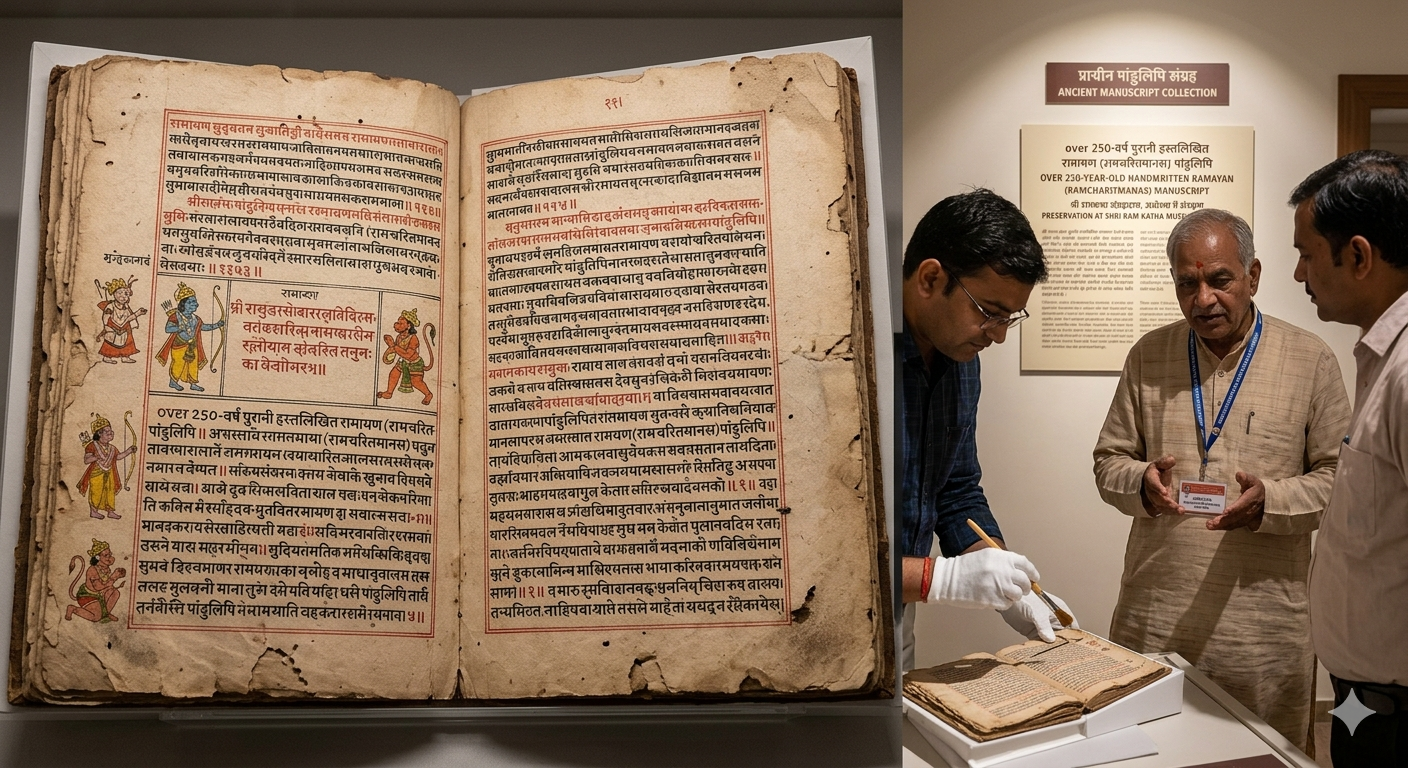
A rare handwritten manuscript of Tulsidas’s Ramcharitmanas, estimated to be more than 250 years old, has been acquired by the International Ramkatha Museum in Ayodhya for preservation and public display.
The acquisition was approved on Wednesday by the museum’s screening committee, chaired by Nripendra Misra.
Sanjeev Kumar Singh, Director of the International Ramkatha Museum, said the manuscript, despite being damaged and partially affected by termite infestation, holds immense historical, literary and cultural significance. He said the manuscript would become an important addition to the museum’s ongoing “Ramayana Manuscript Collection Yajna” project.
“Although it is damaged, torn and partially eaten by termites in places, it remains a valuable manuscript of the Ramcharitmanas that deserves preservation. Its inclusion will significantly enrich our collection,” Singh said.
According to Singh, the manuscript is estimated to be around 270 to 275 years old. He highlighted three key factors that make it worthy of preservation: its antiquity, the linguistic style of its inscription, and the artistic craftsmanship employed in its creation.
“The manuscript is exceptionally beautiful despite signs of deterioration. Its age, distinctive language and the artistic method used in writing make it a significant acquisition. Ancient artefacts hold special value, and available evidence suggests this manuscript dates back roughly 270 to 275 years,” he said.
Singh said the manuscript comprises approximately 650 pages and showcases a striking use of red and black inks. Beyond its religious significance, he noted, the document offers insights into the materials and writing techniques of its era, including the quality of paper and ink used.
“It is not only important because it contains the Ramcharitmanas, but also because it provides a glimpse into the technology and craftsmanship of the period. The interplay of red and black inks is particularly noteworthy,” he added.
Manuscript collector Madhavendra Porwal, associated with Lucknow-based Chambal Archives, said the manuscript is believed to date back to around 1768 AD and was written on traditional handmade paper.
“We have compiled numerous versions of the Ramayana, and this manuscript contains around 600 to 700 pages. It was handwritten on handmade paper commonly used at the time and includes several unique textual variations and rare details that manuscript experts consider significant,” Porwal told ANI.
He noted that handwritten manuscripts of this scale would typically take one-and-a-half to two months to complete, with scribes often recording completion dates at the end of chapters.
Porwal said the manuscript has remained in his family since his grandmother’s time. He added that the family possesses 41 other versions of the Ramayana, along with several ancient texts, which led to the establishment of an archival initiative focused on preservation and restoration.
“We are working to conserve these manuscripts and make them available digitally to the public free of charge. People frequently approach us with similar historical documents for restoration and preservation,” he said.
The manuscript is expected to become a key addition to the museum’s growing collection of Ramayana-related artefacts and texts, aimed at preserving India’s literary and cultural heritage.
(With ANI inputs)


