







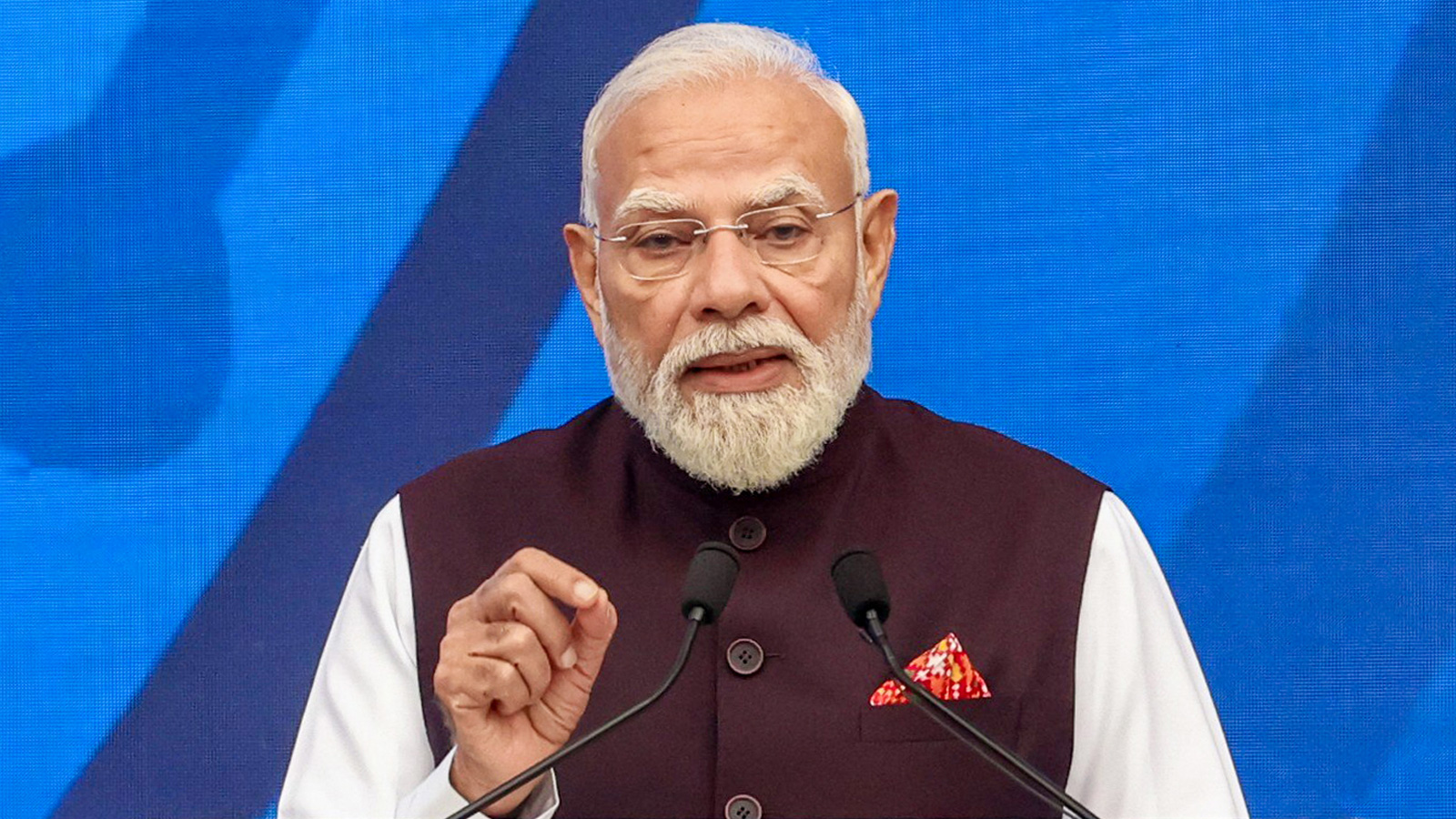
Prime Minister Narendra Modi on Monday underscored India’s economic resilience during the recent Gulf conflict, saying the country demonstrated remarkable stability despite global uncertainties and its structural dependence on imported energy.
Sharing an article by Chief Economic Advisor (CEA) V. Anantha Nageswaran on X, the Prime Minister said, “India has shown remarkable stability during tough and testing times globally, despite our structural vulnerabilities. It has been achieved by ensuring macroeconomic stability over the last decade while making policy-making responsive and agile. We are committed to further the process of Aatmanirbharta to safeguard our nation.”
In his article, Nageswaran outlined how India successfully weathered the disruption caused by the temporary closure of the Strait of Hormuz, a critical maritime route through which nearly one-fifth of the world’s crude oil and a significant portion of India’s crude oil and cooking gas imports pass.
The Chief Economic Advisor noted that when the Strait was closed at the end of February, many expected India – an economy that imports nearly 90 per cent of its crude oil and more than half of its cooking gas through the Gulf – to face severe fuel shortages, surging inflation, pressure on the rupee and a balance of payments crisis.
However, nearly four months later, after the Strait reopened and crude oil prices returned close to pre-crisis levels, none of those fears materialised.
Nageswaran said, not a single fuel retail outlet ran dry, every household continued to receive cooking gas cylinders without interruption, and India avoided the kind of macroeconomic crises experienced during 1991 and 2013.
He attributed this outcome to calibrated and timely policy interventions rather than chance.
Drawing parallels with the government’s response during the COVID-19 pandemic, Nageswaran said authorities adopted a measured strategy by implementing a series of targeted interventions instead of relying on a single dramatic policy measure.
Protecting households remained the government’s foremost priority during the crisis.
Although the import-linked cost of a 14.2 kg LPG cylinder rose to more than ₹1,600, the retail price for consumers was maintained at around ₹900, with lower prices for economically weaker sections. Commercial and bulk consumers were required to adjust consumption priorities to ensure uninterrupted domestic supply.
Nageswaran highlighted that India simultaneously strengthened domestic supply by increasing cooking gas production. Domestic refiners reportedly boosted LPG output by nearly 50 per cent within a week, substantially offsetting reduced imports.
The government also diversified energy procurement by increasing purchases from the United States and Russia, adding new suppliers and securing necessary waivers to continue importing Russian crude oil.
Alongside immediate measures, the government accelerated long-term energy security initiatives, including expansion of piped natural gas networks, promotion of coal gasification, higher ethanol blending and enhancement of strategic crude oil storage capacity following agreements reached during PM Modi’s visit to the United Arab Emirates.
Nageswaran observed that India was among the few countries that managed to maintain uninterrupted energy supplies even as maritime traffic through the Strait of Hormuz slowed significantly.
To shield the broader economy from rising fuel prices, the government reduced excise duty on petrol and diesel by ₹10 per litre, absorbing an estimated revenue loss of about ₹1.7 lakh crore. Relief measures were also extended to the aviation sector, while oil marketing companies maintained stable retail fuel prices for more than two months before implementing only a limited price revision.
The Chief Economic Advisor said that during periods of global uncertainty, governments possess both the financial capacity and the long-term perspective necessary to absorb economic shocks, thereby protecting households and businesses.
Targeted support packages for airlines and a credit guarantee scheme for Micro, Small and Medium Enterprises (MSMEs) were also introduced, mirroring the policy approach adopted during the pandemic.
Nageswaran noted India’s external sector was managed with similar prudence.
The government abolished withholding and capital gains taxes on foreign institutional investments in government securities while expanding the scope of the Fully Accessible Route (FAR), measures that attracted higher capital inflows into the bond market.
Additionally, a new non-resident dollar deposit scheme is expected to mobilise substantial foreign currency inflows.
Nageswaran also pointed to the growing benefits of India’s expanding network of free trade agreements, noting that exports of non-oil, non-gems and jewellery merchandise as well as services recorded growth of more than 12 per cent during April and May 2026 compared to the same period a year earlier.
He highlighted several macroeconomic indicators that reinforced India’s resilience.
Gross Foreign Direct Investment (FDI) reached a record USD 95 billion during the previous financial year, exceeding the USD 70-80 billion range observed in the post-pandemic years.
India’s current account deficit stood at just 0.6 per cent of GDP during FY2025-26 and is projected to rise only marginally during FY2026-27.
The Chief Economic Advisor, however, acknowledged that favourable global developments also contributed to India’s stability.
After crude oil prices briefly crossed USD 120 per barrel following the Strait’s closure, reduced demand from China and continued releases from the United States Strategic Petroleum Reserve helped moderate prices below USD 100 per barrel. China’s resumption of fertiliser exports also eased pressure on India’s subsidy bill.
“Sound policy and good fortune both played their part,” Nageswaran said, adding that “fortune eventually favours sound policymakers.”
Reflecting improving global confidence in India’s economy, he noted that Goldman Sachs had recently upgraded India’s economic growth forecast to 6.8 per cent for calendar year 2026 and 6.5 per cent for FY2026-27, both revised upward by 30 basis points.
Looking ahead, however, Nageswaran cautioned that India’s long-term challenges remain significant.
He stressed that in an increasingly fragmented global economy characterised by geopolitical tensions, supply chain disruptions and volatile capital flows, India must prioritise attracting higher levels of foreign direct investment.
He called for a balanced Bilateral Investment Treaty framework, stable tax policies, greater contractual certainty, improved logistics infrastructure and effective single-window clearance mechanisms to attract global supply chains seeking diversified manufacturing destinations.
Nageswaran also emphasised the need to reduce India’s dependence on imports.
While India’s merchandise trade deficit stands at about eight per cent of GDP, it remains around five per cent even after excluding oil imports and approximately 3.5 per cent after excluding both oil and gold.
Nageswaran said India must accelerate domestic manufacturing in sectors where competitive production is feasible while fully leveraging recently concluded trade agreements with the United Kingdom and the European Union to expand labour-intensive exports.
He also underscored the importance of large-scale skill development to prepare India’s workforce for future trade opportunities and emerging technologies.
The Chief Economic Advisor observed that while India had successfully navigated the Gulf conflict, future challenges – including a weaker-than-expected southwest monsoon and the rapid emergence of artificial intelligence – would require similar resilience and policy agility.
“The Gulf conflict tested one kind of resilience; the years ahead will test others. India met the first test in good order. That is a reason for quiet confidence – and for getting on with the next,” he said.


