







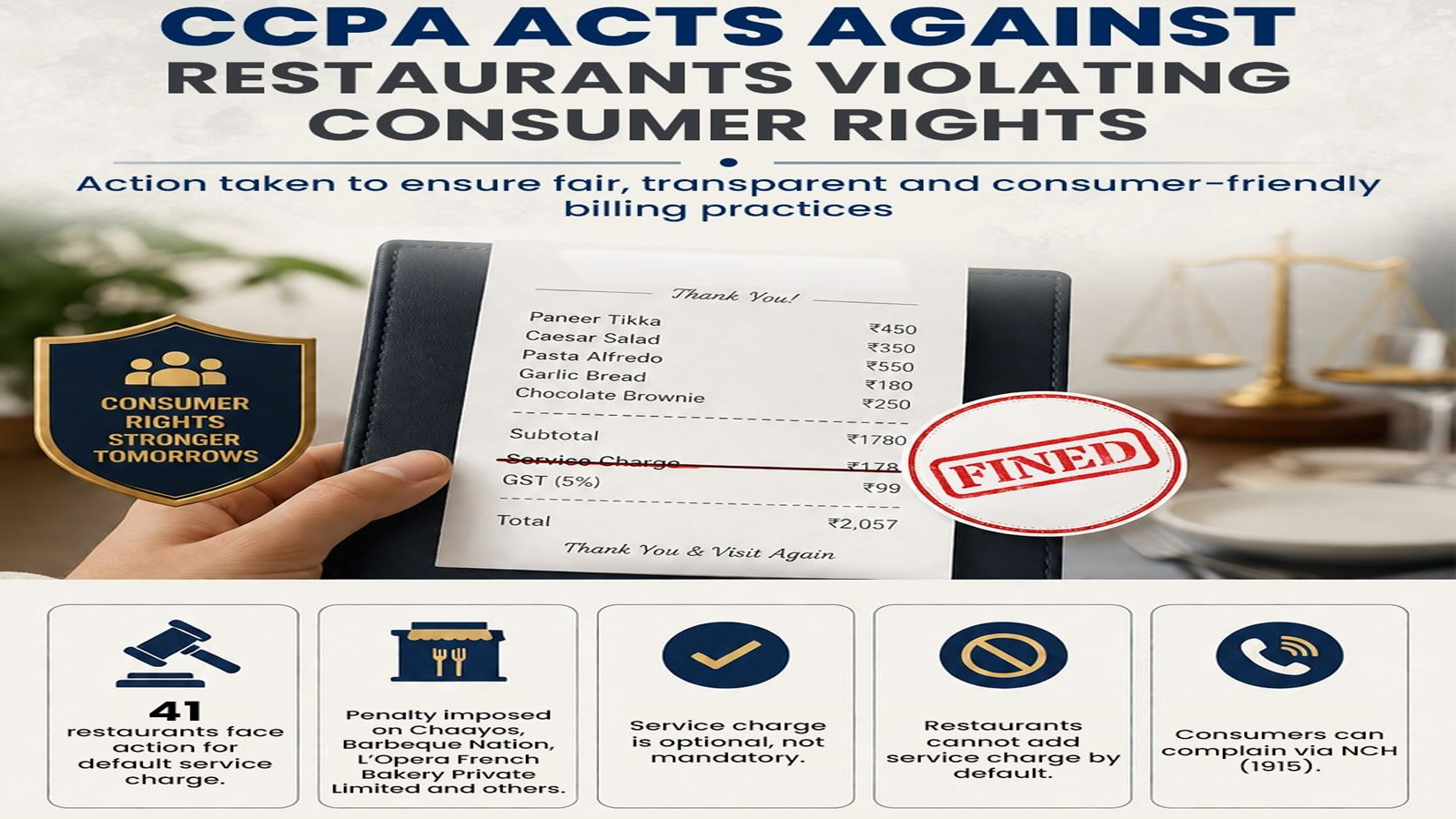
The Central Consumer Protection Authority (CCPA) has initiated suo motu action against 41 restaurants across the country for allegedly violating consumer rights by automatically levying service charges on customers’ bills without their explicit consent.
The action follows multiple complaints received through the National Consumer Helpline (NCH), where consumers submitted invoices showing that service charges had been added to their bills by default. Based on these complaints, the CCPA conducted investigations and concluded that the practice violated the Guidelines to Prevent Unfair Trade Practices and Protection of Consumer Interest with Regard to Levy of Service Charge in Hotels and Restaurants.
The Authority also held that automatically adding service charges amounts to an unfair trade practice under Section 2(47) of the Consumer Protection Act, 2019.
The move comes in the wake of the Delhi High Court’s judgment dated March 28, 2025, in National Restaurant Association of India & Others v. Union of India & Another, which upheld the validity of the CCPA’s service charge guidelines. The court ruled that mandatory collection of service charges is contrary to law and clarified that all restaurant establishments are required to comply with the guidelines. It also affirmed that the CCPA is empowered to enforce them in accordance with the law.
Under the guidelines issued on July 4, 2022, hotels and restaurants are prohibited from adding service charges automatically or by default to food bills. They are also barred from collecting service charges under any other name or compelling customers to pay them. Consumers must be clearly informed that payment of service charge is voluntary, optional and entirely at their discretion. The guidelines further state that restaurants cannot deny entry or services to customers who refuse to pay service charges, and service charges cannot be included in the bill for the purpose of levying GST.
In one of the cases investigated, the CCPA passed a final order against Chaayos, operated by Sunshine Teahouse Pvt. Ltd., imposing a penalty of ₹50,000 for automatically levying service charges. The Authority also directed the company to reimburse the service charge collected from the complainant and modify its software-generated billing system across all its outlets to ensure that service charges or similar charges are not added to customer bills by default.
The CCPA has also passed final orders against several other restaurant establishments, including Cafe Blue Bottle in Patna, China Gate Restaurant Pvt. Ltd., Fiesta Barbeque Nation operated by Barbeque Nation Hospitality Private Limited, FOO Ahmedabad Restaurant operated by Pebble Street Hospitality Pvt. Ltd., L’Opera French Bakery Private Limited, and Zorro – The Luxury Night Club, a unit of Rudra Hospitality Private Limited.
According to the Authority, proceedings are continuing against other restaurants where similar complaints have been received and examined.
Reacting to the development, Union Minister of Consumer Affairs, Food and Public Distribution Pralhad Joshi said in a post on X that the CCPA had initiated suo motu action against 41 restaurants based on complaints received through the National Consumer Helpline. Reaffirming that service charge is voluntary and entirely at the consumer’s discretion, the minister said the Authority had imposed penalties on violators, taken action against restaurants found to be violating consumer protection law and directed them to discontinue the automatic levy of service charges. He also urged consumers to report such violations through the National Consumer Helpline by dialling 1915.
The CCPA has urged consumers to report instances of restaurants automatically levying service charges through the National Consumer Helpline by calling the toll-free number 1915 or using the NCH platform. The Authority said it will continue monitoring complaints related to service charges and take appropriate action against establishments found to be violating the Consumer Protection Act, 2019, and the service charge guidelines, reaffirming its commitment to protecting consumer rights and promoting fair and transparent business practices in the hospitality sector.


