







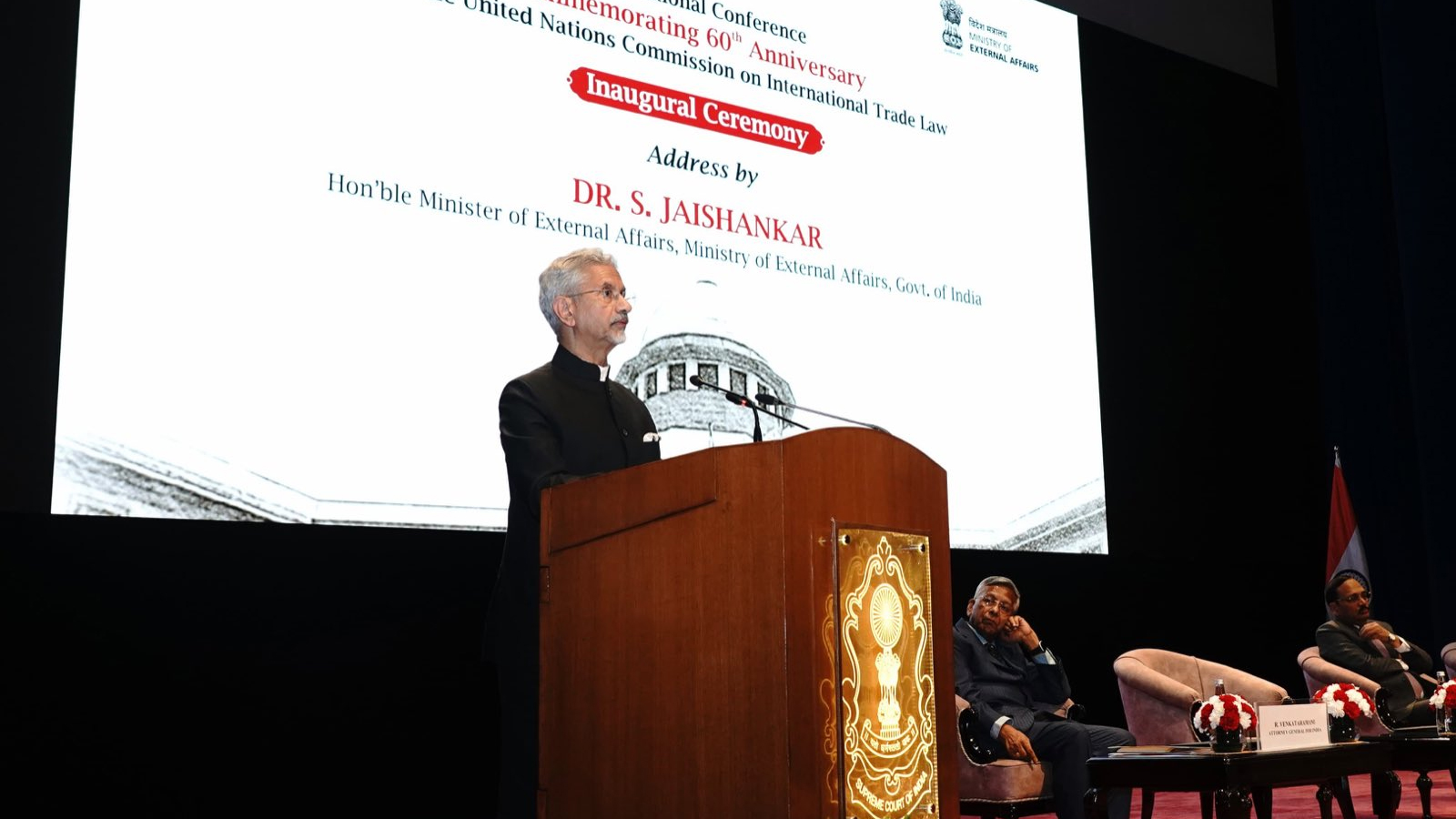
External Affairs Minister S. Jaishankar on Friday underlined the need for predictable and harmonised legal frameworks to support global trade, saying the evolution of international trade law must reflect the developmental priorities of the Global South as India hosted an international conference marking the 60th anniversary of the United Nations Commission on International Trade Law (UNCITRAL).
Addressing the inaugural session of the conference, EAM Jaishankar said the world economy is undergoing profound transformation driven by technological advances, digital commerce, changing supply chains and new investment patterns, making the role of UNCITRAL more relevant than ever.
“Today’s world is witnessing unprecedented geopolitical volatility, supply chain disruptions and rapid technological shifts. These developments are affecting how goods, services, capital and data move across borders, exposing businesses and governments to risks for which no country can be resilient in isolation,” he said.
The External Affairs Minister stressed that nations today seek not only infrastructure and connectivity but also legal predictability, harmonised rules and efficient dispute resolution mechanisms to facilitate seamless cross-border trade and investment.
He said UNCITRAL’s work in developing model laws, conventions and legal standards over the past six decades has significantly contributed to the harmonisation, modernisation and progressive development of international trade law.
Highlighting India’s long-standing engagement with UNCITRAL, EAM Jaishankar noted that India is among the eight countries with continuous membership of the commission and has actively contributed to the evolution of international trade law. He said India’s own legal reforms in arbitration, commercial dispute resolution and insolvency reflect the country’s commitment to creating a modern, transparent and internationally compatible legal environment.
Referring to India’s vision of Viksit Bharat 2047, EAM Jaishankar said the country’s aspirations for a resilient economy, technological innovation, expanded manufacturing and deeper global integration require predictable legal frameworks that promote international trade and commercial cooperation.
He also emphasised that developing countries and the Global South must play a greater role in shaping international legal norms.
“As the economic centre of gravity shifts, the legal architecture of tomorrow must be more democratic, inclusive and sensitive to the realities of the Global South. International trade law should act as a leveller, bridging the gap between developed and developing economies,” he said.
In a post on X after the event, EAM Jaishankar said he was pleased to inaugurate the conference commemorating UNCITRAL’s 60th anniversary and reiterated the importance of harmonised legal frameworks, efficient dispute resolution mechanisms and greater certainty in cross-border transactions. He also reaffirmed India’s commitment to building a modern, transparent and internationally compatible legal environment.
Later, the External Affairs Minister unveiled the book We The People – 250 Voices that Shaped US-India Relationship, published by the US-India Strategic Partnership Forum. Sharing photographs from the event, he said it was a pleasure to meet a diverse group of individuals who had made significant contributions to strengthening India-US ties.
EAM Jaishankar also said he had participated in the ASEAN Post-Ministerial Conference with India, the ASEAN Regional Forum (ARF), the East Asia Summit Foreign Ministers’ Meeting and the QUAD Foreign Ministers’ Meeting in Manila, where he also held bilateral discussions with his counterparts.


