







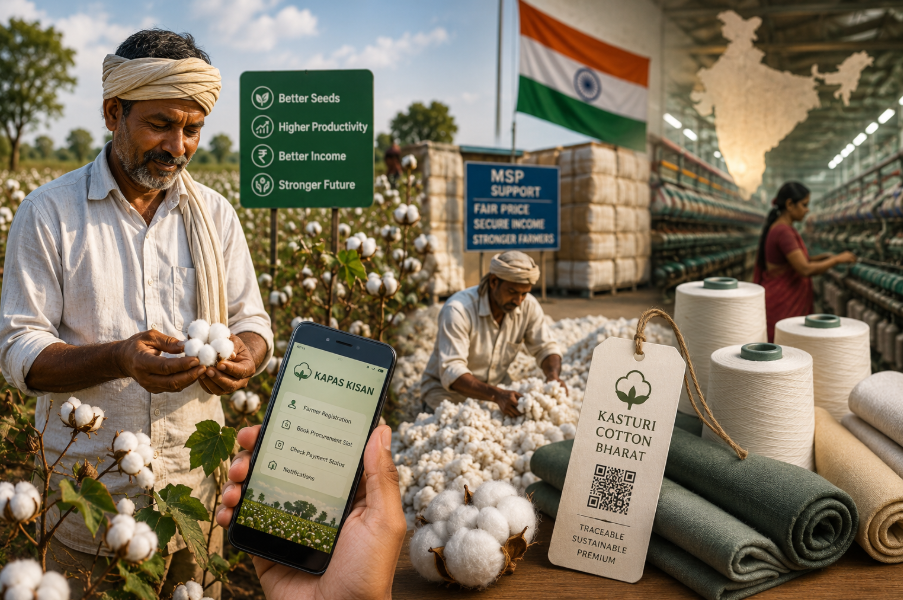
Every cotton shirt has a story. It begins long before it reaches a wardrobe or a retail shelf–on farms where millions of Indian growers contend with unpredictable weather, pests and fluctuating market prices.
Now, India is betting on a new chapter for its most iconic natural fibre.
Through a combination of scientific research, digital innovation, farmer support and premium branding, the government is working to transform the country’s cotton ecosystem–from improving yields in the field to strengthening India’s position in the global textile and fashion industry.
A Fibre That Shapes Millions of Lives
Cotton is woven into India’s agricultural, economic and cultural fabric. The country is the world’s largest cotto
cultivator by area and the only nation that grows all four recognised cotton species. It also ranks among the world’s leading producers and consumers of cotton, making the crop central to both rural livelihoods and the textile industry.
The numbers reflect its scale. Cotton production stood at 290.91 lakh bales in 2025-26, while domestic consumption reached 328 lakh bales during the same period. Nearly six million farmers depend on cotton cultivation, and another 40 to 50 million people are employed across spinning, weaving, garment manufacturing, trading and allied industries.
For India’s fashion and textile sector, cotton is far more than a raw material–it’s the thread that connects farms to factories and, ultimately, to consumers around the world.
The Push for Better Cotton
One of the biggest challenges facing Indian cotton farmers isn’t acreage–it’s productivity.
To address this, the government has launched the Mission for Cotton Productivity in 2025-26, a five-year programme with an investment of ₹5,659.22 crore. The initiative aims to develop climate-resilient, pest-resistant and high-yielding cotton varieties while encouraging modern breeding technologies.
The mission will cover nearly 24 lakh hectares across 140 districts in 14 cotton-growing states, with the goal of benefiting around 32 lakh farmers. Its long-term target is ambitious: increasing India’s cotton production to 498 lakh bales by 2031.
Higher Support for Farmers
Beyond boosting production, the government is also focusing on making cotton cultivation more financially sustainable.
For the 2026-27 cotton season, the Minimum Support Price (MSP) has been increased to ₹8,267 per quintal for medium-staple cotton and ₹8,667 per quintal for long-staple cotton–an increase of ₹557 per quintal over the previous season.
During the 2025-26 season, the Cotton Corporation of India procured 105.09 lakh bales worth ₹41,530 crore under MSP operations, helping protect farmers from sharp market fluctuations.
When Cotton Meets Technology
Digital tools are also reshaping how cotton is bought and sold.
The Kapas Kisan mobile application allows farmers to register online, schedule procurement appointments and receive Aadhaar-linked payments directly into their bank accounts. With more than 41 lakh registered users, the platform is designed to reduce waiting times at procurement centres while making the procurement process more transparent and efficient.
For farmers, that means less time in queues and faster access to payments. For the system, it signals a broader move toward technology-enabled agriculture.
Smarter Farming for Better Yields
Improving productivity isn’t only about new seeds.
Under the Special Project on Cotton within the National Food Security Mission, farmers are being encouraged to adopt high-density planting systems, closer spacing techniques and improved production practices for Extra Long Staple (ELS) cotton.
Field demonstrations have reported yield improvements of up to 40 per cent through high-density planting and over 32 per cent through closer spacing–offering practical ways to increase output without significantly expanding cultivated land.
Giving Indian Cotton a Global Identity
As sustainability and traceability become increasingly important in fashion, India’s cotton industry is also investing in branding.
The Kasturi Cotton Bharat initiative seeks to position premium Indian cotton as a globally recognised fibre by combining certification with digital traceability. Using QR-code authentication and blockchain technology, the programme enables end-to-end tracking of certified cotton through the supply chain.
As of June 30, 2026, more than 3.29 lakh bales had been certified under the initiative, marking another step towards building consumer confidence in the origin and quality of Indian cotton.
Why It Matters
For consumers, cotton often begins with a clothing label. But behind every fabric lies an ecosystem of farmers, researchers, manufacturers and textile workers whose livelihoods depend on the fibre.
India’s latest push signals an effort to strengthen every link in that chain–from developing more resilient crops and improving farmer incomes to building a globally recognised identity for Indian cotton.


