







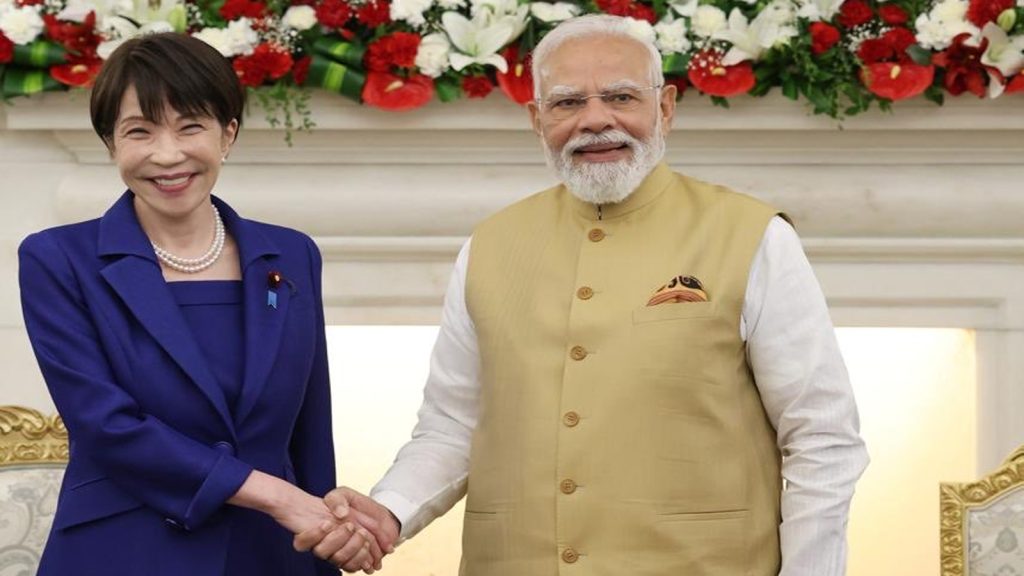
Prime Minister Narendra Modi and his Japanese counterpart, Prime Minister Sanae Takaichi, on Thursday elevated the India-Japan Special Strategic and Global Partnership with a series of landmark agreements spanning defence, artificial intelligence (AI), economic security, clean energy and emerging technologies, including the signing of the first-ever co-development project in the defence sector between the two countries.
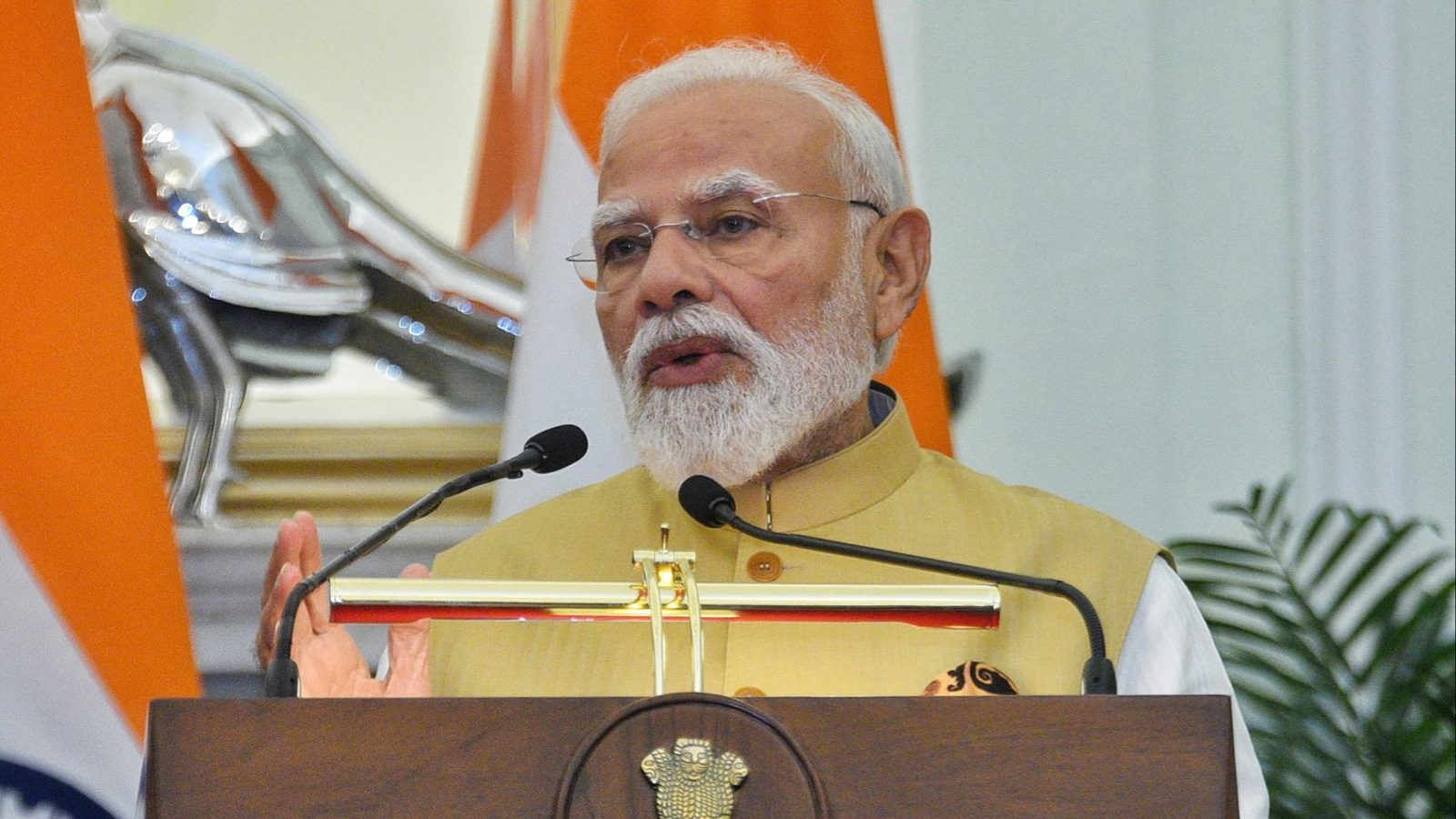
Addressing a joint press statement after the 16th India-Japan Annual Summit in New Delhi, PM Modi described Japan as one of India’s most trusted partners and said the two nations were entering a “new chapter” in their bilateral relationship.
“I am delighted to welcome Prime Minister Takaichi on her first visit to India for the India-Japan Annual Summit. She is also Japan’s first female Prime Minister, and a visionary and popular leader. Furthermore, she hails from Japan’s Nara Prefecture, a very important center of India-Japan’s shared Buddhist heritage,” the Prime Minister said.
Referring to the growing strategic importance of the partnership, PM Modi said, “Just a few days ago, at the G7 Summit, I said that in today’s environment of global turmoil, mutual trust is our greatest strategic asset. And I am proud that the India-Japan partnership fully meets this criterion.”
“Over the past several decades, Japan has built an invaluable bond of friendship and trust by being a key partner in India’s growth story, from automotive to electronics. And today, with Prime Minister Takaichi’s visit, we are beginning a new chapter in our Special Strategic and Global Partnership,” he added.
The Prime Minister noted that both India and Japan are among the world’s largest economies and share a common vision for a free, prosperous and rules-based Indo-Pacific.
“Today, both India and Japan are among the world’s largest economies. A free, prosperous, and rules-based Indo-Pacific is our shared priority. As the region’s largest democratic and market economies, today we have launched several important initiatives. Together, we will pave the way for peace, stability, and progress throughout the region,” he said.
Highlighting technology as a key pillar of future cooperation, PM Modi announced the adoption of a Joint Statement on Artificial Intelligence.
“Prime Minister Takaichi and I believe that technology partnership will become the strongest pillar of our cooperation. To realize this vision, today we have also issued a Joint Statement in the field of AI. Several leading institutions in the Indian AI ecosystem have also signed agreements with their Japanese partners today. The confluence of Japan’s precision technology and India’s software capabilities will give new impetus and strength to global AI development,” he said.
In a major breakthrough in defence cooperation, the Prime Minister announced the signing of the first India-Japan defence co-development project.
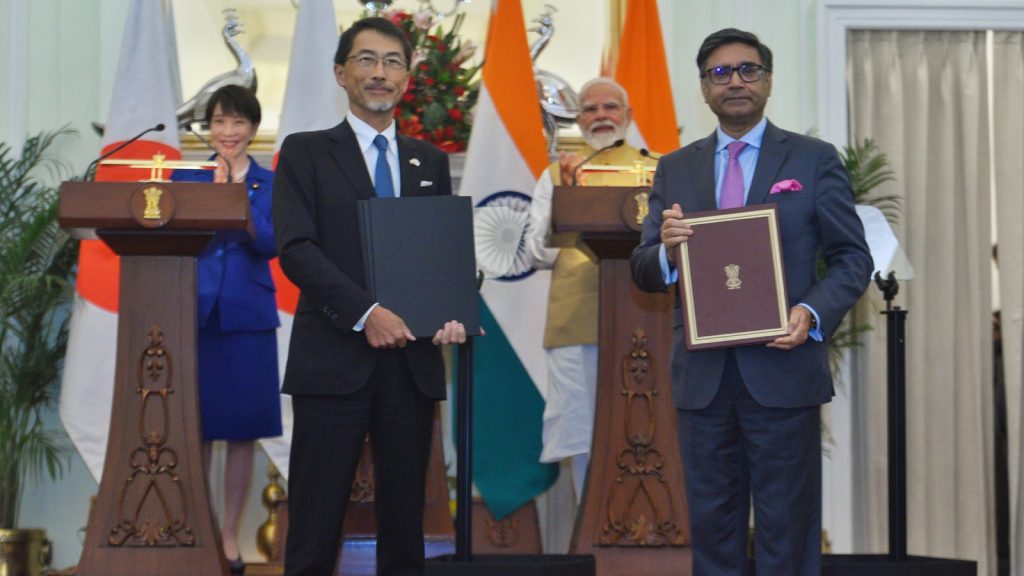
“In the defense sector, today we have signed an agreement on the first co-development project between India and Japan. This Naval Radio Antenna project will open a new chapter in our defense technology partnership. We will now jointly develop defense technologies that strengthen regional peace, maritime security, and rules-based order,” PM Modi said.
The two countries also expanded cooperation in healthcare and biotechnology.
“With the agreements signed today in pharma, medical devices, and bio-tech, we will also contribute to global health security. By combining India’s scale and Japan’s quality, we will work to provide affordable, reliable, and advanced health solutions to the world,” he said.
On economic ties, PM Modi said Japanese investments in India continue to gather momentum.
“The India-Japan Investment Partnership is continuously strengthening. Over 100 new business agreements have been signed in the last one year, which will bring more than $10 billion of Japanese investment to India. Today’s agreement between financial services agencies will further facilitate capital and investment flows,” he said.
“Our goal is clear: to attract 10 trillion yen of investment from Japan to India over the next 10 years, and to double the number of Japanese companies in India. Ongoing reforms in India have increased the ease of doing business, and Japanese companies can also benefit from this,” he added.
Emphasising the importance of economic and energy security amid global uncertainties, the Prime Minister announced a Joint Roadmap on Economic Security.
“In today’s uncertain times, both India and Japan understand the importance of economic security and energy security. Toward this end, today we have prepared a Joint Roadmap for economic security. Through this, we will strengthen supply chain resilience in strategic areas such as semiconductors, quantum, and advanced materials,” he said.
The two sides also unveiled several initiatives in clean energy, including the India-Japan Biogas Initiative.
PM Modi said, “We have also taken several important decisions in the field of energy security. Through the India-Japan Biogas Initiative, we will support the establishment of 1,000 biogas and organic fertilizer plants in India. This will further strengthen our Govardhan initiative. This will give new impetus to sustainability, prosperity, and rural livelihoods in Indian villages. Today, we have also launched an important initiative on energy resilience to address situations like oil shocks. Additionally, our cooperation in batteries, green hydrogen, and nuclear energy will significantly contribute to the world’s clean energy future.”
“India and Japan together view economic security as shared security, and energy transition as a shared opportunity, and we will work towards advancing and transforming them,” PM Modi added.
He also announced the launch of the India-Japan Next Generation Mobility Partnership Framework.
“Today we have also established the India-Japan Next Generation Mobility Partnership Framework. Through this, we will replicate our success story in the automotive sector in areas such as shipbuilding, aviation, and logistics,” he said.
Underscoring the importance of people-to-people ties, PM Modi said both countries would expand cooperation in education, research, skill development and innovation.
“A major strength of our relationship is our people-to-people ties. We are also expanding opportunities for talent mobility, skilling, and technical internship programs. We are also strengthening research, education, and start-up cooperation between our two countries,” he said.
“We are very pleased that next year we will celebrate the 75th anniversary of India-Japan diplomatic relations. On this important occasion, we will connect and deepen our cooperation in culture, tourism, and the creative economy,” PM Modi added.
Concluding his remarks, the Prime Minister expressed confidence that the partnership would continue to scale new heights.
He said, “The economies of India and Japan are complementary. From cultural values to modern technology, our thinking and approach also share similarities. And above all, the foundation of our relationship rests on unwavering mutual trust. I am confident that this special partnership will take your vision of a strong and prosperous Japan, our resolve for a developed India, and global progress to new heights.”
“Let us together realize your vision of a strong and prosperous Japan, our resolve for a developed India, and global progress,” added PM Modi.
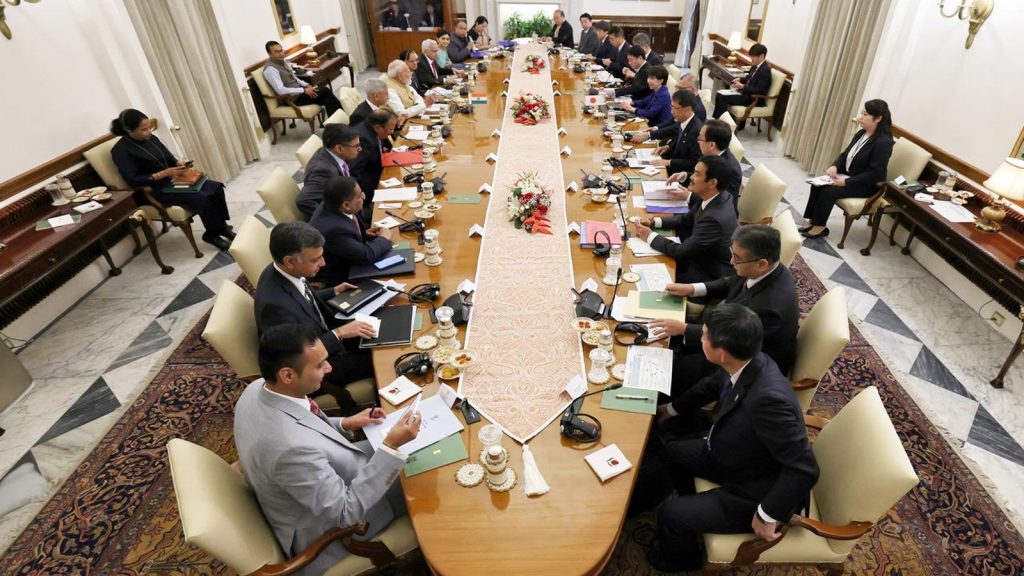
Following the summit, Ministry of External Affairs (MEA) spokesperson Randhir Jaiswal said the leaders held “wide-ranging talks on the full spectrum of India-Japan ties, including trade and investment, economic security, energy, emerging technologies, defence and people-to-people exchanges,” and also exchanged views on regional and global developments of mutual interest.
According to the MEA, the summit resulted in the adoption of three landmark documents – the Joint Declaration on Economic Security, the Joint Statement on Cooperation in the Field of Artificial Intelligence, and the Joint Statement on Energy Resilience. The two leaders also witnessed the exchange of several memoranda of understanding and agreements covering economic security, clean energy, critical technologies, and research and development, while agreeing on a calendar of activities to commemorate the 75th anniversary of the establishment of diplomatic relations between India and Japan next year.


