







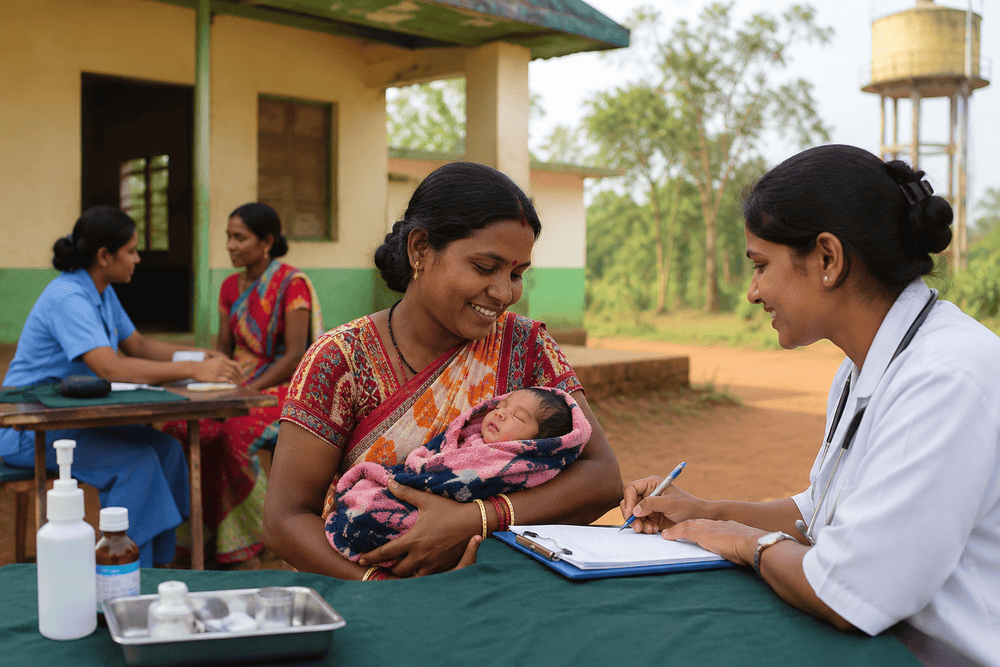
Chhattisgarh’s Mukhyamantri Swasth Bastar Abhiyan has led to a significant improvement in maternal and child healthcare in Sukma district, with a decline in the Maternal Mortality Rate (MMR) and Infant Mortality Rate (IMR), alongside a rise in institutional deliveries to 98.6 per cent, officials said.
The campaign has focused on the early identification of pregnant women, regular antenatal check-ups, monitoring of high-risk pregnancies and promotion of institutional deliveries, contributing to improved health outcomes in the district.
Sukma, once severely affected by Left Wing Extremism and challenges in delivering healthcare services to remote villages, has witnessed considerable progress, with health teams reaching remote habitations despite difficult terrain, including dense forests and hilly areas.
Chief Minister Vishnu Deo Sai said the state was making steady progress in reducing maternal and infant mortality.
“Chhattisgarh is making commendable strides toward reducing maternal and infant mortality rates. Maternal deaths have reduced compared to previous records in the state. We are actively working to further reduce these figures,” Sai said.
Sukma Collector Amit Kumar said the campaign has brought all pregnant women under the health department’s monitoring system.
“Earlier, many pregnant women remained outside the regular monitoring network of the health department. However, through this campaign, everyone has now been registered and brought under the umbrella of health check-ups,” he said.
Kumar added that institutional deliveries in the district have increased from around 96-97 per cent to 98.6 per cent. He also said maternal deaths have declined to single digits from 11 cases recorded last year.
Chief Minister Sai launched the Mukhyamantri Swasth Bastar Abhiyan in Sukma on April 14 with the objective of extending healthcare services to the remotest villages in the Bastar region. Under the programme, health teams are conducting door-to-door health check-ups, identifying pregnant women and screening residents for conditions such as hypertension, diabetes, anaemia and sickle cell disease.
Chief Medical and Health Officer Dr R.K. Singh said identifying high-risk pregnancies and ensuring timely treatment remains the campaign’s top priority. He said more than 2,000 people suffering from anaemia have been identified and placed under treatment, while pregnant women with sickle cell disease are being closely monitored and provided blood transfusions whenever required.
Auxiliary Nurse Midwife (ANM) Mandavi Rajeshwari said pregnant women are registered, tested, vaccinated and provided regular follow-up care during the first trimester. She added that families are being informed about the benefits of institutional deliveries and government welfare schemes. Health facilities have also been equipped with essential neonatal and maternal care services, while ambulance services are available within 15 to 20 minutes when required.
Community Health Officer (CHO) Anjali Baghel of Minpa Health Centre said sustained awareness campaigns have increased public confidence in institutional deliveries.
“Earlier, deliveries used to happen mostly at home, but continuous public awareness campaigns have built trust in hospitals,” she said, adding that safe institutional deliveries have helped protect the lives of mothers and newborns and contributed to reducing maternal and infant mortality.
(With ANI inputs)


