







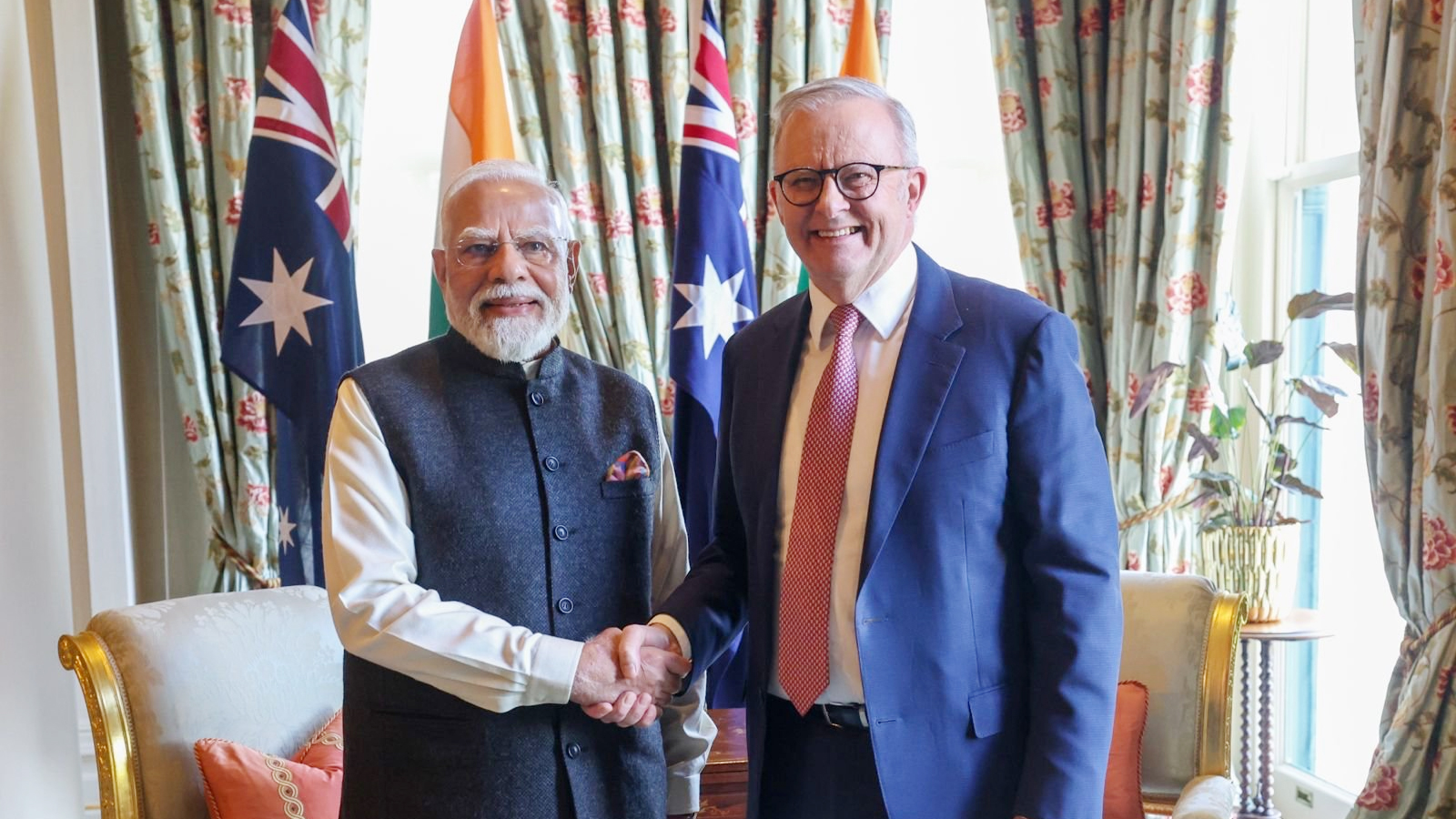
India and Australia on Thursday unveiled an ambitious package of 18 agreements and initiatives spanning defence, maritime security, clean energy, critical technologies, education, skill development and cultural cooperation, marking a major expansion of their Comprehensive Strategic Partnership following the third India-Australia Annual Summit.
The outcomes announced during Prime Minister Narendra Modi’s visit to Australia are aimed at strengthening bilateral cooperation across strategic, economic and people-to-people sectors while reinforcing a shared vision for a free, open and prosperous Indo-Pacific.
At the heart of the announcements was a new Joint Declaration on Defence and Security Cooperation, which replaces the 2009 Joint Declaration on Security. The agreement significantly broadens defence collaboration by focusing on military interoperability, maritime security, defence industrial cooperation, cybersecurity, counter-terrorism, humanitarian assistance and disaster relief (HADR), and cooperation through regional groupings such as the Quad, ASEAN, the Indian Ocean Rim Association (IORA) and the Pacific Islands Forum (PIF).
Complementing the declaration, both countries adopted a Maritime Security Collaboration Roadmap to deepen cooperation through enhanced information sharing, capability development and operational coordination. India and Australia also signed a Memorandum of Understanding between the Indian Coast Guard and Australia’s Maritime Border Command to strengthen collaboration in maritime law enforcement, maritime domain awareness and border protection.
In another significant defence initiative, Australia invited an Indian military instructor to serve at the Australian Defence College during 2028-29, further expanding military-to-military engagement.
Energy security and clean energy cooperation featured prominently in the summit outcomes. India and Australia issued a Joint Statement on Energy Security reaffirming their commitment to ensuring secure and resilient energy supply chains amid growing geopolitical uncertainties. The two countries also finalised the administrative arrangements under the India-Australia Civil Nuclear Agreement, operationalising the pact signed in 2014 and enabling the export of Australian uranium to India for peaceful civilian use.
The leaders also announced the operationalisation of the Rooftop Solar Training Academy at Pandit Deendayal Energy University in Gandhinagar. Established through collaboration involving Australia’s Department of Climate Change, Environment and Water, India’s Sector Skills Council for Green Jobs and ReNew, the academy aims to train 2,000 women and youth as solar technicians and installers in support of the PM Surya Ghar Yojana.
Recognising the strategic importance of emerging technologies, the two countries launched the Australia-India Partnership on Cyber, Critical Technologies and Supply Chains (PACTS). The initiative builds on the 2020 cyber cooperation framework and seeks to strengthen collaboration in cybersecurity, critical technologies, digital resilience and resilient supply chains.
The technology partnership was further expanded through the signing of a trilateral Memorandum of Understanding under the Australia-Canada-India Technology and Innovation (ACITI) Partnership, which aims to promote collaboration in emerging technologies and innovation.
Cooperation in critical minerals also received a boost with a renewed Memorandum of Understanding between Geoscience Australia and the Geological Survey of India to support advanced mineral exploration, technological modernisation, capacity building and scientific cooperation.
In the education and skills sector, both countries announced several initiatives to strengthen academic and vocational collaboration. Australia handed over a Letter of Intent to Flinders University to establish a campus in Bengaluru, while Victoria University received approval to operationalise its campus in Gurugram.
India’s Ministry of Skill Development and Entrepreneurship and the Government of Western Australia’s Technical and Further Education (TAFE) signed an agreement to establish a Centre of Excellence in Mining Equipment, Technology and Services at the National Skill Training Institute in Bhubaneswar. The centre will focus on specialised training in mining operations, mine safety, mineral processing and mining machinery while facilitating student and trainee exchanges.
A separate Letter of Intent between India’s National Council for Vocational Education and Training and the Australian Skills Quality Authority will strengthen quality assurance, occupational standards, regulatory cooperation and capacity building in vocational education and training.
Scientific collaboration was also expanded through a Memorandum of Understanding between the Council of Scientific and Industrial Research (CSIR) and the University of Melbourne covering collaborative research, faculty exchanges, trainee programmes and drug discovery research. CSIR also signed an agreement with IP Australia, providing access to India’s Traditional Knowledge Digital Library to support patent examination and safeguard India’s traditional knowledge.
Cultural and creative cooperation also featured in the summit outcomes. Australia agreed to repatriate three significant Indian antiquities—a granite Nandi sculpture dating to the 11th-12th century, an 11th-century bronze Bhadrakali trident and a 12th-century basalt sculpture of six-headed Skanda (Karttikeya). In addition, the Satyajit Ray Film and Television Institute in Kolkata signed an agreement with Griffith Film School in Australia to collaborate on film education, workshops, academic exchanges and joint creative projects.


