







Recognising soil as a strategic national resource critical to food security, agricultural productivity and rural livelihoods, India is accelerating efforts to promote scientific soil management through sustainable farming practices, digital technologies and climate-resilient agriculture.
According to the government, healthy soil forms the foundation of India’s agricultural economy, which supports more than 46 per cent of the country’s workforce. With nearly 59 per cent of India’s reported geographical area under agriculture, maintaining soil fertility has become central to ensuring higher farm productivity, improving rural incomes and achieving the Sustainable Development Goals, particularly those related to zero hunger and climate action.
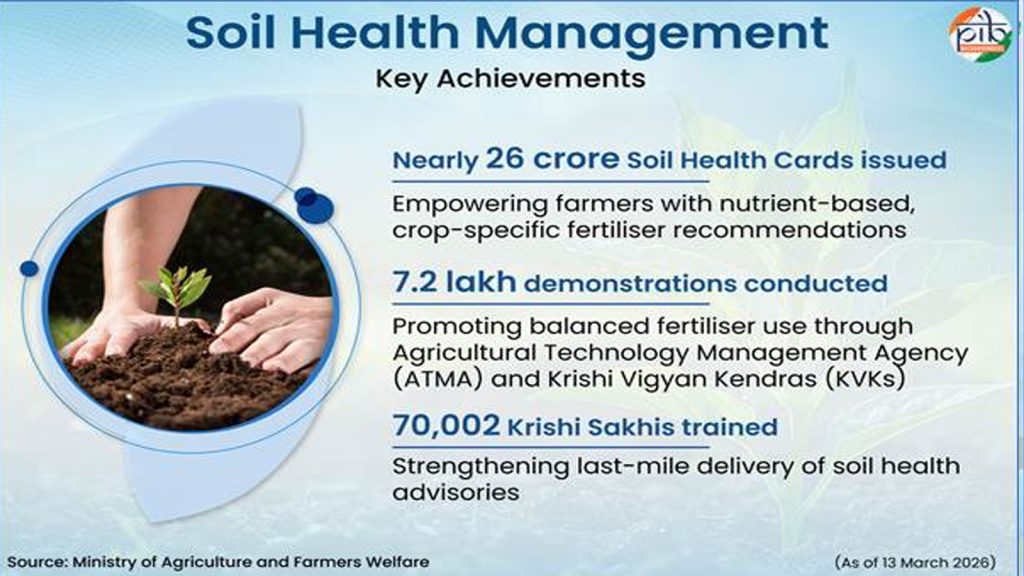
Over the past decade, the government has introduced a series of initiatives aimed at improving soil health while reducing the environmental impact of farming. The Soil Health Card Scheme, launched to encourage scientific nutrient management, has emerged as one of the country’s flagship programmes. As of March 13, 2026, more than 25.89 crore Soil Health Cards had been generated, providing farmers with crop-specific recommendations based on soil testing to promote balanced fertiliser use and improve productivity.
The initiative has also been supported through farmer demonstrations and grassroots outreach. Around 7.17 lakh demonstrations have been conducted to promote balanced fertiliser application through Agricultural Technology Management Agencies (ATMA) and Krishi Vigyan Kendras (KVKs). In addition, 70,002 Krishi Sakhis have been trained to disseminate soil health advisories, while the School Soil Health Programme has engaged 4,430 schools and over 1.29 lakh students during 2025-26 in soil testing and awareness activities.
The government’s push towards sustainable agriculture has also gained momentum through the National Mission on Natural Farming (NMNF), launched in 2024. The mission seeks to reduce farmers’ dependence on chemical inputs by promoting scientifically informed natural farming practices that improve soil organic carbon and strengthen climate resilience. As of March 2026, the mission had expanded to 18,786 clusters covering 8.80 lakh hectares, with over 18.19 lakh farmers enrolled.
The programme is backed by an extensive training ecosystem comprising 33,676 Community Resource Persons and a network of training institutions. Bio-input Resource Centres established under the mission are supplying natural farming inputs such as Beejamrit and Jeevamrit while also conducting demonstrations and training programmes to encourage wider adoption of sustainable agricultural practices.
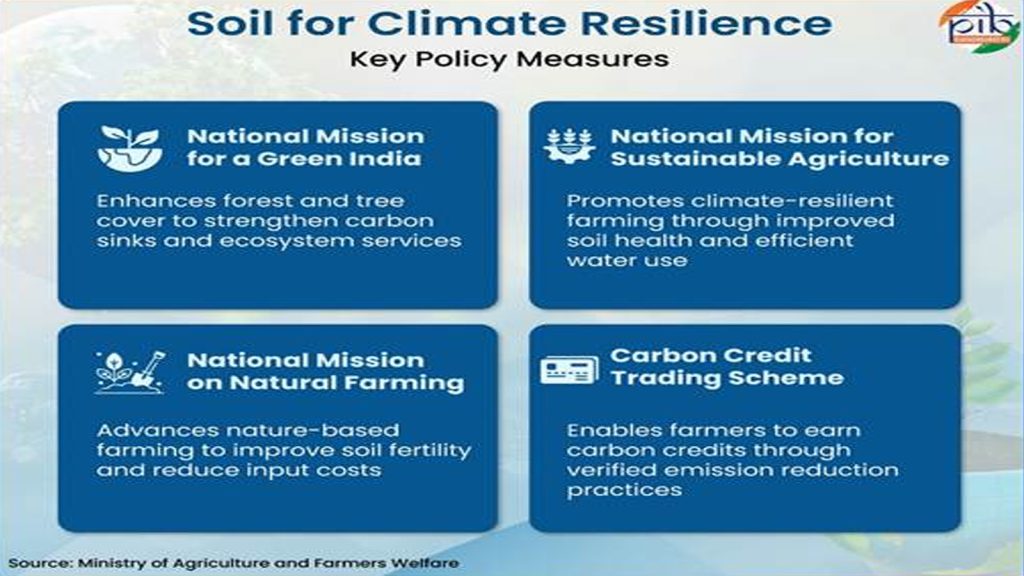
Soil conservation has also become an integral part of India’s climate strategy. The government noted that soils function as natural carbon sinks by storing atmospheric carbon in the form of soil organic carbon, improving soil fertility, moisture retention and resilience against climate variability. Several national programmes, including the National Mission for Sustainable Agriculture, the Green India Mission and the Carbon Credit Trading Scheme, are supporting farming practices that enhance carbon storage and promote climate-smart agriculture.
The Green India Mission, implemented under the National Action Plan on Climate Change, aims to create an additional carbon sink of 2.5 to 3 billion tonnes of carbon dioxide equivalent by 2030 through expanded forest and tree cover. According to the India State of Forest Report 2023, the country had already created an additional carbon sink of 2.29 billion tonnes of CO₂ equivalent between 2005 and 2021, indicating significant progress towards this target.
The National Mission for Sustainable Agriculture, launched in 2014-15, has also contributed to improving soil health by promoting integrated farming systems, water conservation and climate-resilient agricultural practices. Since its inception, ₹2,119.84 crore has been released under the Rainfed Area Development component, covering 8.50 lakh hectares and benefiting 14.35 lakh farmers.
The government has simultaneously undertaken reforms to promote balanced fertiliser use. Under the Nutrient Based Subsidy (NBS) Scheme, subsidies are linked to the nutrient content of fertilisers, encouraging farmers to adopt balanced nutrient application. Aadhaar-enabled Point of Sale devices under the Direct Benefit Transfer system ensure that subsidies are released based on actual sales, while 100 per cent neem coating of domestically produced urea has been made mandatory to improve nitrogen-use efficiency and reduce diversion for non-agricultural purposes. Fertiliser subsidy disbursements amounted to ₹6.77 lakh crore between 2022-23 and July 2025.
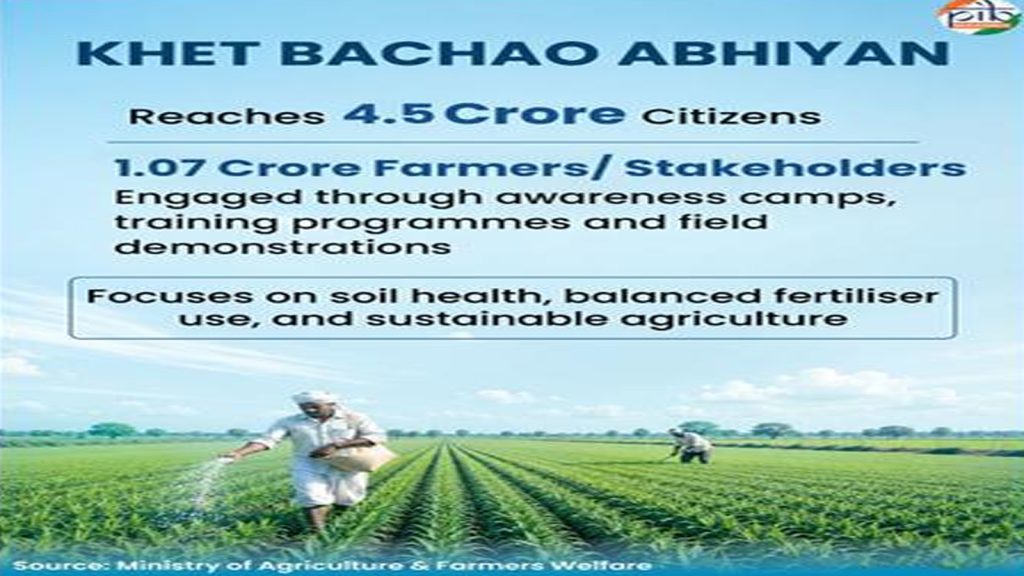
To complement these measures, the government launched the Khet Bachao Abhiyan during June 2026 to create awareness about balanced fertiliser use and sustainable farming. Led by the Indian Council of Agricultural Research (ICAR) and the Department of Agriculture and Farmers Welfare, the month-long campaign organised 99,489 interaction meetings, 25,178 awareness camps, 6,721 training programmes and 96,227 field demonstrations on green manuring and bio-fertilisers. The campaign directly reached around 1.07 crore farmers and stakeholders, while approximately 4.5 crore citizens were engaged through social media.
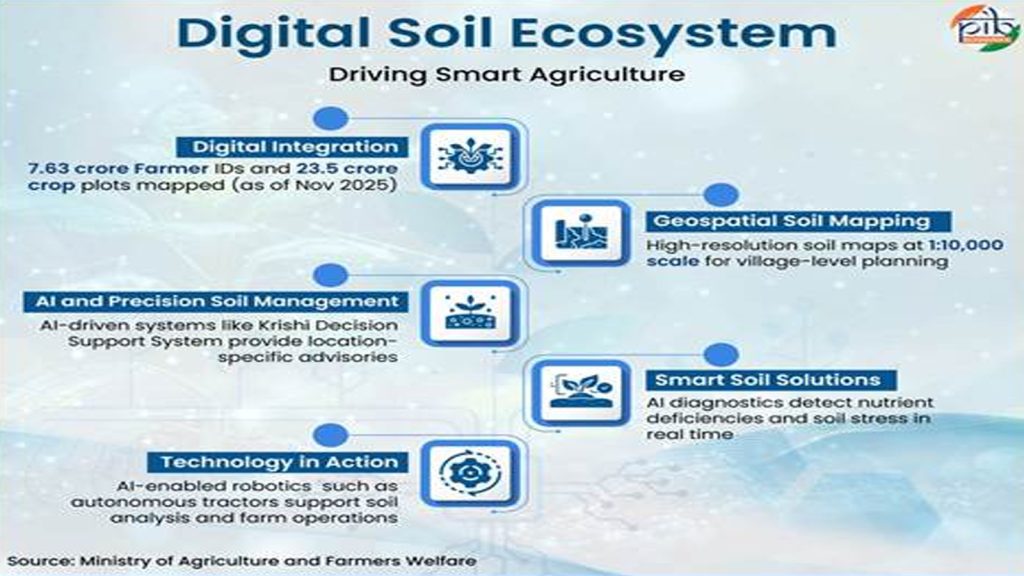
The government is also increasingly relying on digital technologies to improve soil assessment and farm-level decision-making. High-resolution soil mapping under the Nationwide Soil Resource Mapping project is combining satellite imagery with field observations to prepare village-level soil inventories. By September 2024, around 29 million hectares had been mapped against a target of 142 million hectares of agricultural land. Financial assistance of ₹1,076 crore has been provided to six states—Uttar Pradesh, Madhya Pradesh, Rajasthan, Maharashtra, Tamil Nadu and Andhra Pradesh—to accelerate the creation of reliable soil resource datasets.
Digital agriculture platforms are further strengthening these efforts by integrating farmer, land and soil data. Under the Digital Agriculture Mission, platforms such as AgriStack are linking soil information with crop and land records to generate location-specific advisories. As of November 27, 2025, more than 7.63 crore Farmer IDs had been generated, while 23.5 crore crop plots were surveyed during the Rabi 2024-25 season to facilitate precision farming.
Artificial intelligence is also emerging as an important tool in soil management. AI-enabled platforms are using satellite imagery, remote sensing and field-level data to detect nutrient deficiencies, assess soil stress and generate advisories on crop planning, fertiliser application and water management. Precision farming technologies and robotic systems being developed by institutions such as ICAR–Indian Agricultural Research Institute are further supporting efficient resource use and improving farm productivity.
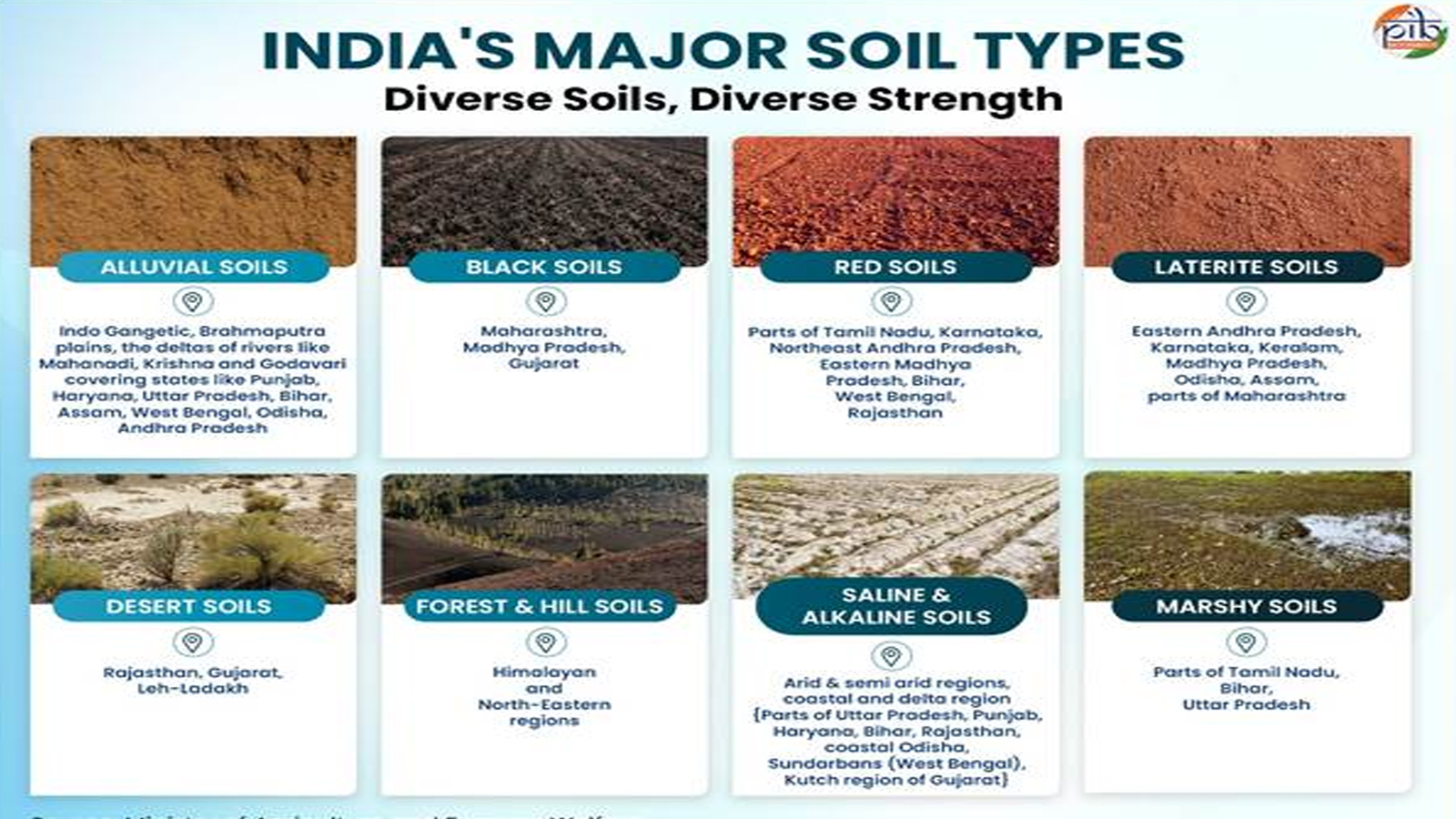
The government highlighted that India’s diverse soil profile—including alluvial, black, red, laterite, desert, forest, saline and marshy soils—supports a wide range of cropping systems across different agro-climatic regions. Protecting this diversity through scientific management and sustainable practices remains essential for ensuring long-term agricultural growth and climate resilience.
With initiatives spanning soil testing, natural farming, balanced nutrient management, digital agriculture and public awareness, the government said India is steadily building a comprehensive framework to conserve soil resources while improving farm productivity and supporting sustainable agricultural development.


