







Human trafficking is no longer confined to forced labour or sexual exploitation. Increasingly, organised criminal networks are trapping victims inside online scam operations, forcing them to commit cyber fraud through threats, violence and coercion. Highlighting this emerging challenge, this year’s World Day Against Trafficking in Persons, observed annually on July 30, has the theme “Trapped Behind the Scam.”
The campaign, led by the United Nations Office on Drugs and Crime (UNODC), draws attention to a rapidly expanding form of trafficking in which organised crime groups lure people with fake overseas job offers before forcing them to operate large-scale online scam centres. Victims are coerced into carrying out romance scams, cryptocurrency fraud and other cyber-enabled financial crimes while being held in exploitative conditions.
India’s legal and institutional response
According to the National Crime Records Bureau (NCRB), 2,166 cases were registered under the Immoral Traffic (Prevention) Act, 1956 in 2023, compared to 1,497 cases in 2022. The number of cases stood at 1,678 in 2021, 1,294 in 2020, and 1,639 in 2019.
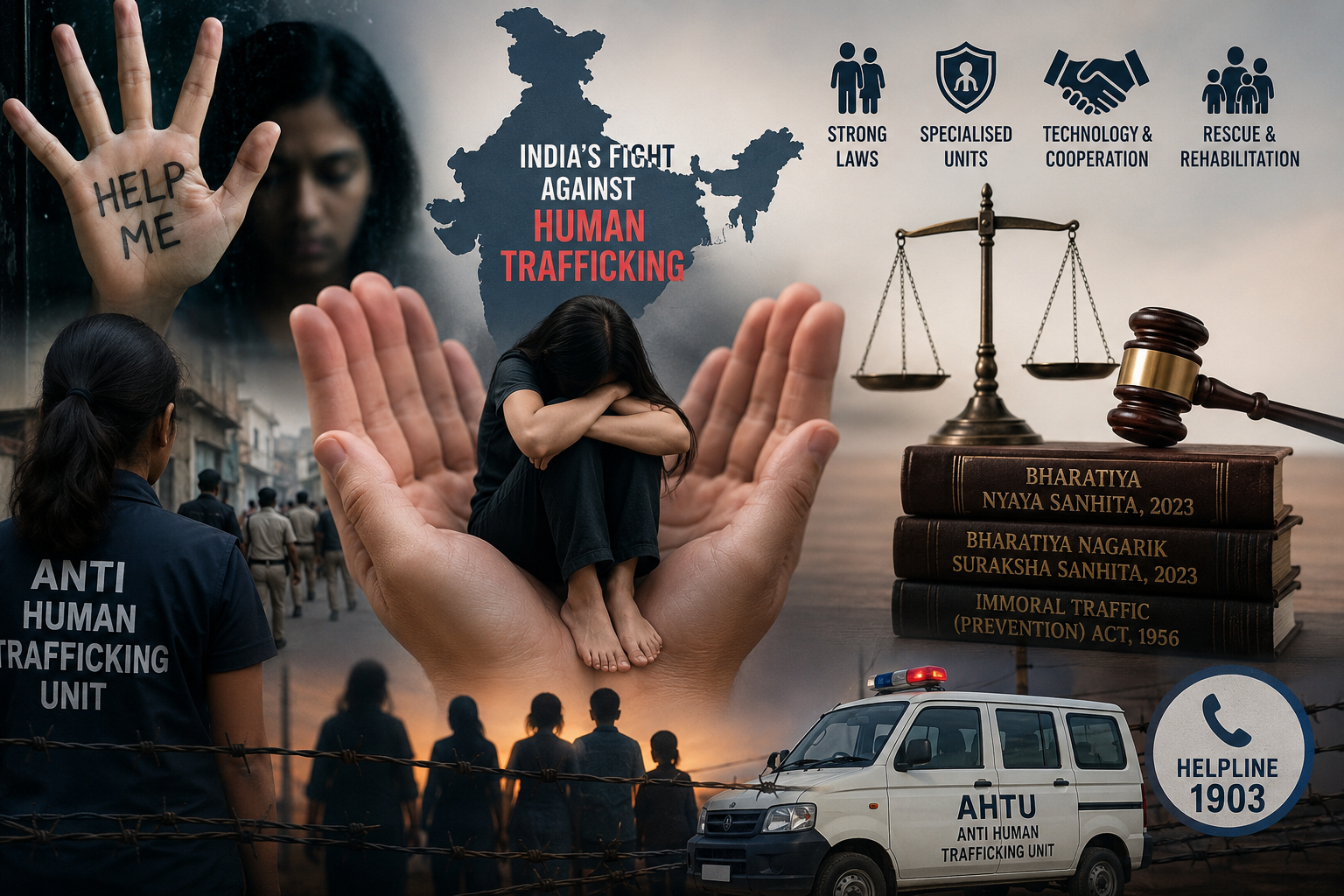
While maintaining law and order is the responsibility of state governments, the Centre has introduced several legislative, institutional and technological measures to strengthen anti-trafficking efforts across the country.
Institutional and international measures
To strengthen enforcement, the Government has established 827 Anti Human Trafficking Units (AHTUs) across the country. Other key initiatives include the Crime Multi Agency Centre (Cri-MAC) for real-time information sharing among law enforcement agencies, the National Database of Human Trafficking Offenders (NDHTO), and the National Investigation Agency (NIA), which investigates trafficking cases involving inter-state, national or international ramifications.
On the rehabilitation front, the Centre provides support through Shakti Sadan under Mission Shakti for women rescued from trafficking, while Mission Vatsalya provides care and rehabilitation services for trafficked children.
Recognising the transnational nature of the crime, India has also signed bilateral Memoranda of Understanding with Bangladesh, the United Arab Emirates (UAE), Cambodia and Myanmar, while participating in multilateral cooperation mechanisms to strengthen action against cross-border human trafficking.
New criminal laws strengthen legal framework
The Government has further strengthened the legal framework through the Bharatiya Nyaya Sanhita (BNS), 2023.
Sections 143 and 144 define offences related to trafficking and the exploitation of trafficked persons, prescribing enhanced punishment for trafficking children and multiple victims. The BNS also recognises trafficking under provisions relating to organised crime, child exploitation, buying children for prostitution, and offences committed through deception, including false promises of marriage or employment.
The Bharatiya Nagarik Suraksha Sanhita (BNSS), 2023 classifies trafficking as a cognisable and non-bailable offence and mandates victim compensation schemes through State Governments to support rehabilitation.
These provisions complement the Immoral Traffic (Prevention) Act, 1956, which continues to address trafficking for commercial sexual exploitation.
From fake job offers to digital captivity
Traffickers often advertise seemingly legitimate employment opportunities abroad. Once victims reach their destination, they are confined in heavily guarded scam compounds where their passports are confiscated and their movement is tightly restricted.
Victims are subjected to constant surveillance, violence, intimidation, debt bondage and unrealistic work targets, leaving them with little opportunity to escape. This emerging form of exploitation reflects the growing convergence of cybercrime, money laundering, corruption and transnational organised crime.
The International Organization for Migration (IOM) has warned of a sharp rise in the number of people forced to work in scam compounds across Asia, with victims from more than 80 countries reportedly lured through fake recruitment advertisements and social media.
According to the IOM, large scam centres employing up to 300,000 workers have emerged across Myanmar, Cambodia and Laos, carrying out online fraud schemes that primarily target victims overseas. Many of those operating these scams were themselves deceived with promises of legitimate employment before being stripped of their documents and forced into cyber fraud under threats and violence.
The agency has also reported that many victims endure sexual abuse, solitary confinement, stigma and debt, making rehabilitation even more challenging after their rescue.
A multi-billion-dollar criminal enterprise
According to UNODC estimates, online scam operations in East and South-East Asia caused financial losses ranging between USD 18 billion and USD 37 billion in 2023, with a significant share linked to organised criminal groups operating across the region.
The figures underscore the growing scale of trafficking-driven cyber fraud and highlight the need for stronger international cooperation to combat a crime that increasingly transcends national borders.
(Inputs from Reuters)


