







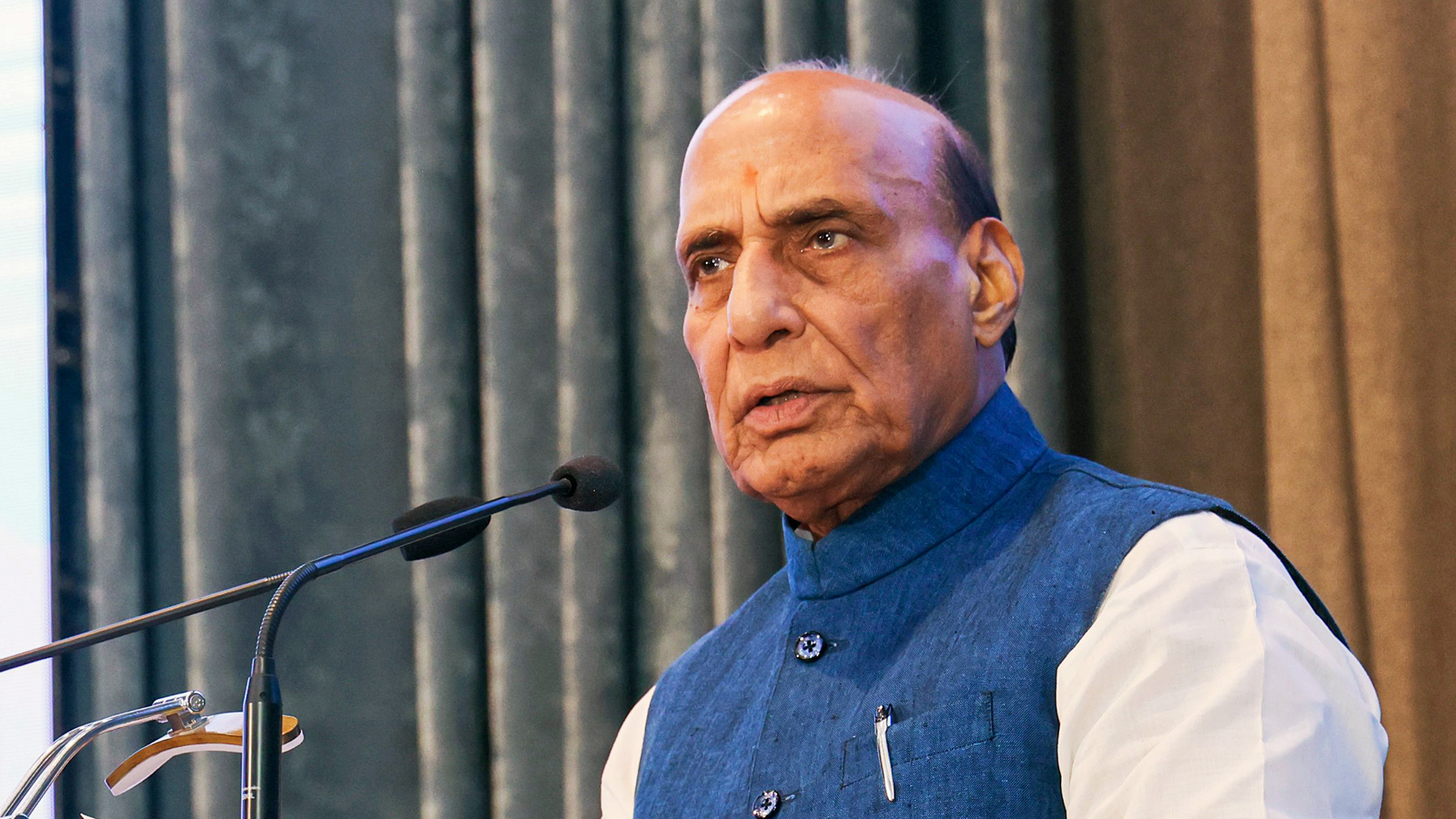
Defence Minister Rajnath Singh on Thursday launched a series of digital and financial management initiatives aimed at strengthening the integration of financial systems across the armed forces, improving defence expenditure monitoring and enhancing transparency in defence financial management.
Singh launched the initiatives while addressing the 279th Annual Day celebrations of the Defence Accounts Department (DAD) at DRDO Bhawan in New Delhi.
Congratulating the DAD on nearly three centuries of service, the Defence Minister described the department’s contribution to defence financial audit and management as a backbone of the country’s defence preparedness.
“Maximum digitization, maximum automation, maximum transparency – this should be our goal,” Singh said, calling for greater integration of the financial systems of the Army, Navy and Air Force.
He also stressed the need to move from an “annual review” to an “any time review” of defence budgets, with real-time data enabling timely and informed decision-making.
SAKSHAM integrated with Army financial system
Singh commended SAKSHAM, the DAD’s project for digitising and integrating the defence accounting and payment ecosystem.
Hosted on a secure dedicated data centre and operating over the DAD Wide Area Network, SAKSHAM uses a modern technology stack, secure role-based access, enhanced validation mechanisms and scalable architecture.
The system supports the government’s broader objective of “One Nation, One Function, One Application” and has been integrated with the Indian Army Financial Information System (IAFIS) for budget, approval and bill-related data.
The integration of the SAKSHAM bill audit and payment system with IAFIS enables digital transmission of budget, sanction and bill information between the two systems. It also facilitates real-time sharing of bill status and budget balances and enables completely paperless processing of bills.
Push for real-time financial monitoring
The Defence Minister highlighted the near 100 per cent expenditure during 2025-26, crediting the DAD and the three Services for achieving the milestone.
Referring to the successful cleaning of data under SPARSH, Singh suggested that grievance redressal should increasingly be automated through a Conversational AI ecosystem covering chat, SMS, WhatsApp, email and phone calls.
He also emphasised the importance of quality audits, digital data cleaning and prompt resolution of grievances and court cases.
“Our approach must be firm, fair, sensitive and responsible, especially when dealing with the legitimate dues and service rights of those who have devoted their lives to defending the nation,” he said.
Singh also called for the early implementation of SAMPURNA, a fully automated, end-to-end revenue procurement system designed to use data analytics, Artificial Intelligence and Machine Learning as a decision-support mechanism.
Treasury Single Account launched for Defence Ministry
The Defence Minister also inaugurated the Treasury Single Account (TSA) system in the Ministry of Defence, aimed at enabling just-in-time release of funds to autonomous bodies under the Central government.
The system has been operationalised through the Payment Routing and Integrated System Management (PRISM) platform and is fully integrated with RBI eKUBER.
The TSA is expected to improve grant management for autonomous bodies under the Defence Ministry while providing greater visibility of accounting and expenditure.
Revamped National Compilation System
Another major initiative launched at the event was the revamped National Compilation System (NCS) for Defence.
The NCS serves as the single source for accounting and compilation of defence expenditure across the country.
Given the Defence Ministry’s financial delegation framework, budget allocation and expenditure have to be tracked across various Controllers of Defence Accounts operating across the country.
The revamped NCS has been redesigned on a new technical architecture to improve the accuracy of budget reporting and expenditure monitoring.
It will provide granular reporting to the Ministry of Finance, Ministry of Defence, Service Headquarters and field controllers, supporting policy planning and improved budget management.
Awards recognise digital reforms
The Raksha Mantri Awards for Excellence 2026 were also presented during the event to recognise teams and individuals for outstanding achievements in implementing reforms and projects in defence financial management.
The awards recognised innovation, professionalism and efficiency, as well as contributions to institutional capacity and transparency.
DAD officials were recognised for the successful digitisation of the Annual Review of Balances (ARoB) and implementation of initiatives including SAKSHAM and SAMAR-SETU.
SAMAR-SETU is a centralised application for managing the pay and allowances of Agniveers of the Indian Army. Operating through the Central Agniveer Pay and Accounts Office (CAPAO), the system manages the pay accounts of more than 2.3 lakh Agniveers through automated, system-driven processes.
Publications and SPARSH film released
Singh also released three publications during DAD Day 2026 – the Comprehensive Statistical Handbook on Defence Expenditure (COSHE) 2026, Raksha Lekha Bharati and the Market Intelligence Report 2025-2026.
A film showcasing the achievements of the System for Pension Administration (Raksha), SPARSH, was also screened during the event.
Controller General of Defence Accounts Alka Nangia Arora highlighted the department’s recent initiatives, including significant progress in centralising and digitising its core functions of internal audit, payments and accounting, financial advice and management of defence pensions.
The event was attended by Chief of Defence Staff General NS Raja Subramani, Chief of the Naval Staff Admiral Krishna Swaminathan, Chief of Army Staff General Dhiraj Seth, Defence Secretary Rajesh Kumar Singh, Secretary (Defence Finance) Vishvajit Sahay and Vice Chief of Air Staff Air Marshal Ashutosh Dixit, besides senior officials of the Ministry of Defence.


