







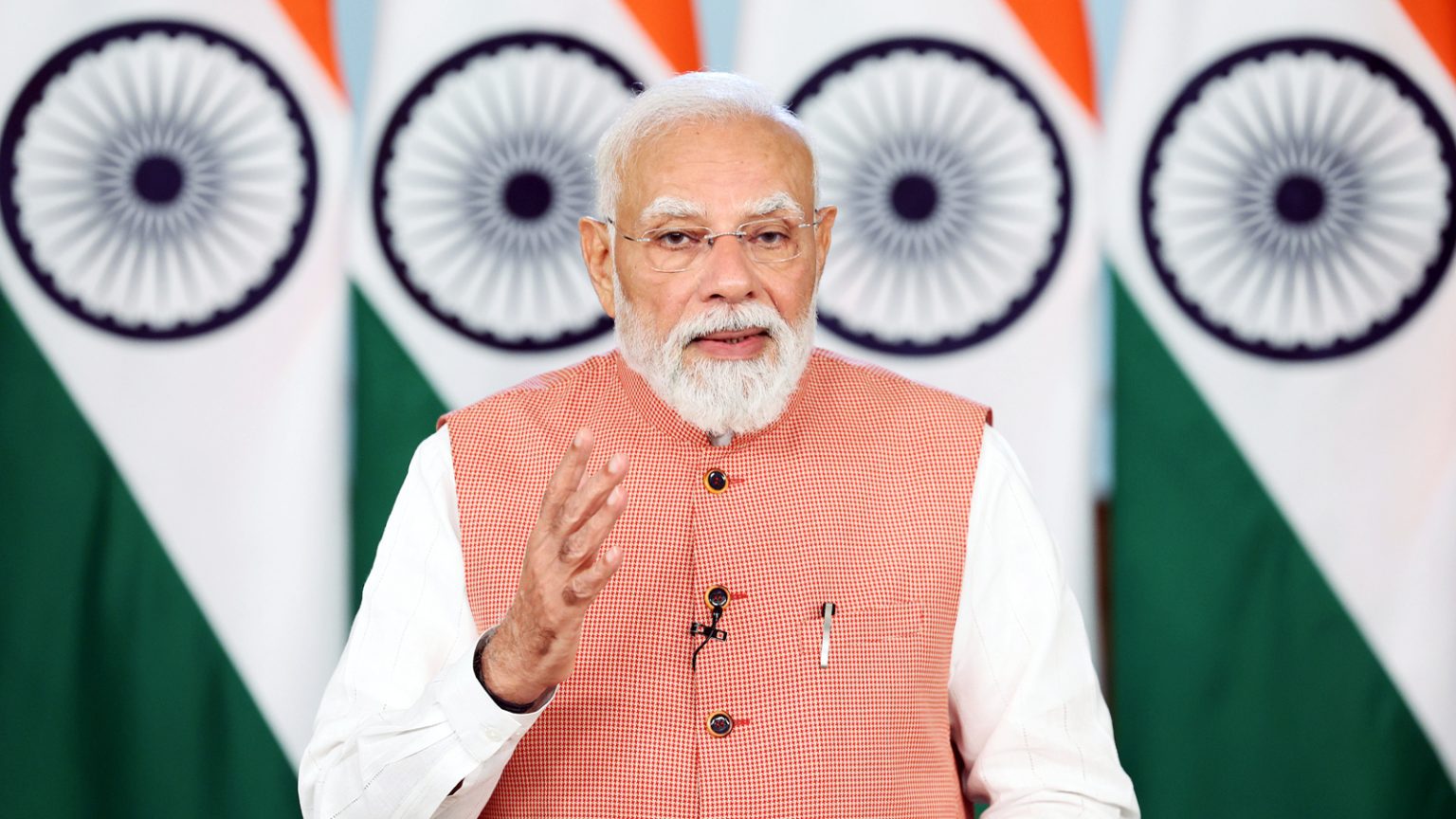
Prime Minister Narendra Modi on Friday praised President Droupadi Murmu’s address to the nation on the eve of the 80th Independence Day, describing it as “motivating and thoughtful”.
In a post on X, PM Modi said, “A motivating and thoughtful address by Rashtrapati Ji on the eve of Independence Day. Her thoughts reflect the strength of our nation and the aspirations of every Indian. Her message inspires us all to work with renewed determination for a Viksit Bharat.”
In her address, President Murmu extended her greetings to citizens in India and abroad and said the country was entering the 80th year of its Independence. She emphasised that the true meaning of freedom lies in ensuring that every citizen has the opportunity to fulfil their aspirations and contribute to making India a leading nation.
The President said students, teachers, scientists, engineers, doctors, healthcare workers, farmers, workers, sportspersons, artisans, artists, entrepreneurs, public representatives, civil servants, social workers and sanitation workers were all contributing to nation-building. She also paid tribute to the soldiers of the Armed Forces, Armed Police Forces and police personnel for their dedication, while appreciating the contribution of the Indian diaspora in enhancing India’s standing globally.
Highlighting the goal of building Viksit Bharat by 2047, President Murmu said development must reach every individual, guided by the principle of Antyodaya. She called for a balance between India’s rich heritage and modern development, while recalling the contributions of Mahatma Gandhi, B.R. Ambedkar, Mahatma Jyotiba Phule, Savitribai Phule and Sardar Vallabhbhai Patel to the country’s freedom, social reform and national integration.
Referring to Partition, the President observed Vibhajan Vibheeshika Smriti Divas on August 14 by remembering those who lost their lives or were displaced during the violence surrounding Partition. She also paid tribute to Sardar Patel for integrating more than 550 princely states into independent India.
President Murmu underlined the importance of public participation in strengthening democracy and said the Constitution guarantees equality of status and opportunity along with the dignity of the individual. She stressed that the Executive, Legislature and Judiciary must discharge their respective responsibilities while ensuring that citizens, particularly those from deprived sections, have equal access to justice.
Highlighting developments over the past decade, the President pointed to rapid and inclusive growth, the harmonisation of heritage with development and the removal of long-standing barriers to progress. She cited the lifting of more than 25 crore people out of poverty, expansion of financial inclusion through the Pradhan Mantri Jan Dhan Yojana, free foodgrain support for more than 80 crore people and healthcare coverage under Ayushman Bharat for around 60 crore people.
President Murmu also highlighted India’s digital transformation, noting the widespread use of digital payments and the expansion of digital infrastructure that has enabled transparent delivery of welfare benefits. The expansion of highways, waterways, railways and airways, she said, was creating new economic opportunities, generating employment and strengthening investor confidence.
On the economy, President Murmu said India was continuing to grow despite global instability and conflicts, while the Atmanirbhar Bharat Abhiyan had strengthened the foundations of economic progress and national security. She also highlighted India’s efforts towards renewable energy and sustainable development.
The President said national interest remained the foundation of India’s foreign policy, with peace, cooperation, dialogue and the principle of Vasudhaiva Kutumbakam serving as its guiding pillars. She noted India’s growing engagement with the Global South and its efforts to promote a rules-based international order and greater representation for developing countries in multilateral institutions.
Environmental protection also featured prominently in her address. President Murmu urged citizens to safeguard natural resources for future generations and called for individual and collective action through initiatives such as Ek Ped Maa Ke Naam and Lifestyle for Environment (LiFE).
The President placed particular emphasis on women and youth, describing India’s young population as one of its greatest assets. She highlighted the increasing participation of women in education, the economy, entrepreneurship, sports and leadership, noting that women had won eight of India’s 13 gold medals at the recently concluded Commonwealth Games in Glasgow.
President Murmu said more than 10 crore women were members of Self Help Groups and noted the achievement of the target of creating three crore Lakhpati Didis. She also referred to the Nari Shakti Vandan Adhiniyam, enacted in 2023 to provide for 33 per cent representation for women in the Lok Sabha and state legislative assemblies.
With 65 per cent of the population below the age of 35, President Murmu described India’s youth as a key force behind the country’s future. She highlighted the growth of the start-up ecosystem, the increasing culture of entrepreneurship and the contribution of young Indians to innovation and space exploration.
The President also stressed the need to reform public examinations to make them more transparent, secure and free from unfair practices. She called for collective efforts by families, society and the government to safeguard the physical and mental wellbeing of young people and highlighted sports as an important instrument for youth development and nation-building.
President Murmu also spoke about the welfare of senior citizens, noting that people aged 70 years and above can avail themselves of healthcare coverage of up to Rs 5 lakh annually under government initiatives. She urged society to ensure that senior citizens are treated with dignity and a sense of belonging.
On national security, the President recalled Kargil Vijay Diwas and Operation Sindoor, paying tribute to the Armed Forces and highlighting their capability to respond to terrorism with precision. She also referred to the suspension of the Indus Waters Treaty as a decisive step in the national interest in view of Pakistan’s support for terrorism.
President Murmu said the decline of Naxalism was a major achievement and noted that areas once affected by Left Wing Extremism were witnessing development and greater participation in events such as the Bastar Olympics and Bastar Pandum.
The President also highlighted India’s cultural heritage, noting the inclusion of 12 Maratha forts in the UNESCO World Heritage List and the addition of Sarnath, associated with Buddha’s first sermon, to the list.
Concluding her address, President Murmu said the ultimate objective of Viksit Bharat was the development and wellbeing of every Indian. Quoting Telugu writer Gurajada Apparao, she stressed that a nation is not merely its land but its people.
She called upon citizens to dedicate themselves to the national goal of transforming Swatantra Bharat into Viksit Bharat through collective participation, patriotism and sustained efforts.


