







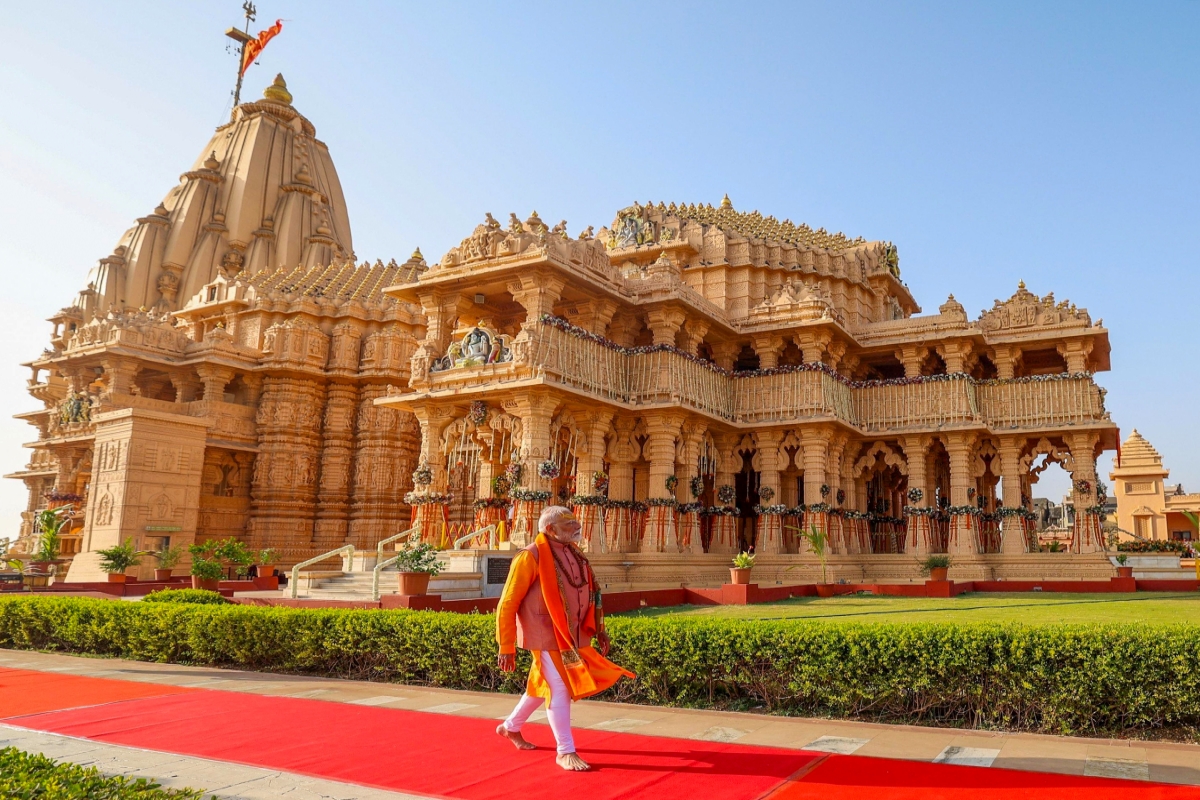
Prime Minister Narendra Modi on Sunday highlighted India’s historical resilience, cultural heritage and commitment to preserving its ancient legacy, recalling the history of the Somnath Temple and Modhera Sun Temple during the 138th episode of his monthly radio programme ‘Mann Ki Baat’.
PM Modi recalled that the year began with the ‘Somnath Swabhiman Parv’, a celebration of national pride marking the history and enduring legacy of the Somnath Temple.
“A thousand years ago, in 1026, Mahmud of Ghazni had demolished the Somnath Temple for the first time,” the Prime Minister said.
He contrasted the destruction carried out by historical invaders with the continued existence of the temple.
“Those who came to destroy Somnath and erase India’s identity have no existence at all today, whereas the Somnath Temple stands in all its grandeur by the vast sea, bestowing the blessing of immortality upon India,” PM Modi said.
He said this enduring legacy was the reason the country celebrated the Somnath Swabhiman Parv with pride.
Modhera Sun Temple also attacked in 1026
Explaining why he was revisiting the subject, PM Modi said that the same year Somnath was destroyed by Ghazni, the famous Sun Temple at Modhera in Gujarat was also attacked and destroyed.
“In 1026 AD when Somnath was destroyed by Ghazni, the same year, the famous Sun Temple in Modhera, Gujarat, was also attacked and destroyed,” he said.
The Prime Minister noted that the Modhera temple had been constructed only a year earlier, in 1025, under the reign of King Bhimdev I.
Reflecting on the circumstances of that period, PM Modi said the large-scale invasions and destruction of major centres of faith could have severely affected the morale of any society or administration.
“Imagine that era; a massive invasion had taken place, a major centre of faith like the Somnath Temple had been vandalised, and attacks were occurring at multiple locations—any society or administration could have had its morale shattered,” he said.
However, King Bhimdev I confronted the forces of Ghazni and ensured that the Modhera Sun Temple was rebuilt within a short period, highlighted PM Modi.
“It is because of this very resilience that the Somnath Temple, too, was rebuilt every time despite facing repeated destruction,” the Prime Minister said.
Modhera emerges as India’s first solar village
PM Modi also recalled that the Modhera Sun Temple faced further destruction in later periods, including during the reign of Alauddin Khilji.
However, he said India’s connection with the Sun goes beyond temples and architecture.
“We, the people of India, do not worship the Sun solely through architecture and temples; for us, Sun worship also signifies light, energy, science, and the inspiration for continuity,” PM Modi said.
He highlighted Modhera’s transformation into India’s first ‘Surya Gram’ or Solar Village.
“Modhera now runs entirely on solar energy, setting an example of sustainability for the nation,” the Prime Minister said.
He also pointed to the development of tourist facilities in the village and the Modhera Dance Festival, held in January after Makar Sankranti, which features performances of Indian classical and cultural dances.
Urging citizens to visit the historic site, PM Modi said, “I would urge all of you to visit Modhera at least once and witness this glorious Indian heritage.”
Efforts to discover and preserve local heritage
PM Modi also spoke about contemporary efforts to strengthen the connection between people and India’s past.
“Our connection with the past remains very much alive today. This is driven by the dedication and hard work of individuals who are deepening this bond,” he said.
He cited a heritage-related initiative underway in Manapparai in Tiruchirappalli, Tamil Nadu, led by A. Selvaraju, who is associated with the Department of Tamil Studies at a college.
The Prime Minister said Selvaraju became interested in ancient sculptures after learning about them from a student during a lecture. Following discussions on the subject, he planned a field visit, during which several sculptures and ancient temples were discovered at different locations.
PM Modi described the initiative as an example of how people can deepen their understanding of India’s heritage by directly exploring historical sites.
“This is a fascinating way to connect with the past; this way, we can understand our heritage even better,” he said.
The Prime Minister suggested that similar initiatives could be undertaken in other parts of the country, saying they provide an opportunity to observe and understand India’s history more closely.


