







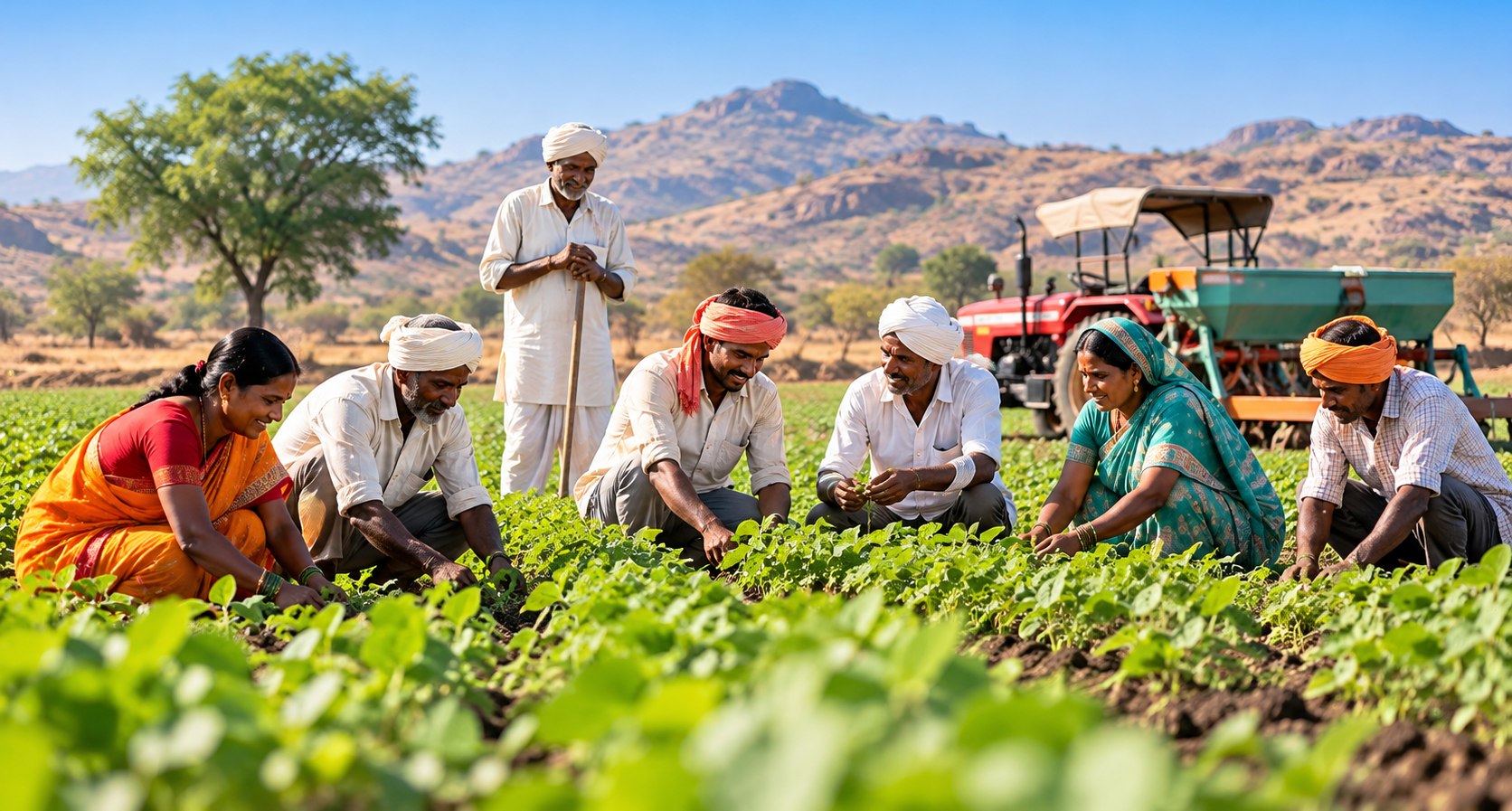
At a time when drought concerns, rising agricultural labour costs and mounting debts are putting pressure on farmers, 12 cultivators in Maharashtra’s Latur district have shown how collective efforts can make farming more economical through cooperation, shared resources and scientific practices.
These farmers from Keket-Sindgi village in Jalkot taluka of the district have come together by forming Chhatrapati Shivaji Maharaj Farmers’ Group.
The group activity has helped the farmers not only in bringing down their expenses by more than Rs 2 lakh this season, but it has also done away with the need to borrow from moneylenders to meet agricultural expenses.
The group comprises 12 farmers who initially worked together on 24 acres of their own land, with each member contributing two acres. Subsequently, they extended their collective efforts to an additional 30 acres, taking the total area covered by their joint farming activities to 54 acres.
“Our group has saved approximately Rs 2.3 lakh in labour costs this year by harvesting soybean collectively across 54 acres. Our production has also increased by around two quintals. Working together as a group gives us immense satisfaction. Most importantly, none of us had to borrow from a moneylender for farming operations this year. As a result, the profit remains with us,” farmer Sudhakar Gond told PTI.
The initiative was inspired by training under the Paani Foundation.
After learning about the benefits of collective farming through instructional videos, Gond encouraged fellow farmers to adopt the approach. The group later underwent training at Sagaroli in Nanded district and began implementing the techniques.
One of the most significant changes has been the adoption of the traditional system for soybean harvesting, under which farmers work on one another’s fields instead of hiring separate labourers. With harvesting charges in the area reaching around Rs 5,500 for 1.25 acres, pooling labour has substantially reduced their dependence on paid workers.
The farmers have also coordinated seed purchases, ploughing, sowing and other agricultural operations to reduce expenditure. By scheduling work across members’ fields, they can negotiate better rates with tractor operators while ensuring more efficient use of machinery.
Beyond reducing costs, the group has adopted scientific farming practices under the guidance of the agriculture department and Paani Foundation.
These include seed treatment, selection of suitable crop varieties, sowing on raised beds using the Broad Bed and Furrow (BBF) method, and natural pest management. Members have also prepared Dashparni Ark using locally available leaves and cow dung.
In drought-prone Marathwada, where inadequate rainfall can threaten standing crops, the farmers are also supporting one another through water-sharing arrangements. Members share available water to help protect crops during shortages, reinforcing the importance of collective action in times of distress.
The group holds meetings every Sunday and discussions before the sowing season to plan crop selection and coordinate agricultural activities. Soybean, tur and cotton are among the crops cultivated by its members.
Abhilash Kshirsagar, Taluka Technology Manager with the Agriculture Technology Management Agency (ATMA), said collective farming should continue beyond the kharif season and not remain restricted to the Paani Foundation competition.
He said collective procurement of agricultural inputs, shared labour and coordinated farming operations had benefited the farmers. However, the long-term success of the initiative would depend on whether they continued these practices during the rabi season and in subsequent years.
“Paani Foundation is fostering a culture of collective farming among farmers. Through joint efforts and shared cost savings, farmers can tackle drought challenges and make agriculture more sustainable,” Pradeep Reddewad, Assistant Agriculture Officer, said.
“Coordination among the agriculture department, ATMA and the UMED Mission is strengthening collective farming in Jalkot, Ahmedpur, Deoni, Chakur and Udgir in Latur district. The farmers’ group at Kekat-Sindgi is an excellent example of this collaborative effort,” Om Kurde, Field Officer of Paani Foundation, said.
-PTI


