







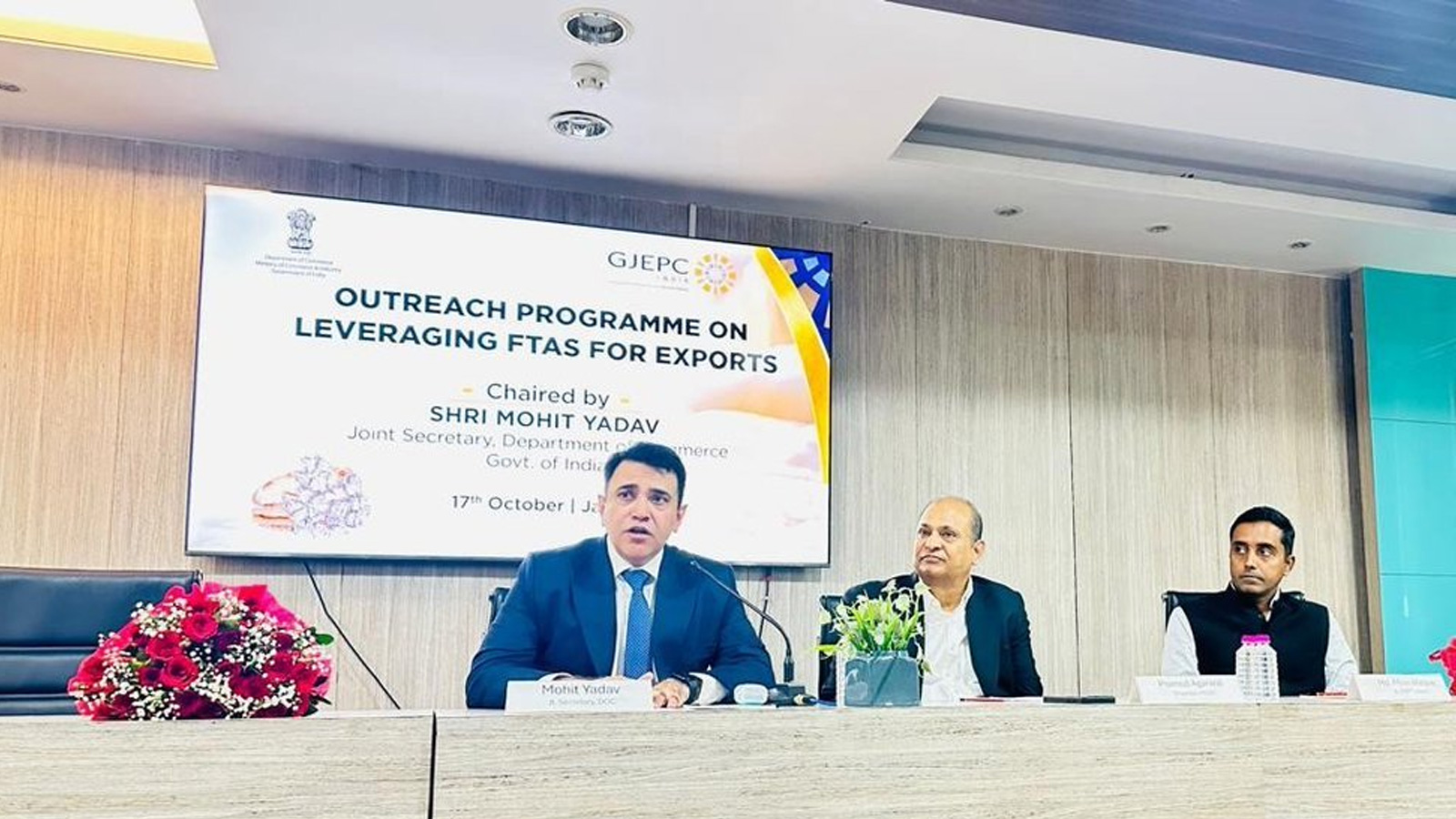
The Department of Commerce organised an outreach programme in Jaipur to help exporters use preferential market access under India’s free trade agreements (FTAs), with discussions covering tariff benefits, rules of origin, quality standards and overseas buyer connections.
Joint Secretary Mohit Yadav addressed the “Leveraging FTAs” programme, attended by exporters from various sectors and representatives of the Rajasthan government, Directorate General of Foreign Trade, Jaipur Special Economic Zone and Gem and Jewellery Export Promotion Council.
The initiative aimed to translate negotiated market access into export opportunities through practical guidance, capacity building and coordination among government agencies, industry associations and businesses.
Exporters discussed opportunities and challenges under India’s trade agreements and arrangements with partners including the UAE, Australia, European Free Trade Association countries and the United Kingdom. Benefits depend on the provisions and implementation status of each agreement.
The discussions focused on identifying export-ready products, understanding tariff preferences and origin requirements, securing quality certification and connecting with international buyers.
The programme comes amid growth in India’s merchandise and services exports. Combined exports during April–September of FY 2026–27 were estimated at $476.20 billion, up 13.84% from $418.31 billion in the corresponding period a year earlier.
Major drivers of merchandise export growth in September included electronic goods, petroleum products, organic and inorganic chemicals, engineering goods, and cotton yarn, fabrics, made-ups and handloom products.
A sector-specific presentation by Jaipur Joint Director General of Foreign Trade Md. Moin Afaque examined opportunities for gems and jewellery exporters under recently concluded FTAs.
India ranks eighth among global gems and jewellery exporters, with a 2.9% share of the $1 trillion global market, according to the presentation. It examined tariff advantages, competition from major suppliers and opportunities in specific products and markets.
Potential growth areas included lab-grown diamond jewellery, coloured gemstones, Kundan-Meenakari heritage jewellery, smart and wearable jewellery, recycled and ethically sourced gold jewellery, and pearl and cultured jewellery.
These categories are particularly relevant to Rajasthan’s established jewellery industry. The state also has export potential in textiles and garments, handicrafts, engineering goods, stone and minerals, and agricultural and processed-food products.
The Rajasthan Economic Review 2024–25 outlines an ambition to build a $350 billion economy by 2029. The Rajasthan Export Promotion Policy 2024 envisages exports of ₹1.5 lakh crore by that year, while the state Budget 2026–27 sets a longer-term goal of a $4.3 trillion economy by 2047.
The programme highlighted opportunities for farmers and farmer-producer organisations to access markets for eligible agricultural produce, millets, spices and processed foods, subject to importing countries’ food-safety, traceability and other requirements.
For MSMEs and artisans, tariff preferences could improve price competitiveness and support entry into international supply chains. Women-led enterprises and self-help groups could benefit from export training, e-commerce and buyer linkages, while larger businesses could explore investment, technology partnerships and market diversification.
The outreach reflects calls by Prime Minister Narendra Modi and Commerce and Industry Minister Piyush Goyal for businesses to use FTA opportunities while meeting international quality standards.
Goyal has emphasised the potential for reduced- or zero-duty access to create opportunities for farmers, women entrepreneurs, young people, MSMEs, artisans and industry.
By strengthening awareness of trade preferences, documentation, standards, logistics and market intelligence, the initiative seeks to help enterprises in Jaipur, Jodhpur, Udaipur, Bhilwara and other districts expand into overseas markets.
The Ministry of Commerce and Industry also highlighted the role of state support through industrial infrastructure, export-focused task forces, credit, financial incentives, skill development, quality certification and technology upgrades in helping businesses make effective use of trade agreements.


