







India’s supercomputing journey has evolved from developing its first indigenous systems to building a broader high-performance computing ecosystem that supports scientific research, national applications and advanced technology development.
At the centre of this effort is the National Supercomputing Mission (NSM), which aims to expand access to high-performance computing while strengthening indigenous capabilities in hardware, software, applications and skilled manpower.
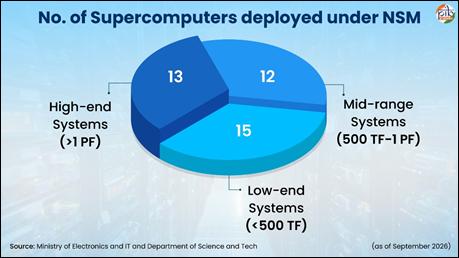
The Mission plans to establish 50 supercomputers with a cumulative computing capacity of more than 123 petaflops (PF) across academic and research institutions in the country. As of September 2026, 40 supercomputers with a combined capacity of 68 PF had been deployed. Of these, 13 were high-end systems with capacities exceeding 1 PF, while 12 mid-range systems had capacities between 500 teraflops (TF) and 1 PF. Another 15 systems had capacities below 500 TF.
From PARAM 8000 to PARAM Rudra
India’s indigenous supercomputing journey began with PARAM 8000, developed by C-DAC and unveiled in 1991. With a speed of one gigaflop, the system marked India’s entry into indigenous supercomputing.
The PARAM series subsequently evolved into more powerful systems, including PARAM Yuva, which reached 54 teraflops. These systems supported computationally intensive applications such as weather forecasting and computational fluid dynamics, while expanding India’s capabilities in advanced scientific computing.
A major development under the NSM has been the PARAM Rudra series. These systems use indigenously designed and manufactured Rudra servers along with an indigenous system software stack.
As of September 2026, around 6,000 Rudra servers had been deployed in PARAM Rudra supercomputers, with another 1,500 servers under manufacturing. The systems support research in areas including astronomy, material science, atomic physics and earth sciences.
Building an indigenous ecosystem
The focus of the National Supercomputing Mission extends beyond installing supercomputers. It includes the development and manufacture of critical components needed for high-performance computing.
The Rudra series of servers, designed and developed by C-DAC, provides the processing capability required for complex calculations, simulations and artificial intelligence workloads. The technology has also been transferred to Indian electronics manufacturing services partners for production.
India has also developed high-speed interconnect technology capable of speeds of 100 Gbps and 200 Gbps, enabling faster communication between computing nodes. Indigenous cooling technology has been developed and demonstrated and is now moving towards deployment.
An indigenous HPC system software stack has also been developed, while PARAM Shavak, a supercomputing-in-a-box system, has been designed and manufactured in India for the HPC and AI requirements of students and researchers in engineering colleges and universities.
Supercomputing for national applications
The growing computing infrastructure is being used for applications that address challenges across healthcare, environment, energy and scientific research.
A Genomics and Drug Discovery Platform uses large-scale molecular data to support drug discovery and was used during the COVID-19 pandemic to screen existing drugs and predict potential side effects.
Supercomputing is also being used for urban weather and air pollution modelling, seismic imaging for oil and gas exploration, flood forecasting, forest-fire spread modelling, materials science and computational chemistry.
The flood early-warning system, for instance, uses predictive models to forecast floods up to two days in advance and is being used for the Mahanadi River basin. Forest-fire modelling combines satellite remote sensing with computational models to assess the likely spread of fires.
These applications demonstrate the role of HPC in converting large volumes of data and complex simulations into tools that can support decision-making and research.
Connecting research institutions
The National Knowledge Network (NKN) serves as an important part of the supercomputing ecosystem by connecting supercomputing facilities across academic and research institutions through a high-speed national network.
This connectivity enables researchers to access computational resources, collaborate across geographical boundaries and share research capabilities and scientific knowledge.
Building a skilled workforce
Expanding computing infrastructure also requires trained users capable of effectively deploying HPC resources.
As of September 2026, NSM infrastructure had supported more than 16,000 researchers, including over 2,900 PhD scholars, across more than 400 institutions. The systems had executed over 1.5 crore compute jobs and contributed to more than 1,990 research publications.
The Mission has undertaken awareness programmes, hackathons, bootcamps, faculty development programmes and specialised training initiatives to expand the HPC user base.
The EduHPC Workshop, a High-Performance Scientific Computing course on the SWAYAM platform and the HPC Shiksha Portal are among the initiatives aimed at providing students, faculty and researchers with access to training and learning resources.
Supercomputing and sustainable development
The National Supercomputing Mission also contributes to development goals through applications in areas such as climate modelling, flood prediction and forest-fire management.
Its applications support climate action, while HPC training and skill-development initiatives contribute to education and capacity building. The Mission also seeks to promote innovation and collaboration among academia, industry and research institutions.
The road ahead
India’s next phase of supercomputing is expected to focus on increasing computing capacity while making systems faster, more energy-efficient and reliable.
The focus is also on strengthening indigenous hardware and software capabilities and expanding access to HPC among researchers, academia and industry.
Greater integration of Artificial Intelligence and High-Performance Computing is expected to support work in areas including weather and climate, healthcare, agriculture, energy, drug discovery, engineering and scientific research.
The broader objective is to bring government, academia, industry, startups and research institutions together to turn advanced computing capabilities into practical applications while building a secure, sustainable and self-reliant supercomputing ecosystem.


