







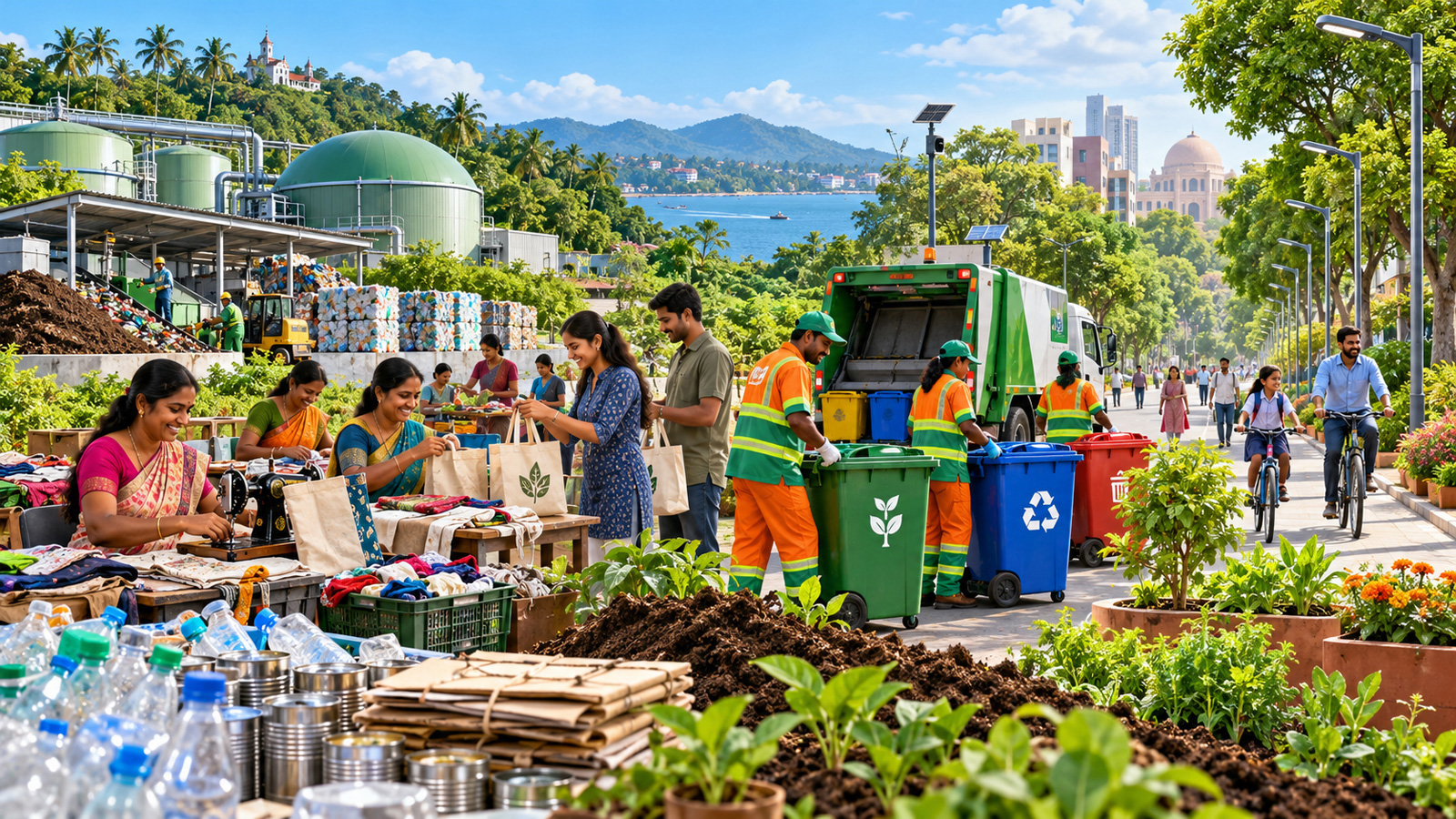
A former garbage dump in Goa now processes waste into biogas, electricity and compost. In Gandhinagar, discarded clothes find a second life as reusable bags. Kakinada uses digital tools to track household waste collection, while Ghaziabad is working to turn emission reductions into carbon credits.
These initiatives illustrate how urban waste management under the Swachh Bharat Mission is expanding beyond collection and disposal. Cities are recovering useful materials, encouraging residents to adopt sustainable habits and using technology to improve municipal services. Their approaches differ, but each places greater value on resources that would otherwise be discarded.
Goa: A dumping ground becomes a resource hub
In the valleys of Saligao, Goa, an erstwhile garbage dump has been transformed into an integrated waste management facility spread across 113,000 square metres. Operated by the Goa Waste Management Corporation, the centre handles 250 metric tonnes of wet and dry waste every day, processing approximately one-third of the state’s total waste.
Organic matter is separated and converted into biogas to generate electricity. Wet waste from restaurants produces valuable bioproducts, including methane-rich biogas, while recyclable materials are recovered from the 100 metric tonnes of dry waste processed at the facility. The remaining dry waste is sent to cement factories for co-processing.
The facility generates 1.32 kilowatts of electricity from wet waste, powering 35 units, with half the electricity supplied to the Goa Electricity Department. The energy generated also helps alleviate local power shortages.
The plant produces seven to eight tonnes of compost daily, which local panchayats use for gardening and reforestation projects. Its operations therefore link waste processing with both energy generation and the restoration of green spaces.
The transformation has also created livelihood opportunities. People who previously collected waste have become part of the plant’s trained workforce, supporting several families in the region. Operating throughout the year, the facility is working towards a zero-waste goal.
Gandhinagar: Citizens put reuse into practice
Gandhinagar’s approach places community participation at the centre of its zero-waste ambitions. Through the Swachh Bharat Mission and participation in Swachh Survekshan, the city has sought to build a culture of cleanliness and sustainability.
Inspired by the global Zero Waste Week movement, the Gandhinagar Municipal Corporation organised activities from September 2 to 7, 2026, promoting the three principles of Reduce, Reuse and Recycle. Events at 25 locations directly engaged more than 600 citizens, while targeted social media campaigns reached and sensitised over 40,000 people.
Among the initiatives were My Theli stalls, where residents donated used clothes that skilled women from local self-help groups transformed into reusable carry bags. The effort brought together household donations, local skills and a practical alternative for everyday use.
School students participated through the “Swachhata Se Shuruvat” campaign. Quizzes raised awareness about environmental concerns, while interactive games offered practical insights into sustainable habits.
A Reduce, Reuse, Recycle van took the campaign to residents’ doorsteps, collecting old clothes, plastic and electronic waste. Participants received rewards for their donations, encouraging wider involvement. Citizens were also invited to share their daily practices and personal efforts through online testimonials.
Together, these activities are helping Gandhinagar strengthen resource-conscious habits and advance its zero-waste vision as it works towards the goal of Garbage Free Cities.
Kakinada: Digital monitoring strengthens daily collection
In Andhra Pradesh, Kakinada is using technology to manage approximately 144 tonnes of waste generated each day, including wet, dry and hazardous materials.
The Kakinada Municipal Corporation’s collection network covers 50 wards divided into 382 micro pockets. Each micro pocket comprises 250 to 350 households and is managed by two sanitation workers.
Across the city, around 112,993 households are organised into 40,661 designated waste collection points, with more than 973 sanitation workers employed to manage waste.
The Online Waste Management System tracks collection and transportation in real time. Radio Frequency Identification, facial recognition, GPS and a human resource management system support the monitoring of workers and vehicles.
RFID chip-enabled tags are installed at the gates of every waste generator. Collectors scan the tags when picking up waste, and the information is recorded in the online system, allowing officials to monitor collection progress. Continuous monitoring and dedicated sanitation staff have helped Kakinada achieve 100 per cent door-to-door collection.
The municipal corporation has also deployed 108 hopper vehicles fitted with GPS devices to track transportation and report deviations during collection and movement to processing plants.
For SafaiMitras, a facial recognition system enables attendance to be recorded without manual registers or fingerprint scanners. These technologies are integrated into a Central Command Centre for close monitoring.
Alongside the digital infrastructure, residents’ participation remains essential. Around 60 per cent now segregate waste at source, supporting the work of sanitation teams and improving the city’s ability to manage discarded materials efficiently.
Ghaziabad: Emission reductions offer a new source of value
Ghaziabad is connecting its cleanliness efforts with measures to reduce carbon emissions and generate potential revenue.
The Ghaziabad Municipal Corporation has registered for an international carbon credit project. The United Nations-verified initiative states that the corporation has been accredited under the Verified Carbon Standard, supported by the United Nations Framework Convention on Climate Change.
Improved solid waste management under the Swachh Bharat Mission can reduce greenhouse gases such as methane released from dumping sites. Greater use of clean fuels and energy sources can also lower dependence on fossil fuels and cut carbon emissions.
The corporation has replaced old streetlights with energy-efficient LED lights, reducing electricity consumption and associated emissions. It is also adopting wet waste composting to produce compost, support faster waste management and reduce greenhouse gas emissions.
Together, these measures are expected to reduce carbon dioxide emissions by approximately 2.7 lakh tonnes, corresponding to 2.7 lakh carbon credits. Each credit represents one tonne of carbon dioxide equivalent. Once certified, the credits can be sold on the international carbon market to generate revenue.
Ghaziabad is set to become the first urban local body in Uttar Pradesh and the second in the country, after Indore in Madhya Pradesh, to turn waste into a new source of value through this approach. The initiative also reflects the corporation’s commitment to the Sustainable Development Goals.
Across these four cities, urban transformation is taking shape through processing plants, neighbourhood campaigns, digitally monitored collection systems and emission-reduction projects. Their experiences show how municipal services and citizens’ efforts can work together to make cities cleaner, more circular and more efficient in their use of resources.


