







Inside This Week’s Economic Brief
This week’s Economic Brief covers the IMF’s upgraded 7% India growth forecast, the US-Russia diesel deal straining EU sanctions unity, and Japan’s record $5.71 billion FDI surge into India led by the MUFG-Shriram deal.
This week’s edition of The Economic Brief on DD India examined three major stories: the IMF’s upgraded growth forecast for India, a US-Russia diesel deal that has unsettled European allies, and Japan’s emergence as India’s top source of foreign direct investment. The episode featured extensive analysis from Dr. Gulshan Sachdeva, Professor and Jean Monnet Chair at JNU’s Centre for European Studies.
IMF Raises India’s Growth Forecast to 7% for 2026 and 2027
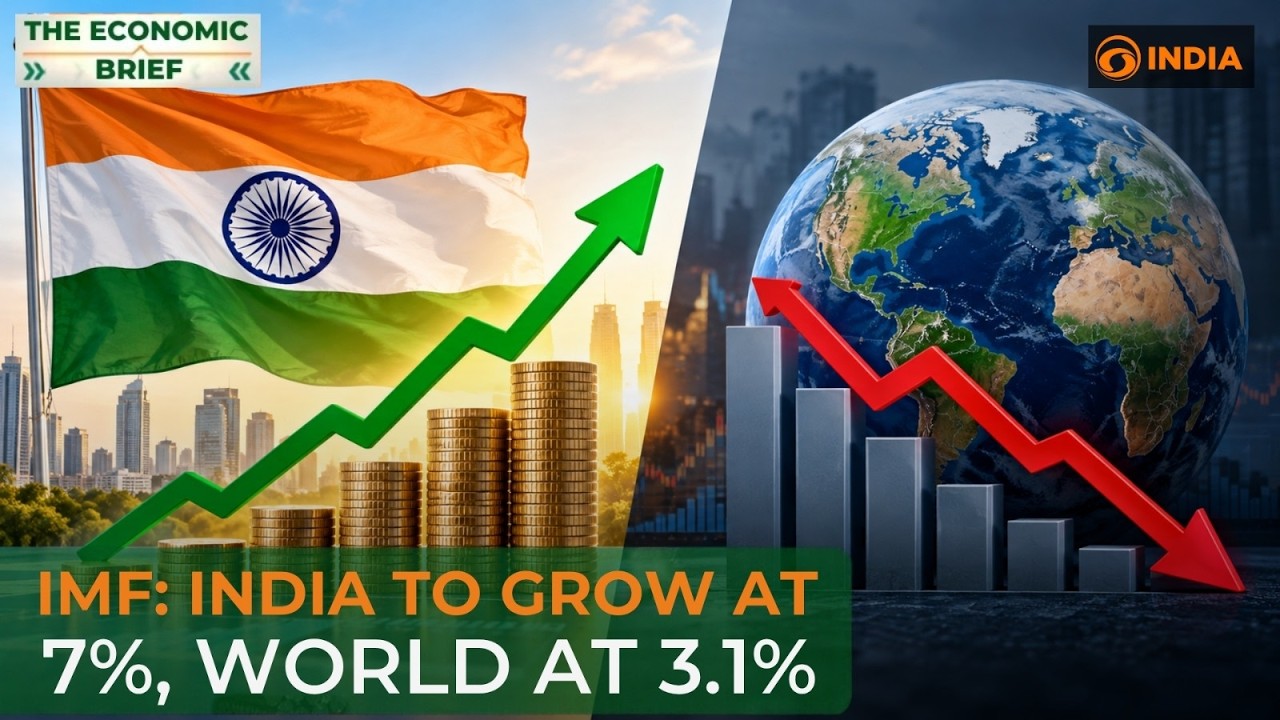
The IMF’s October 2026 World Economic Outlook lifted India’s GDP growth forecast to 7% for both this year and next, citing four factors: strong domestic demand, robust services activity, favorable demographics, and continued structural reforms. India remains the world’s fastest-growing major economy, well ahead of China’s 4.5% and the US’s 2.3%, against a subdued global growth rate of 3.1% in 2026, rising to 3.4% in 2027.
The Asian Development Bank and OECD have both aligned with similar upgrades to around 7-7.1%, while the World Bank and RBI issued comparable revisions last week. The IMF flagged weaker prospects for China on property-sector headwinds and soft domestic demand, for Russia on war-related disruptions, and for Brazil on a moderating commodity surge, while crediting India’s resilience partly to its position as a net exporter of refined oil.
Speaking at the Bloomberg New Economy Forum in New Delhi, Michael Bloomberg called India a global engine of economic growth and innovation, noting it has risen from the world’s 11th-largest economy a decade ago to its fastest-growing today, with a recent $20 billion government commitment to strengthen the power grid among the investments underpinning that trajectory.
Dr. Gulshan Sachdeva said the IMF outlook reflects resilience not just in India but across much of the global economy despite the Ukraine war, tensions in West Asia, and Trump-era tariff disruptions, with the only major soft spots in parts of Asia and West Asia. He cautioned that India cannot grow in isolation from a slowing world economy and pointed to its expanding web of free trade agreements as essential to achieving the 8-9% annual growth needed to meet its 2047 developed-economy ambitions, particularly as other Asian economies recalibrate their historic reliance on China.
US-Russia Diesel Deal Strains Transatlantic Sanctions Unity
Washington has temporarily lifted sanctions on Russian diesel, allowing more than 300,000 tons of immediate shipments with larger volumes expected from November, a move President Trump framed as easing US fuel prices ahead of the midterms. Russia says it can restore exports to pre-crisis levels of 3 to 3.5 million tons monthly. The decision has angered Ukraine and unsettled European allies, who simultaneously approved roughly 1,600 new sanctions targeting Russia’s military-industrial supply chain, bringing the EU’s total sanctioned list to around 4,600 individuals and entities since 2022, at an estimated €1.3 trillion cost to Russia’s economy. European officials urged Washington to align more closely through measures like the Graham Act.
Dr. Sachdeva called the US move and the EU’s sanctions round contradictory signals, noting the Russian economy continues modest growth, around 1% per IMF projections, partly because elevated global oil prices benefit Moscow even as it loses market share. He said Europe faces a genuinely difficult trade-off: higher energy costs have hurt European industrial competitiveness since the shift away from Russian energy, yet European governments see sanctions as one of the few remaining levers of pressure on Moscow.
https://www.youtube.com/watch?v=X4mZhzbeSKw
Japan Becomes India’s Top FDI Source on Record MUFG-Shriram Deal
Japan became India’s largest source of foreign direct investment in Q1 FY2026-27, with inflows of $5.71 billion — already exceeding the $3.74 billion received for all of FY2025-26 — representing nearly 29% of India’s total equity inflows of $19.81 billion for the quarter. The surge was driven by Mitsubishi UFJ Financial Group’s acquisition of a 20% stake in Shriram Finance for approximately ₹39,620 crore ($4.4 billion), accounting for over 77% of Japan’s quarterly inflows. The deal marks Japan’s deepening push into India’s financial services sector, building on MUFG’s 2023 investment in DMI Finance. Other top FDI sources for the quarter included Singapore ($5.2 billion), Mauritius ($2.4 billion), the Netherlands ($1.38 billion), and the US ($1.35 billion), as Japan continues toward its committed 10 trillion yen in India investment over the next decade.
Key Takeaways
The IMF’s upgraded forecast cements India’s position as the world’s fastest-growing major economy despite global headwinds. The US-Russia diesel deal highlights growing friction between Washington’s domestic price concerns and Europe’s sanctions strategy against Moscow. And Japan’s record FDI surge, anchored by the MUFG-Shriram deal, signals deepening Japanese investment in India’s financial sector.


