







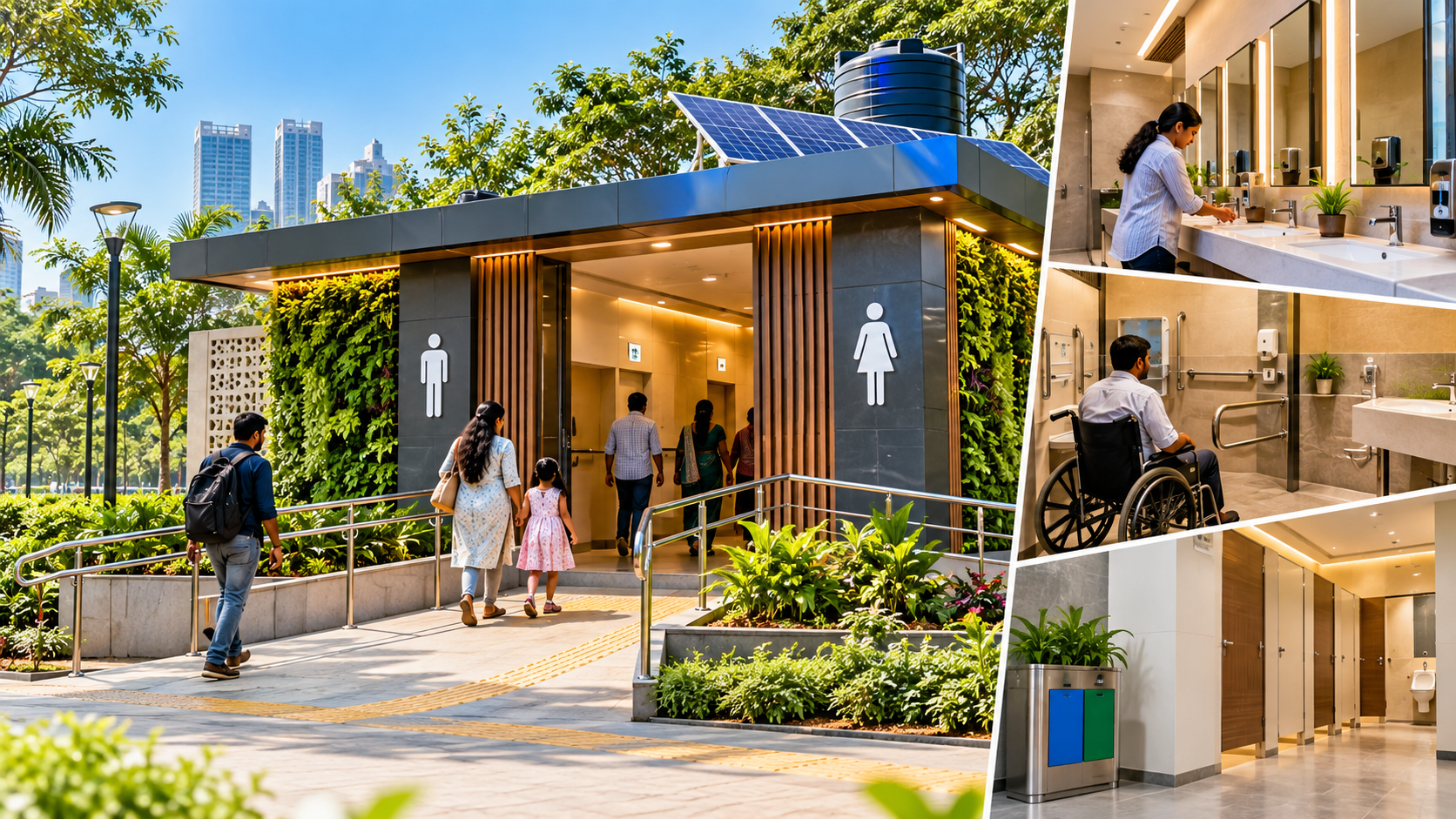
India’s cities have made significant progress in expanding access to public sanitation, with growing emphasis on cleanliness, safety, accessibility and inclusivity. From repurposing discarded vehicles and plastic waste to deploying sensor-based facilities and scientific sanitary waste disposal systems, urban local bodies are increasingly adopting innovative approaches to improve the public toilet experience.
The Swachh Bharat Mission (SBM), launched on October 2, 2014, gave fresh impetus to sanitation efforts across the country. Alongside construction of toilets and public awareness campaigns, cities worked towards achieving Open Defecation Free (ODF) status, with several subsequently progressing to ODF+ and ODF++ standards.
In 2022, the Toilets 2.0 initiative under the Swachh Bharat Mission-Urban (SBM-U) sought to further improve Community and Public Toilets (CT/PTs), focusing on making them safe, clean and accessible. Citizens can also locate nearby facilities through the ‘SBM Toilet Locator’ on the Swachhata app.
Across cities, these efforts are taking different forms — from a discarded bus converted into a women-only toilet in Bengaluru and public conveniences made from recycled plastic in Navi Mumbai to smart sanitation facilities in Bhopal and scientific sanitary waste management in Karad.
Scrap Bus Transformed into Women’s Toilet in Bengaluru
In Bengaluru, Karnataka, an old bus has been repurposed as a dedicated sanitation facility for women at the Karnataka State Road Transport Corporation’s (KSRTC) Majestic bus terminal.
Known as the Sthree Toilet, the facility has three Indian-style and two Western-style commodes. It is also equipped with a sanitary napkin vending machine and an incinerator to support menstrual hygiene.
A dedicated area allows mothers to breastfeed their babies and change diapers. Sensor-based lighting is powered by solar energy generated at the facility, while wastewater is connected to the nearest sewage chamber at the bus station.
The facility has proved particularly useful for women travelling with young children, providing them with greater privacy and convenience at one of the city’s busiest transit hubs.
Navi Mumbai Turns Plastic Waste into Public Toilets
The Navi Mumbai Municipal Corporation (NMMC) has used discarded material to develop Aspirational Toilets at Sector 14 in Koparkhairane, near the Nisargudyan urban garden.
The facility, which receives around 8,000 to 9,000 users daily, incorporates 426 square metres of recycled plastic sheeting, including 5.3 metric tonnes of single-use plastic, 11,700 plastic bottles and 35,200 bottle caps.
The project also reused 85 computer keyboards and 284 kg of scrap metal, demonstrating the application of the principles of Reduce, Reuse and Recycle in public infrastructure.
The complex has separate sections for men and women, along with facilities for children and persons with disabilities. Baby care stations and sanitary pad vending machines have also been provided.
A fountain operating on treated sewage water adds another sustainability feature to the complex, which combines sanitation infrastructure with waste recycling and inclusive urban design.
Smart ‘Freshrooms’ Offer Modern Facilities in Bhopal
In Bhopal, the municipal corporation has introduced ‘Freshrooms’, smart public convenience centres aimed at combining sanitation with technology and user comfort.
Developed under a Design-Build-Operate-Transfer (DBOT) model through a Public-Private Partnership (PPP), the Smart Lounge at the city’s busy 10 Number Market covers around 800 to 1,000 square feet and caters to 500 to 1,000 visitors daily.
The facility includes sensor-based toilets and touch-free urinals, along with hot and cold showers, lockers and Wi-Fi. A café, vending machines, baby-changing rooms and a digital information wall are among the additional amenities.
Separate and accessible facilities have been provided for men, women and persons with disabilities. The model seeks to combine modern sanitation services with financial sustainability through private-sector participation.
Karad Develops System for Safe Sanitary Waste Disposal
While clean toilets remain central to urban sanitation, the safe disposal of sanitary waste poses another challenge.
Karad, a city in Maharashtra’s Satara district, has developed a system for the 100 per cent segregation, collection and processing of sanitary and biomedical waste. Around 300 to 350 kg of sanitary waste is collected every day from hospitals, clinics, households and other facilities.
The Karad Municipal Council (KMC) initially focused on raising awareness about the health and environmental risks associated with improper sanitary waste disposal. Workshops, community outreach programmes and public announcements were organised, while women residents were involved in awareness groups to spread the message across residential areas.
Separate red bins were installed in public toilets for sanitary waste disposal. Schools were encouraged to install sanitary pad vending machines and disposal systems, while the city’s Information, Education and Communication (IEC) team advised users to wrap used sanitary pads in paper before disposal.
Several schools have since installed incinerators, with the residue sent to the biomedical waste treatment facility.
Municipal garbage collection vehicles also carry separate bins for sanitary waste. The collected material is segregated to ensure that only suitable waste is sent for incineration.
KMC has partnered with the Karad Hospital Association for treatment of the waste. The municipal council provided land for a 600-kg-per-day Common Biomedical Waste Treatment Facility (CBWTF), while the association operates and maintains the plant.
The facility processes sanitary waste collected by the council free of charge. Its central incinerator operates at temperatures of up to 1,200 degrees Celsius, while gases are filtered to remove harmful substances. Emissions are monitored in real time and linked to the State Pollution Control Board (SPCB) system.
The PPP arrangement has reduced the financial burden on the municipal council, which bears only collection and transportation costs. The system has also eliminated open dumping of sanitary waste, reducing environmental contamination and health risks, including those faced by sanitation workers.
Tirupati Expands Inclusive Sanitation for Pilgrims
In Tirupati, one of India’s major pilgrimage destinations, the municipal corporation has developed modern public toilet complexes to meet the sanitation needs of devotees, tourists and residents.
A dedicated Pink Toilet Complex for women has been established near the bus station, connecting key locations including Srinivasam, Vishnuvasam, the railway station and the bus terminal.
The complex provides Indian and Western-style toilets, restrooms, mother-care facilities and changing rooms. Sanitary napkin vending machines and incinerators have also been installed. The facility serves around 12,000 to 15,000 users daily and is maintained through a structured three-shift cleaning system.
A Common Public Toilet Complex near the railway station caters to an estimated 20,000 to 25,000 devotees daily in the Govindarajaswamy Temple area.
Designed for universal access, the complex has dedicated facilities for men, women, transgender persons, Divyaang users and children. Ramps, handrails, child-friendly fixtures and bathing rooms have been incorporated to improve accessibility, hygiene and convenience.
The Road Ahead
Under SBM-U 2.0, the focus on urban sanitation has expanded beyond toilet construction to ensuring that facilities remain clean, safe, inclusive and sustainable.
Initiatives across Bengaluru, Navi Mumbai, Bhopal, Karad and Tirupati illustrate how cities are adapting sanitation infrastructure to local requirements through recycling, technology, inclusive design, scientific waste management and public-private partnerships.
As the Swachh Bharat Mission completes 12 years, these initiatives reflect a broader shift from providing basic sanitation infrastructure to improving dignity, accessibility and user experience. From markets and transport hubs to pilgrimage centres, urban sanitation is increasingly being designed to serve citizens across gender, age and ability.
-PIB


