






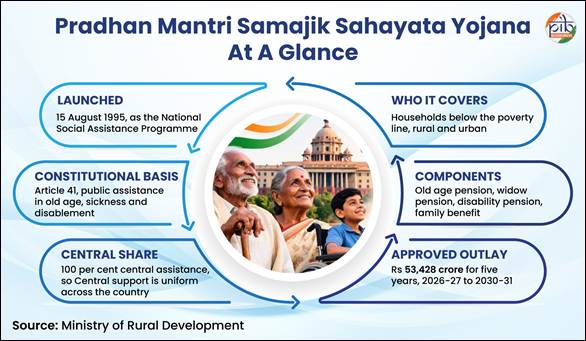
The Union Cabinet has approved the continuation of the National Social Assistance Programme (NSAP) for five years, from 2026-27 to 2030-31, with a total outlay of ₹53,428 crore. The programme has been renamed the Pradhan Mantri Samajik Sahayata Yojana, with revised eligibility criteria and enhanced financial assistance under its disability pension component.
Approved on October 14, 2026, the decision aims to strengthen social security for vulnerable sections of society, including senior citizens, widows, persons with disabilities and families facing the loss of their primary breadwinner. While the old-age pension, widow pension and family benefit schemes will continue in their existing forms, the disability pension has undergone significant changes in eligibility, financial assistance and beneficiary coverage.
A Renewed Framework for Social Assistance
Launched on August 15, 1995, the National Social Assistance Programme is a centrally sponsored welfare programme that provides financial support to eligible households below the poverty line. It gives effect to Article 41 of the Constitution, which directs the State to provide public assistance in cases of unemployment, old age, sickness and disablement, within the limits of its economic capacity and development.
The programme provides 100 per cent central assistance under its components and covers both rural and urban areas. Its implementation is primarily handled by State and Union Territory administrations through designated welfare departments, with Gram Panchayats and urban local bodies also involved in identifying beneficiaries. Payments are largely made through Direct Benefit Transfer (DBT).
Under the revised nomenclature, the four components have been renamed the Pradhan Mantri Vridhavastha Pension Yojana for old-age pensions, Pradhan Mantri Vidhawa Pension Yojana for widow pensions, Pradhan Mantri Divyangjan Pension Yojana for disability pensions, and Pradhan Mantri Parivar Labh Yojana for family benefits.
The programme covered approximately 3.09 crore beneficiaries earlier, with the October 2026 approval putting the total coverage at 3.20 crore beneficiaries across all 36 States and Union Territories. The new framework retains the existing structure of three pension schemes and one family benefit scheme, while introducing wider eligibility under the disability pension.
Disability Pension: A Major Change in Eligibility
The most significant reform concerns the disability pension, which was introduced in February 2009 as the Indira Gandhi National Disability Pension Scheme.
Under the earlier criteria, applicants had to be at least 18 years old and have a severe disability assessed at 80 per cent or above. Central assistance stood at ₹300 per month for beneficiaries up to 79 years of age and ₹500 per month for those aged 80 years and above.
The revised framework replaces the 80 per cent disability threshold with the benchmark disability criterion of at least 40 per cent under the Rights of Persons with Disabilities Act, 2016. It also removes the minimum age requirement, allowing eligible beneficiaries to receive assistance from birth.
The revised central assistance has been fixed at ₹375 per month for beneficiaries aged up to 79 years and ₹625 per month for those aged 80 years and above.
The government has also expanded the number of beneficiaries under the disability pension component from 8.33 lakh to 27.48 lakh. The broader eligibility criteria are expected to bring more persons with disabilities within the social assistance framework, including those with benchmark disabilities between 40 and 79 per cent and eligible children below 18 years of age.
Alignment with the Rights of Persons with Disabilities Act, 2016
The changes bring the disability pension into alignment with the Rights of Persons with Disabilities Act, 2016, which was enacted to give effect to the United Nations Convention on the Rights of Persons with Disabilities.
Section 2(r) of the Act defines a person with benchmark disability as someone with not less than 40 per cent of a specified disability, certified by the designated authority. The legislation recognises 21 categories of disabilities.
The earlier pension framework used a higher disability threshold of 80 per cent, along with a minimum age requirement of 18 years. The revised criteria adopt the 40 per cent benchmark and remove the age restriction, widening the scope of eligibility under the scheme.
The change is significant for children with certified benchmark disabilities in eligible households, who were previously excluded from the pension on account of the minimum age requirement. It also extends the potential coverage to adults whose certified disability falls between 40 and 79 per cent.
Financial Assistance and the Role of States
The central assistance under the disability pension has been increased from ₹300 to ₹375 per month for beneficiaries up to 79 years of age, and from ₹500 to ₹625 for those aged 80 years and above.
These amounts represent the central contribution under the scheme. States and Union Territories may supplement this assistance through their own welfare provisions, resulting in different pension amounts across the country.
According to the background information released by the government, State and Union Territory top-ups ranged from ₹50 to ₹5,700 per month per beneficiary as of September 2026, with the average monthly pension reaching around ₹1,100 in most States and Union Territories.
The household must continue to meet the below-poverty-line eligibility condition, and applicants must possess the required disability certification under the applicable rules. Applications continue to be routed through the relevant State welfare administration.
The government has stated that revised guidelines covering eligibility criteria, beneficiary numbers and assistance rates will be issued and implemented within three months of the decision.
Five-Year Continuation and Wider Social Security Coverage
The programme’s continuation from 2026-27 to 2030-31, backed by an outlay of ₹53,428 crore, provides a renewed framework for social assistance to vulnerable households. The approved coverage of 3.20 crore beneficiaries reflects the programme’s continuing role in India’s social protection system.
The disability pension reform marks a shift towards a broader eligibility framework based on the benchmark disability standard under the 2016 Act. By extending eligibility to persons with disabilities from birth and lowering the disability threshold from 80 per cent to 40 per cent, the government has widened the group of people who may qualify for assistance.
-PIB


