







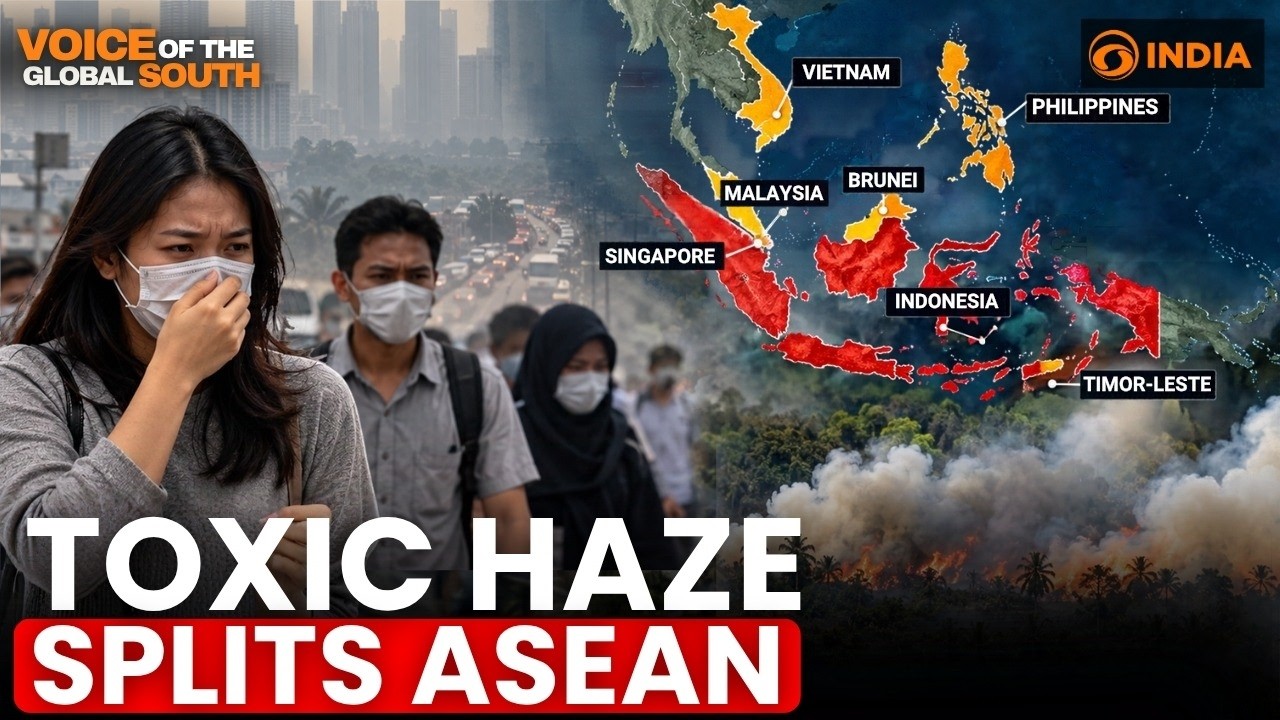
A prolonged wildfire crisis in Indonesia has triggered a massive environmental and humanitarian emergency, blanketed at least eight nations in toxic smog, and escalated into an explosive, multi-nation diplomatic showdown.
The trans-boundary crisis has pushed air-quality indices to hazardous levels, completely erasing iconic skylines from Palangkaraya in Indonesian Borneo to Singapore’s Marina Bay Sands.
What is visible from space isn’t simple cloud cover; it is a suffocating blanket of peat smoke trapping millions of lives in its wake.
The sheer geographical spread of the 2026 haze crisis highlights the borderless nature of the disaster. Originating from intense blazes in Indonesia, the toxic smog has torn through Singapore and Malaysia, pushed south to Timor-Leste, drifted north to the Philippines, and reached as far as Brunei, Vietnam and Thailand.
Peatland fires are notoriously dangerous environmental threats. Dried wetland soils smoulder at low temperatures and burn underground through expansive deposits of peat, making them incredibly difficult to extinguish. According to scientific data, peat fires generate significantly higher volumes of fine particulate matter, sulphur dioxide, organic carbon, methane, and carbon monoxide than standard tropical forest fires.
The current crisis is fuelled by three compounding factors:
— Hyper-intense land-clearing fires are driven by commercial palm-oil, mining and timber operations on Indonesia’s Sumatra and Borneo;
— a historic 2026 El Nino cycle has severely parched the region, turning dried-out peatlands into a global tinderbox;
— And independent-trackers at the Nusantara Atlas report a staggering 900,000 hectares of land have already been scorched by late August, with the fire season still active.
The human cost of the ongoing disaster has been devastating. Schools have been forced to close across parts of Malaysia and the worst-hit Indonesian provinces. Hospitals are completely overwhelmed by a massive surge in patients suffering from acute respiratory infections. Hundreds of thousands have required medical treatment and a growing number of premature deaths are directly linked to the thick smog.
Tragically, the battle on the frontlines has already cost lives, with four emergency workers in Indonesia killed while attempting to tame the relentless blazes.
Beyond a public health emergency, the haze has triggered total economic paralysis across South-East Asia:
— Agriculture systems are failing due to a lack of sunlight and severe drought conditions;
— vital regional supply chains have been severed; and
— outdoor work has ground to a complete standstill, leaving daily-wage workers vulnerable.
As the air thickens, regional patience has worn thin, prompting neighbouring governments to take aggressive stances against the source of the pollution.
In Singapore, Prime Minister Lawrence Wong announced that the city-state is actively investigating the entities responsible for the burning. Singapore is threatening to invoke its stringent Trans-boundary Haze Pollution Act to criminally and financially penalise errant companies — even those operating entirely outside Singapore’s borders.
Meanwhile, Malaysia is pushing to rewrite regional protocols. Foreign Minister Mohamad Hasan has called for a new, legally binding regional pact. He warns that the Association of Southeast Asian Nations (ASEAN) and its current natural disaster frameworks lack the teeth required to enforce environmental accountability.
The immediate political pressure now lands on the Philippines. Serving as the current ASEAN chair, Manila has confirmed that foreign ministers will convene a high-stakes, emergency meeting in November to aggressively tackle the trans-boundary crisis.
Perhaps the most significant challenge to the crisis is unfolding within Indonesia’s own borders. Fed up with recurring toxic air, citizens are no longer waiting for governmental promises. Activists and local residents in West Kalimantan have launched a historic class-action lawsuit targeting President Prabowo Subianto and high-ranking officials, accusing the State of gross negligence. In response, officials in Jakarta say that they respect the legal action and that they are currently investigating 95 companies for illegal burning. However, for millions of citizens choking on the ground, corporate investigations are just not enough.
From local courtrooms in Borneo to the upcoming ASEAN Leaders’ Summit in Manila, South-East Asia has reached a critical tipping point. The 2026 haze crisis has permanently shattered the illusion that environmental neglect can be contained by national borders. As corporate greed, extreme climate anomalies and geopolitical friction collide, an entire region is left holding its breath, demanding true accountability.


