






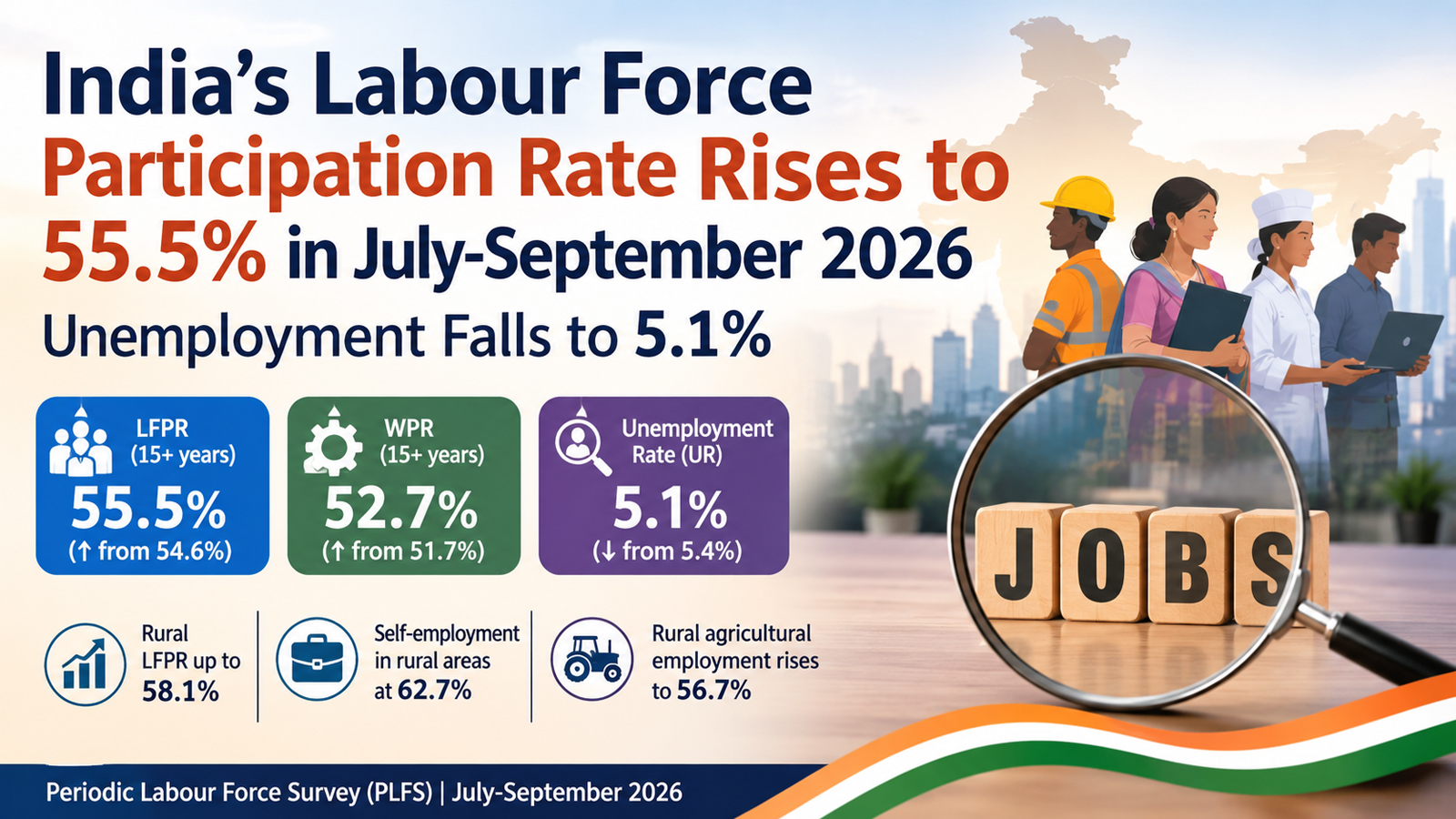
India’s overall Labour Force Participation Rate (LFPR) for people aged 15 years and above increased to 55.5 per cent during July-September 2026, up from 54.6 per cent in the previous quarter, while the unemployment rate declined to 5.1 per cent from 5.4 per cent, according to the latest Periodic Labour Force Survey (PLFS) released by the Ministry of Statistics and Programme Implementation (MoSPI) on Tuesday.
The Quarterly Bulletin also reported an improvement in the Worker Population Ratio (WPR), which rose to 52.7 per cent from 51.7 per cent in April-June 2026. The gains were largely driven by improved labour force participation and workforce participation in rural areas.
Labour force participation improves across rural and urban areas
The LFPR for people aged 15 years and above in rural areas increased to 58.1 per cent in July-September 2026 from 56.9 per cent in the previous quarter. In urban areas, it edged up to 50.4 per cent from 50.2 per cent.
Female labour force participation also recorded a notable improvement, with the overall female LFPR rising to 34.7 per cent from 33.2 per cent in the previous quarter. Among men, the urban LFPR increased marginally to 77.3 per cent from 77 per cent.
On a year-on-year basis, the overall LFPR improved by 0.4 percentage points from 55.1 per cent in July-September 2025 to 55.5 per cent in the corresponding quarter of 2026. Rural LFPR rose by 0.9 percentage points from 57.2 per cent to 58.1 per cent, while urban LFPR declined marginally by 0.3 percentage points.
Worker population ratio records improvement
The overall WPR for people aged 15 years and above increased to 52.7 per cent during July-September 2026 from 51.7 per cent in the previous quarter. Rural WPR rose by 1.4 percentage points to 55.6 per cent from 54.2 per cent, while the urban ratio remained largely stable at 46.9 per cent compared with 46.8 per cent.
Among men, the WPR increased to 73.4 per cent from 73 per cent, while the female WPR registered a sharper rise to 32.8 per cent from 31.3 per cent.
Compared with the corresponding quarter of the previous year, the overall WPR increased by 0.5 percentage points. Rural WPR also improved by 0.9 percentage points, while urban WPR remained broadly stable.
Unemployment rate declines to 5.1 per cent
The overall unemployment rate for people aged 15 years and above declined to 5.1 per cent in July-September 2026 from 5.4 per cent in the previous quarter.
The rural unemployment rate fell to 4.3 per cent from 4.8 per cent, while the urban rate remained broadly stable at 6.8 per cent, compared with 6.7 per cent in April-June 2026.
On a year-on-year basis, rural unemployment remained largely unchanged at 4.3 per cent against 4.4 per cent in July-September 2025. Rural male unemployment declined by 0.3 percentage points to 4.4 per cent from 4.7 per cent.
Urban unemployment also recorded marginal improvement among both men and women. The male unemployment rate declined from 6.2 per cent to 6.1 per cent, while the female rate fell from 9 per cent to 8.8 per cent over the same period.
Self-employment rises in rural areas, salaried jobs increase in cities
The distribution of workers by employment status showed an increase in rural self-employment and urban regular wage or salaried employment.
The share of self-employed workers in rural areas increased to 62.7 per cent in July-September 2026 from 61.4 per cent in the previous quarter. In urban areas, the share of regular wage or salaried workers rose to 49.6 per cent from 49.3 per cent.
Meanwhile, the proportion of workers engaged in casual labour declined in both rural and urban areas. In rural areas, it fell from 22.5 per cent to 21.7 per cent, while in urban areas it decreased from 11.1 per cent to 10.7 per cent.
The year-on-year comparison also showed a decline in casual labour employment, with its share falling by 0.5 percentage points in rural areas and 0.2 percentage points in urban areas.
Agriculture accounts for a larger share of rural employment
The sectoral distribution of employment continued to reflect distinct rural and urban patterns, with agriculture dominating rural employment and the tertiary sector remaining the principal source of urban employment.
The share of rural workers engaged in agriculture increased to 56.7 per cent in July-September 2026 from 52.9 per cent in the previous quarter, marking a rise of 3.8 percentage points.
In contrast, the share of rural employment in the secondary sector, including mining and quarrying, declined to 21.9 per cent from 24.4 per cent. The tertiary sector’s share also fell to 21.4 per cent from 22.7 per cent.
Compared with the corresponding quarter of 2025, the share of rural workers in the secondary sector increased from 21 per cent to 21.9 per cent, while the tertiary sector’s share remained broadly stable at around 21.4 per cent. Employment distribution across the secondary and tertiary sectors in urban areas also remained largely unchanged.
Nearly 58 crore people employed during the quarter
Based on projected population figures from the Ministry of Health and Family Welfare, the PLFS estimated that an average of 57.9 crore people aged 15 years and above were employed in India during July-September 2026.
Of the total estimated workforce, 40.5 crore were male and 17.4 crore were female.
Revised PLFS methodology
The Periodic Labour Force Survey, conducted by the National Statistical Office (NSO) under MoSPI, is the country’s primary source of data on labour force participation and employment-unemployment conditions.
The survey methodology was revamped from January 2025 to generate high-frequency employment indicators for both rural and urban India under the Current Weekly Status (CWS) framework. The revised system provides monthly estimates of LFPR, WPR and unemployment rates at the all-India level, along with quarterly estimates covering both rural and urban areas.
Earlier quarterly PLFS bulletins, released up to December 2024, covered only urban areas. The April-June 2025 bulletin was the first to provide quarterly estimates for both rural and urban India. The July-September 2026 bulletin is the sixth in this series.
The latest bulletin also provides estimates of the absolute number of workers and state-level estimates of key labour force indicators for selected states. The full report is available on the Ministry of Statistics and Programme Implementation’s website.
(PIB)


